The World of Paul's Mind by Patrick Henry Reardon

As It Is Written . . .

The World of Paul's Mind

by Patrick Henry Reardon

Theology should be personal—even biographical—in the sense that a man's reflection on the things of God is preferably of a piece with the rest of his life. Obviously, this attribute is easiest to trace in those theologians whose writings include correspondence or other autobiographical elements. One thinks of Justin, Basil, and particularly Augustine, and, in more recent times, Bonhoeffer and Schmemann.

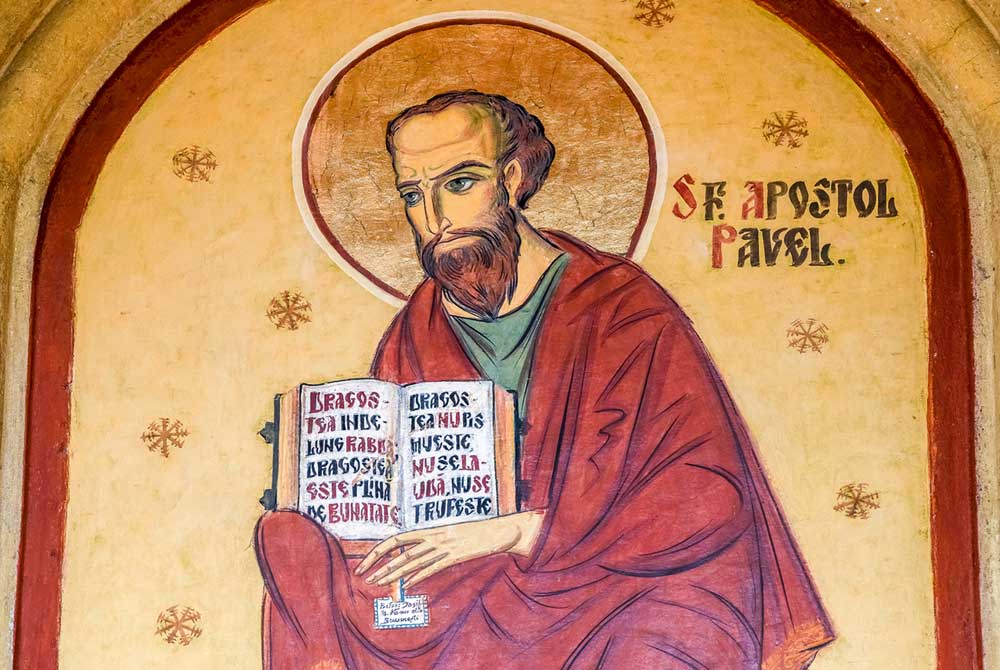
The earliest models of this feature of theology, I suppose, were those eighth-century b.c. prophets whose messages were explicitly rooted in their personal experience: Amos, Hosea, and Isaiah. And in varying degrees, we find this true of later prophets as well, notably Jeremiah and Ezekiel. It was St. Paul, however, who established the standard of this trait, because we know an unusual amount about his life, education, and personal experience—certainly more than we know about any other New Testament writer. Moreover, the nature of this information is such that we can even speak of "sources" and "influences" on the structure, content, and development of Paul's thought. I suggest that we may distinguish five influences that especially shaped the mind of the apostle in ways easy to discern in his writings and helpful to their interpretation.

Five Influences

First, there was Paul's early training in rabbinic studies, to which he referred in Galatians 1:14 and Philippians 3:5–6. His companion Luke provided further details on this subject in Acts (22:3; 23:6; 26:4–5).

I suggest that one fruit of this education was Paul's preference for the deeper, less obvious, perhaps even unsuspected lessons of Holy Scripture. To cite but one outstanding example, we observe how Paul shaped a single verse of Habakkuk—"The just shall live by his faith" (2:4)—into a hermeneutic key by which to unlock the whole of salvation history (cf. Rom. 1:17; Gal. 3:11). His letters abound with examples of this rabbinic approach to biblical interpretation, and largely through Paul's example it has remained a trait of Christian theology to the present day.
Second, there was Paul's inherited Hellenic culture, primarily manifest in his habit of citing the Bible in the Septuagint version. Greek was his native language. Though he pursued his rabbinic studies in Jerusalem, Paul had been raised in the pagan city of Tarsus, where he learned to be at home just about anywhere in the Mediterranean world, particularly in such cultural centers as Damascus, Antioch, Ephesus, and Athens.

Paul's imagery and points of reference, which reflect the urban culture of the Hellenic world, are readily contrasted with the agrarian and village atmosphere characteristic of the teaching of Jesus. This merging of rabbinic and Hellenic backgrounds made Paul an essential link in the gospel's transmission across these two cultures.

Third, there was Paul's adult experience of conversion, which gave his theological thought a very strong impression of contrasts—of then and now, before and after. Unlike so many theologians of later times, Paul did not inherit a Christian worldview. His vocation, rather, was to create such a thing from his own experience. For this reason, Paul's thought ever remains the Church's cutting blade, the biting edge of her apologetics and evangelism.

Fourth, Paul's mind was essentially formed by the doctrine he inherited from the Christian tradition. Failing to notice that he spent a decade or so living among other Christian teachers before his first missionary journey, and rooting his theology solely in his conversion, many of Paul's readers (starting with Marcion) have isolated his thought from its native ecclesiological context. This sense of continuity, however, in which theology is always an ecclesiological effort, has marked the thinking of the Church ever since.

Fifth and finally, several aspects of Paul's theology developed from specific problems and questions he encountered in the practical labor of his ministry. The schismatic dispositions at Corinth, for instance, prompted his deeper reflections on the nature of love. The Galatian controversy, too, planted the seed of Paul's theology of dialectical history, which eventually appears in the Epistle to the Romans. And so forth. It can be said that the organic relationship between theology and pastoral labor in Paul's life laid the foundation for much of the theological enterprise during the rest of Christian history. 

Patrick Henry Reardon is pastor emeritus of All Saints Antiochian Orthodox Church in Chicago, Illinois, and the author of numerous books, including, most recently, Out of Step with God: Orthodox Christian Reflections on the Book of Numbers (Ancient Faith Publishing, 2019).

A Journal of Mere Christianity—Delivered to Your Door

  • Essays on theology, culture, and the Church
  • Contributors from across the Christian traditions

Subscribe (Print + Online)

Six print issues (one year) of Touchstone, plus full online access and PDF downloads for only $39.95.

Subscribe (Online Only)

Get a one-year full-access subscription to the Touchstone online archives for only $19.95.


bulk subscriptions

Order Touchstone subscriptions in bulk and save $10 per sub! Each subscription includes 6 issues of Touchstone plus full online access to touchstonemag.com—including archives, videos, and pdf downloads of recent issues for only $29.95 each! Great for churches or study groups.

Transactions will be processed on a secure server.


more on bible from the online archives
24.3—May/June 2011

God's English

The Making & Endurance of the King James Bible, 1611-2011 by Barton Swaim

32.5—September/October 2019

Peter's Sword

by Patrick Henry Reardon

32.3—May/June 2019

Editing Jesus

on the Implications of Changing the Pater Noster by John M. McCarthy

more from the online archives

35.3—May/Jun 2022

Babylon's Furnace

Truth, Suffering & the Hard Road Ahead by Rod Dreher

35.6—Nov/Dec 2022

To Is or Not To Is

on E-Prime by J. Douglas Johnson

20.8—October 2007

Aliens in Zion

on Why I Can’t Be Just Another Earthman by Louis Markos

calling all readers

Please Donate

"There are magazines worth reading but few worth saving . . . Touchstone is just such a magazine."
—Alice von Hildebrand

"Here we do not concede one square millimeter of territory to falsehood, folly, contemporary sentimentality, or fashion. We speak the truth, and let God be our judge. . . . Touchstone is the one committedly Christian conservative journal."
—Anthony Esolen, Touchstone senior editor

Support Touchstone

00