Book Review
Strategic Christians
The Year of Our Lord 1943: Christian Humanism in an Age of Crisis
by Alan Jacobs
Oxford University Press, 2018
(256 pages, $29.95, hardcover)
reviewed by Jesse Russell
In January 2004, as the guerilla insurgency began to engulf the fragile peace achieved following the early stages of the Iraq War, a group of Christian figures, including Catholic journalist and papal biographer George Weigel, Harvard law professor Mary Ann Glendon, and Fr. Richard John Neuhaus, editor-in-chief of First Things, met with President George W. Bush in the Oval Office. A famous photograph of the meeting shows a relaxed Commander-in-Chief speaking affectionately with "Fr. Richard" as Weigel and Glendon look on in attentive seriousness.
In many ways, that meeting symbolized the apogee of political power these thinkers—often called "neocons" or "theocons" by friend and foe alike—would achieve. That same month, President Bush would advocate for a constitutional amendment upholding marriage. Later that spring, he would sign into law the Unborn Victims of Violence Act. And the following January, in his second inaugural address, he would make clear that even the Iraq War itself was being waged on behalf of human liberty, which, the theocons would frequently remind their readers, was in keeping with their vision of Christian humanism.
This Christian humanism has a deep and often confusing history, both in the United States and in the West as a whole. In the U.S., it was forged on the streets of Selma, where then-Lutheran pastor Richard John Neuhaus joined the marchers for blacks' civil rights in the 1960s, as well as at the Vietnam War protests, in which Neuhaus also participated, along with fellow theocon Michael Novak. It was envisaged as a "New Religious Right" in the pages of Neuhaus's 1984 Naked Public Square and in Weigel's 1999 biography of Pope John Paul II, Witness to Hope.
The theocons' Christian humanism presented itself as faithfully orthodox in its theology but also as willing to make accommodations for the liberal philosophy produced by the late Enlightenment. It advocated for what Michael Novak called Democratic Capitalism, a vision of free-market economics paired with Christian personalism. While taking a hard line against radical Islam, it nonetheless was dedicated to alleviating the longstanding and deep divisions between Christianity and other religions. Finally, it sought to revive Western haute culture through renewed interest in classical education and the Great Books, and in this way to combat the leveling effects of cultural Marxism on American education. For nearly three decades, this movement dominated much American and European—especially British—thinking about Christianity and culture.
The View from 1943
Neuhaus et al. did not emerge from a vacuum, however, but followed upon an earlier generation of Christian humanists, one that helped craft a new vision for the emerging liberal world order following World War II. In The Year of Our Lord 1943: Christian Humanism in an Age of Crisis, Baylor University's Alan Jacobs provides what is unquestionably the most thorough exposition of the complexity of thought of this generation by focusing on five of its leading lights—W. H. Auden, T. S. Eliot, C. S. Lewis, Jacques Maritain, and Simone Weil—while also giving attention to other influential figures, such as Reinhold Niebuhr and Jacques Ellul.
While many contemporary conservative Christians view contemporary conservative Christianity as continuing in an unbroken line from the way the pre-modern and early modern Church related to the culture, one of Jacobs's central theses is that, for many twentieth-century thinkers, the Second World War catalyzed a reboot of Christianity in this respect. Just as the war was for many German people a Stunde Null or "zero hour" in which German history was reset and a new era or Nachkriegszeit was born, so too, Jacobs argues, was it a watershed for Christianity, which would have to recalibrate itself to deal with the liberal technocratic world order expected to dominate the post-war years.
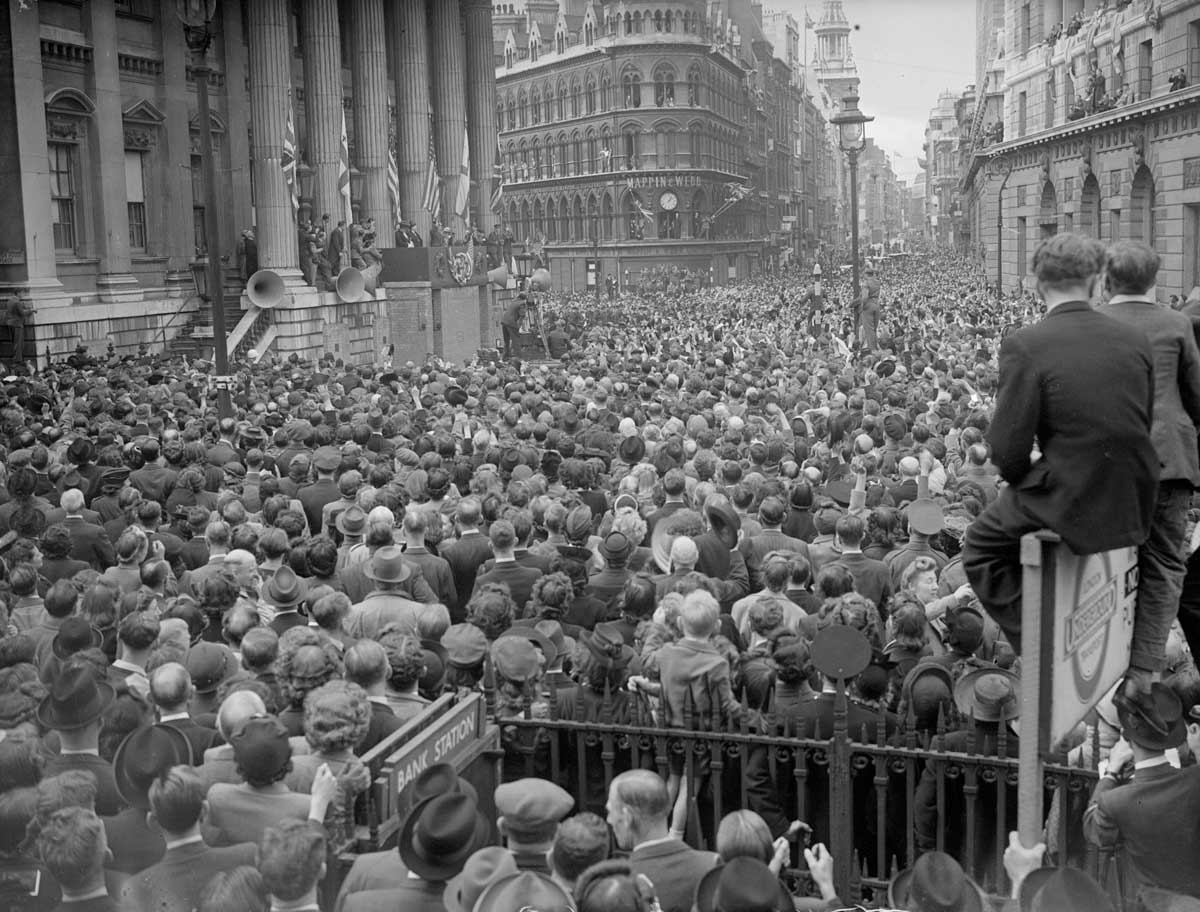
For Jacobs, the recalibration of Christianity to Christian humanism parallels the political recalibration that occurred at the Casablanca Conference on January 14, 1943, when Franklin D. Roosevelt and Winston Churchill, recognizing that the tide of the war had turned in their favor, sought to plan a new global vision. In tandem with the Casablanca Conference, John Foster Dulles (whose brother Allen would help found the Central Intelligence Agency), along with Lutheran theologian Reinhold Niebuhr, published a series of articles in Christianity and Crisis titled "Six Pillars of Peace," to serve as a blueprint for a new world order that would provide peace and stability.
Jesse Russell is Assistant Professor of English at Georgia Southwestern State University. He has published on literary theory, semiotics, and politics, and is at work on a book that explores Neo-Platonic magic in the work of Edmund Spenser. He is a Roman Catholic.
A Journal of Mere Christianity—Delivered to Your Door
- Essays on theology, culture, and the Church
- Contributors from across the Christian traditions

Six print issues (one year) of Touchstone, plus full online access and PDF downloads for only $39.95.

Get a one-year full-access subscription to the Touchstone online archives for only $19.95.
bulk subscriptions
Order Touchstone subscriptions in bulk and save $10 per sub! Each subscription includes 6 issues of Touchstone plus full online access to touchstonemag.com—including archives, videos, and pdf downloads of recent issues for only $29.95 each! Great for churches or study groups.
Transactions will be processed on a secure server.
more from the online archives
calling all readers
Please Donate
"There are magazines worth reading but few worth saving . . . Touchstone is just such a magazine."
—Alice von Hildebrand
"Here we do not concede one square millimeter of territory to falsehood, folly, contemporary sentimentality, or fashion. We speak the truth, and let God be our judge. . . . Touchstone is the one committedly Christian conservative journal."
—Anthony Esolen, Touchstone senior editor