




A Thousand Words
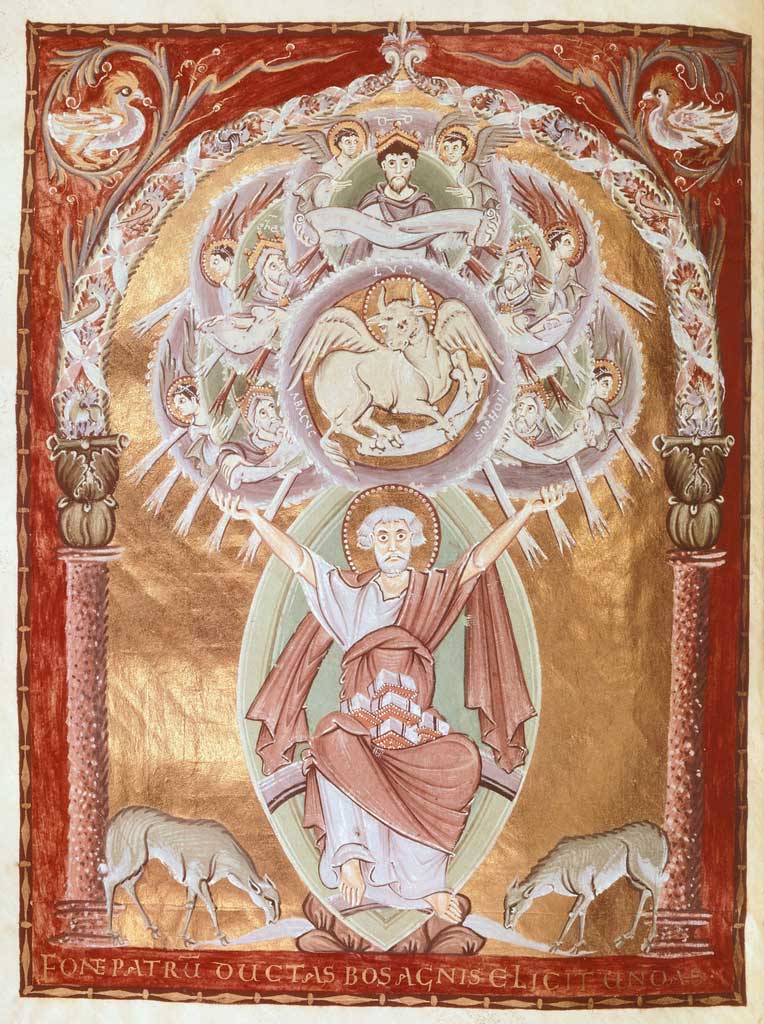
Portrait of St. Luke in the Gospel Book of Otto III
by Mary Elizabeth Podles
This Luke is not a conventional seated scholar, placidly penning his Gospel. This Luke is a mystic, a visionary in a state of exaltation, lifted up to heaven by the inspiration of the Holy Spirit and set among visionaries. The frame around him seems to be made of living trees, bursting into leaf and then into a fantastic archway made of ribbons, garlands, birds, lambs, and even the winds, all in warm reds and browns. Within the archway, the Evangelist sits in a mandorla, an almond-shaped aureole usually reserved for Christ or Mary in glorified state. Luke, like Christ on the Judgment Seat, is seated on a rainbow. The mystical vision has set him outside of time and space. A contrasting icy green sets the mandorla off from the frame in an expressionistic burst of color.
Similarly expressionistic are Luke’s enormous eyes, which seem to stare through and beyond the viewer. His arms are raised ecstatically, hands gripping the clouds above as if the vision were a palpable, touchable fact. The clouds are a series of overlapping circles in greens and purples, seemingly exploding with rays of light, as if their jagged outlines can barely contain their energy. (Clouds like these appear nowhere else in contemporary manuscripts except once or twice in depictions of Pentecost, in which, as here, the Holy Spirit breaks through into the apostles’ vision.)
Angels in the outer circles stare in wonderment. The inner circles contain King David at the top, and below him four partial figures crowned as kings and conveniently labeled, clockwise from the upper right: Nahum, Zechariah, Habakkuk, and Ezekiel. All the prophets look expectantly toward David, who holds open the scroll of the Psalms above Luke’s symbolic winged ox. Together, as one writer puts it, they “make Luke’s vision spin like an exploding fireworks display.” These are the “wheels within wheels” and flashing clouds of Ezekiel’s fiery vision of the glory of the Lord. There, too, we find the winged ox for the first time.
To Feed the Faithful
Luke, then, in his ecstatic state, is in direct contact with the Divine Word. The figures above him are shown only in partial view. King David is half-length, while the prophets, also crowned as kings, are even more truncated. They are shown as partial figures because, lacking the knowledge of Christ, they have only a partial understanding of the Word. They look toward David, from whose line the Messiah will spring, in hope: he is the closest prototype they know. David in turn holds all the prayers of Israel and gazes outward in expectation.
Only Luke is shown in full. He holds the books of the prophets in his lap, piled up like the building blocks they are. He grips the spinning clouds: he grasps the meanings of the prophecies and integrates them into the fullness of the revelation in Christ. Above him, his winged ox draws together David and the prophets and energetically scribbles down the Gospel. At the bottom of the page runs the inscription, “Fonte Patru ductas bos agnis elicit acquae [From the source of the Fathers, the ox brings forth water for the lambs],” who drink from the streams flowing from Luke’s feet. Luke’s purpose in writing, then, is to feed the faithful.
A final word about Luke’s extraordinary expressive eyes: when the Gospel book is shut, his eyes look directly at the initial page of the Gospel; when it is open, they stare out at us, and perhaps beyond, as if commanding us to take up the challenge put forward in this page, to take the Gospel from the heavenly realm to the thirsty lambs on earth.
A Princely Gift
One has to wonder what circumstances gave rise to such a Gospel book as this, filled with such powerful images. On the basis of style, this manuscript can be identified as a product of the Benedictine monastery at Reichenau, and dated to about the year 1000. At that time, Otto III reigned over the Holy Roman Empire, which included the island of Reichenau.
Otto was born in 980 to Emperor Otto II and his wife Theophanu, the daughter of the Byzantine emperor Romanus II. Otto II died in 983 and his son acceded to the throne. Theophanu, a brilliant woman, served as regent until the pope crowned Otto III emperor in 996. She, and her son in turn, maintained close contact with Byzantium, and it was Otto’s ambition to set himself up as the Western equivalent of the Byzantine emperor. Probably artisans, and certainly artifacts, were brought west from Byzantium, and with them came a strong Byzantinizing influence to the Benedictines and to the court at large.
Mary Elizabeth Podles is the retired curator of Renaissance and Baroque art at the Walters Art Museum in Baltimore, Maryland. She is the author of A Thousand Words: Reflections on Art and Christianity (St. James Press, 2023). She and her husband Leon, a Touchstone senior editor, have six children and live in Baltimore, Maryland. She is a contributing editor for Touchstone.
A Journal of Mere Christianity—Delivered to Your Door
- Essays on theology, culture, and the Church
- Contributors from across the Christian traditions

Six print issues (one year) of Touchstone, plus full online access and PDF downloads for only $39.95.

Get a one-year full-access subscription to the Touchstone online archives for only $19.95.
bulk subscriptions
Order Touchstone subscriptions in bulk and save $10 per sub! Each subscription includes 6 issues of Touchstone plus full online access to touchstonemag.com—including archives, videos, and pdf downloads of recent issues for only $29.95 each! Great for churches or study groups.
Transactions will be processed on a secure server.
more on art from the online archives
33.2—March/April 2020
An Architectural Sign of Mere Christianity by Michael Ward
32.4—July/August 2019
on Single-Mindedness in Durer's Ritter, Tod, und Teufel by Anthony Costello
more from the online archives
31.5—September/October 2018
Errands into the Moral Wilderness
Forms of Christian Family Witness & Renewal by Allan C. Carlson

33.2—March/April 2020
Lewis, Chesterton, et al. Against the Frauds, Experts & Revisionists by Vigen Guroian
calling all readers
Please Donate
"There are magazines worth reading but few worth saving . . . Touchstone is just such a magazine."
—Alice von Hildebrand
"Here we do not concede one square millimeter of territory to falsehood, folly, contemporary sentimentality, or fashion. We speak the truth, and let God be our judge. . . . Touchstone is the one committedly Christian conservative journal."
—Anthony Esolen, Touchstone senior editor
