The Pope Is Christian! by S. M. Hutchens
The Pope Is Christian!
S. M. Hutchens on Disappointing Catholic Revisionists
I have now lived through five papal elections, those of John XXIII (which
I remember as a young boy) through Benedict XVI. In each of them we heard from
a “progressive” element in the Catholic Church that was very interested
in a pope who would bring it up to date. From early days I found this confusing.
Just what was it about the Catholic Church that could be “brought
up to date,” at least that would have enough significance to justify
the fuss certain Catholics were making about its old-fashionedness? (My Catholic
playmates would have suggested the retirement of Sister Ursula and her yardstick
as a useful update, but nobody asked them.)
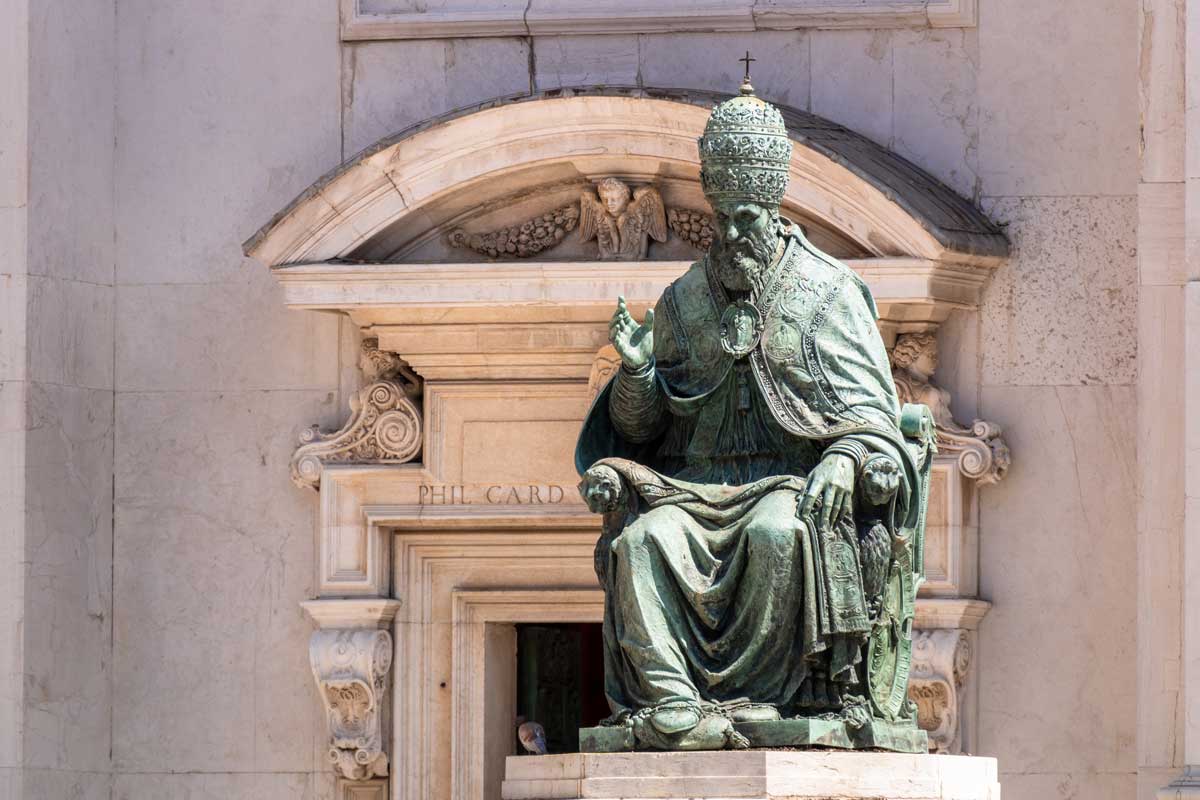
Might the papal tiara be replaced by a ceremonial homburg, those red slippers
with Earth Shoes? The Ave Maria performed in rock-and-roll
mode? How could guitar Masses or even the sprouting of all those ugly church
buildings change what was essentially Catholic? I had been brought up to understand
that the differences between us and the Catholics were doctrinal. What, really,
could a pope do to update the doctrine of his church? Could he make Leviathan
believe anything different than it did? Any change by way of making the Catholic
Church more “relevant,” as the liberalizing Protestants were so
intent to effect among us, must be a change in its very constitution.
Change doctrine, and it wouldn’t be the Catholic Church anymore, at
least as we conservative Protestants understood it. Anything less would be
merely a stylistic adjustment, and surely not worth all the agitation we were
hearing from Catholic progressives. Just what did they want of each new pope,
anyway? An ex cathedra pronouncement that “mistakes
have been made”? Would the pope who made it be Catholic?
The progressives clearly didn’t find Vatican II (much less Pope Paul
VI) as helpful as they had hoped, but seized upon its “spirit” (fairly
well disembodied from its letter, I later discovered) to question traditional
church teachings—not to deny them outright, but to establish themselves
in a persistent interrogatory state that escaped obedience while not directly
renouncing it.
I experienced this first-hand while taking classes at the Catholic Theological
Union in Chicago. There was constant questioning of the “opinions” of
the pope, then John Paul II, and outright contempt for his odious henchman
Cardinal Ratzinger. When the title “Holy Father” was used, one
could expect the slight smile and ironic inflection that made it mean “that
old fool in Rome.” The Catholics seemed to expect this, but comparing
notes with the other Protestants, I found that they were, with me, deeply disturbed.
Why on earth, we kept asking ourselves, were these people Catholics?
That, indeed, was the question. At every papal election the ante seemed to
up, and the progressives sounded more like radicals who wanted to make the
Catholic Church not only different than it had been, but very much like what
we knew as liberal Protestantism, and therefore not only not-Catholic, but
not-Christian. These progressive Catholics were singing a tune we had heard
before.
They were not asking for changes in manner, but were after much more. The
litany by now has become familiar: birth control, married priests, and priestesses
at least, and from some, more openness to homosexuality and euthanasia. They
wished for the Catholic Church to adopt these things and remain not only Catholic,
but “the Church.”
A Miscalculation
There is, in my view, a major miscalculation in all of this. These people
seem to think that in their media-supported campaign to change the Catholic
Church they are dealing only with the Catholic Church—that their quarrels
with Catholic traditionalism are essentially an internal matter to be settled
among Catholic factions, success being marked by the election of progressive
popes who will work with the enlightened to make the church over in their own
image. Once this is done, it will be much more open, more reasonable, and more
acceptable to the people who count, to the kind of people who believe that
the church must change with the times to relate to people who are formed by
the times.
This, however, will not happen. The changes Catholic revisionists are proposing
for their own church are not simply of the sort that offend conservative Catholics,
but all Christians. At the base of the progressive mind as it is revealing
itself in the Catholic Church is a will to make it not a different kind of
Catholic Church, but no church at all. This is recognized by orthodox Christians
outside the Roman communion, who have dealt with this mind, and emphatically
rejected it, in their own.
In the event that Rome elects a weak or a progressive pope, those traditionalist
Catholics who are marginalized and oppressed in the resulting regime will be
sustained and supported by other Christians who are just as strongly opposed
to modernist designs on the Church, and who, because of that, view conservative
popes as allies in the war against the mind of Antichrist. Those who are disappointed
by the latest papal election would be advised to take note of the cheering
one hears among conservative Protestants and Orthodox, for whom Benedict XVI
stands not for reactionary Catholicism, but is already known and respected
as a firm and trusty defender of the Christian faith.
These non-Roman Christians have, of course, their traditional disagreements
with Rome, but in the face of the common opposition they understand that an
educated and catholic sense of proportion requires they not only may, but—if
they have come to the conclusion that traditional Catholics are to be honored
with the name of Christian—must subordinate these perennial
concerns to resistance on the common front. They must not allow their disagreements
to weaken their support for each other.
Within the context of a progressive papacy, traditional Roman Catholicism—Catholicism
not only in the form that is obnoxious to Catholic revisionists, but disagreeable
in some respects to its Protestant and Orthodox allies as well—is not
only likely to survive, but to survive in strength. This is because, whatever
its faults, much of Orthodoxy and conservative Protestantism view it as
Christian while regarding the revisionist program, whatever attractions
it may hold for non-Roman believers (relaxation of the pastoral discipline
on the marriage of priests, for example), as emphatically not. Despite their
disagreements, they will support traditionalist Roman Catholics against the
parasites at their own table.
Revisionist War
The war conducted by revisionist Catholics, they understand full well, is
not simply against reactionary old men in the Vatican, but Baptists in Virginia,
Anglicans in Nigeria, Pentecostals in Brazil, and against the heart of Orthodox
doctrinal and moral teaching. It is not only against the beliefs of old-fashioned
Catholics, but has been unmistakably revealed in the last generation, as revisionism
marches steadily from the controversial to the abominable, to be against all
Christians, everywhere, and at all times.
A revisionist victory in a papal election would not be a small thing, but
neither would it be as large as many of the liberal Catholics and their friends
in the secular media seem to think it would. The Church—and by this I
mean the Church as C. S. Lewis’s spirits could see it, spread down through
the ages, as terrible as an army with banners—will survive it, and become
stronger and more unified with the disciplines it imposes.
S. M. Hutchens works as a reference librarian in Kenosha, Wisconsin. He holds a doctorate in theology. He is a senior editor of Touchstone. |