Feature
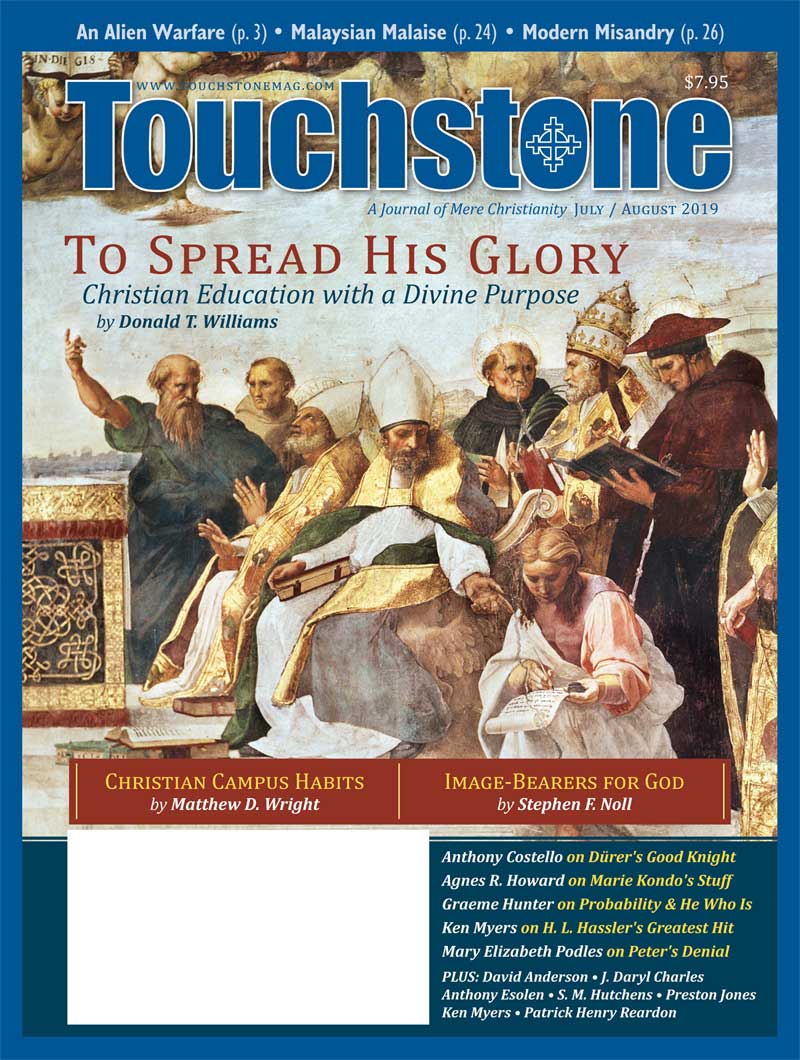
To Spread His Glory
Four Theses on Christian Education
Christian education should be more than just avoiding the evil influence of the secular academy. It not only has a critical role to play alongside the Church and the home in transmitting the biblical worldview to the next generation; it also, in its higher levels, has a role to play in showing the relevance of the Christian worldview by applying it to all of life. It is not a luxury; it is a necessity if the Church is going to fulfill its mission.
Yet the Christian school movement—whether on the primary, secondary, or collegiate level—is the stepchild of the Church. We give lip service to its importance, but we will not support it on a level at which it can function well. It struggles to pay its faculty a living wage and still remain affordable enough to be a viable option for parents in the real world, for these are incompatible goals. They simply cannot both be met without a constant infusion of cash from outside the tuition structure—whether from endowments or from unrestricted giving. Most Christian schools do not have the endowments and aren’t going to get what they need in gifts. Qualified faculty members are hard to retain, and when they are retained, they are usually overworked in ways that make it difficult for them to advance in their fields.
Nevertheless, despite their constant struggle for survival, Christian schools almost all outperform the public schools when it comes to the basics, the “three Rs”—not even considering the inculcation of the biblical worldview. We need them to have a much greater impact, but we are not willing to make the sacrifices necessary for that to happen. We talk a good game, but they continue to struggle, and the Church is content to have it so. This is a major reason why revival tarries. How do we get beyond talking a good game and start actually playing one? Understanding these four theses about what is at stake could help.
Thesis 1
Secular education is an oxymoron.
Let us imagine that we are trying to create a school that will do what our secular state schools think they are obligated to do: provide an education that is religiously neutral. It will not be Protestant, Catholic, or Orthodox; it will not be Christian, Muslim, or New Age; it will not even be theistic, animistic, pantheistic, or atheistic. It will maintain a strict neutrality on all such beliefs. And let us imagine that it succeeds in that neutrality, treating all such beliefs even-handedly the same, neither privileging one nor denigrating any. We might be able to imagine such a thing—until we get down to specifics. And then our supposed neutrality will quickly vanish into thin air.
As we design our curriculum, we find that we have to ask what our purpose is. What do we want our graduates to be? Well, surely we want them to be productive workers, able to hold good jobs and provide for themselves. But all the vocational training in the world will not accomplish that goal if they are dishonest, lazy, undependable, and lacking in self-discipline. Employers will not retain them if they cannot trust them. So in order to achieve what we thought was the purely secular goal of vocational training, we discover that we cannot ignore virtue.
But which set of virtues are we going to inculcate? On what basis? Will it be Christian ethics, or Sharia law, or moral therapeutic deism, or naturalistic utilitarianism? The last option is the only one with even a pretense of religious neutrality. But will a purely pragmatic view of honesty as something that will help you keep your job suffice to keep you from stealing from your employer if you think you can get away with it? Even if we think it will, we have just lost our neutrality. For now we are teaching ethics as if atheism were true.
Do we just want our graduates to be good workers, or do we also want them to be good citizens? Society will surely expect us to do something toward the latter end. So what kind of country are we training them to be citizens of? One that is founded on the idea that all men are created equal and are endowed by their Creator with certain inalienable rights, or one that thinks such ideas are only rhetorical flourishes that were thought useful in the past? One that grounds its concept of rights in the created order, or one that grounds it in the will of the majority? Or one that just grounds it in the perceived greater good of the greater number? Or one that has no concept of rights for anyone not favored by those in power? Once again, our goal of religious neutrality has proved elusive. We have to make choices that have religious implications. We don’t have the choice not to do so. The only choice we have is whether or not we are going to be honest about it.
Secular education is an oxymoron. It is a contradiction in terms. It cannot really be religiously neutral without implying that it does not matter which religion one embraces, or whether one embraces any. And if religion has no consequences, then it is trivial and unimportant. The harder education tries to be secular, then, the more it becomes secularist. Atheism and naturalism are subtly privileged, in effect, as the only truths that matter. And this privileging is unavoidable.
It is unavoidable because in our supposedly neutral school the secularist message is effectively delivered by the whole structure of the curriculum even if it is never actually verbalized. The very premise of neutrality prevents anyone from saying anything that could possibly contradict it. Even if released time for religious instruction is granted, that instruction is still secluded and segregated from the rest of the curriculum. Science, history, civics, and literature will still have to be taught as if that religious instruction did not exist. One reason Christians lost their influence in the public schools is that they had been lying to themselves about what, by its inherent nature, public education was capable of being, about the bias that is built into it by its very stance of enforced neutrality.
Donald T. Williams is Professor Emeritus of Toccoa Falls College. He stays permanently camped out on the borders between serious scholarship and pastoral ministry, between theology and literature, and between Narnia and Middle-Earth. He is the author of fourteen books, including Answers from Aslan: The Enduring Apologetics of C. S. Lewis (DeWard, 2023). He is a contributing editor of Touchstone.
A Journal of Mere Christianity—Delivered to Your Door
- Essays on theology, culture, and the Church
- Contributors from across the Christian traditions
Six print issues (one year) of Touchstone, plus full online access and PDF downloads for only $39.95.
Get a one-year full-access subscription to the Touchstone online archives for only $19.95.
bulk subscriptions
Order Touchstone subscriptions in bulk and save $10 per sub! Each subscription includes 6 issues of Touchstone plus full online access to touchstonemag.com—including archives, videos, and pdf downloads of recent issues for only $29.95 each! Great for churches or study groups.
Transactions will be processed on a secure server.
more on Education from the online archives
more from the online archives
calling all readers
Please Donate
"There are magazines worth reading but few worth saving . . . Touchstone is just such a magazine."
—Alice von Hildebrand
"Here we do not concede one square millimeter of territory to falsehood, folly, contemporary sentimentality, or fashion. We speak the truth, and let God be our judge. . . . Touchstone is the one committedly Christian conservative journal."
—Anthony Esolen, Touchstone senior editor