





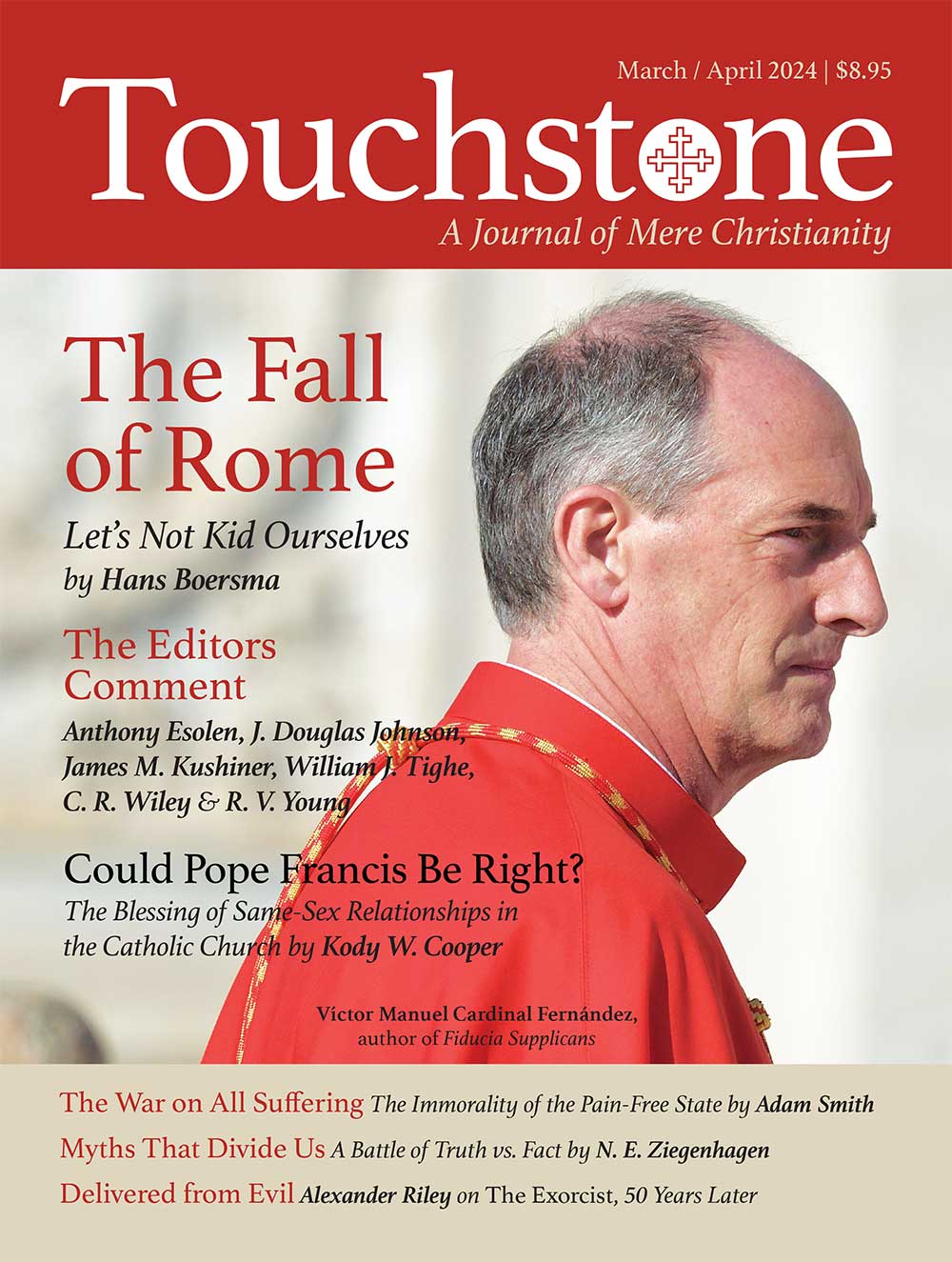
Could Pope Francis Be Right?
The Blessing of Same-Sex Relationships in the Catholic Church
Can it be an act of charity to bless the relationship of a committed same-sex couple? I plan to answer this question from within the teaching of the Catholic Church for three reasons: (1) I’m Catholic and it is the tradition I understand best; (2) recent events in Germany, questions put to Pope Francis by some of his cardinals, and the Vatican’s recent replies have brought these questions to the fore; (3) the Catholic Church has striven to address such questions in a collective manner that is not possible for most Protestant denominations. And finally, all Christians have a stake in how the Catholic Church answers this question.
Orthodox Christians could be forgiven for thinking this question was closed. First, because perennial Christian teaching on marriage and sexuality has never been (and cannot be) changed, any more than the natural and divine law can be repealed. And second, because in 2021, the Vatican answered the question in the negative.
THIS ARTICLE ONLY AVAILABLE TO SUBSCRIBERS.
FOR QUICK ACCESS:
Kody W. Cooper is UC Foundation Associate Professor of Political Science at the University of Tennessee at Chattanooga, and 2023–2024 Visiting Fellow with the Civitas Institute at the University of Texas at Austin. He is the coauthor of The Classical and Christian Origins of American Politics (Cambridge Univ. Press, 2022). He lives with his wife and nine children in Chattanooga, Tennessee.
A Journal of Mere Christianity—Delivered to Your Door
- Essays on theology, culture, and the Church
- Contributors from across the Christian traditions

Six print issues (one year) of Touchstone, plus full online access and PDF downloads for only $39.95.

Get a one-year full-access subscription to the Touchstone online archives for only $19.95.
bulk subscriptions
Order Touchstone subscriptions in bulk and save $10 per sub! Each subscription includes 6 issues of Touchstone plus full online access to touchstonemag.com—including archives, videos, and pdf downloads of recent issues for only $29.95 each! Great for churches or study groups.
Transactions will be processed on a secure server.
more on Catholic from the online archives
27.5—Sept/Oct 2014
The Culture of Death's Campaign Against the Catholic Church by Brantly Millegan
29.3—May/June 2016
A Deathbed Reflection on Catholic Social Teaching & Our Future Prospects by Karl D. Stephan

24.5—Sept/Oct 2011
A Critical Memoir of Thomas Merton at Gethsemani Abbey by Patrick Henry Reardon
more from the online archives

31.2—March/April 2018
The Transmission of Christianity Is Not a New Task by Nathanael Devlin
31.4—July/August 2018
The Difficulty of Apologetics for Dead Souls in the Real World by R. J. Snell
29.1—Jan/Feb 2016
on Marriage, Moral Corruption & the Christian Duty of Witness by Regis Nicoll
calling all readers
Please Donate
"There are magazines worth reading but few worth saving . . . Touchstone is just such a magazine."
—Alice von Hildebrand
"Here we do not concede one square millimeter of territory to falsehood, folly, contemporary sentimentality, or fashion. We speak the truth, and let God be our judge. . . . Touchstone is the one committedly Christian conservative journal."
—Anthony Esolen, Touchstone senior editor
