Feature
Can We Hang Together?
Ecumenical Agreement on Religious Liberty Awaits Catholic Clarity
For at least a generation now, ecumenism and religious liberty have been very much intertwined, not least in what has come to be called the "ecumenism of the trenches." In a culture increasingly hostile to the Christian faith, those of differing confessions have made common cause in defending the freedom to act on those confessions. While both necessary and beneficial, this ecumenism for the sake of religious liberty does have certain shortcomings. Particularly, it is by its nature ad hoc, pragmatic, and under-theorized.
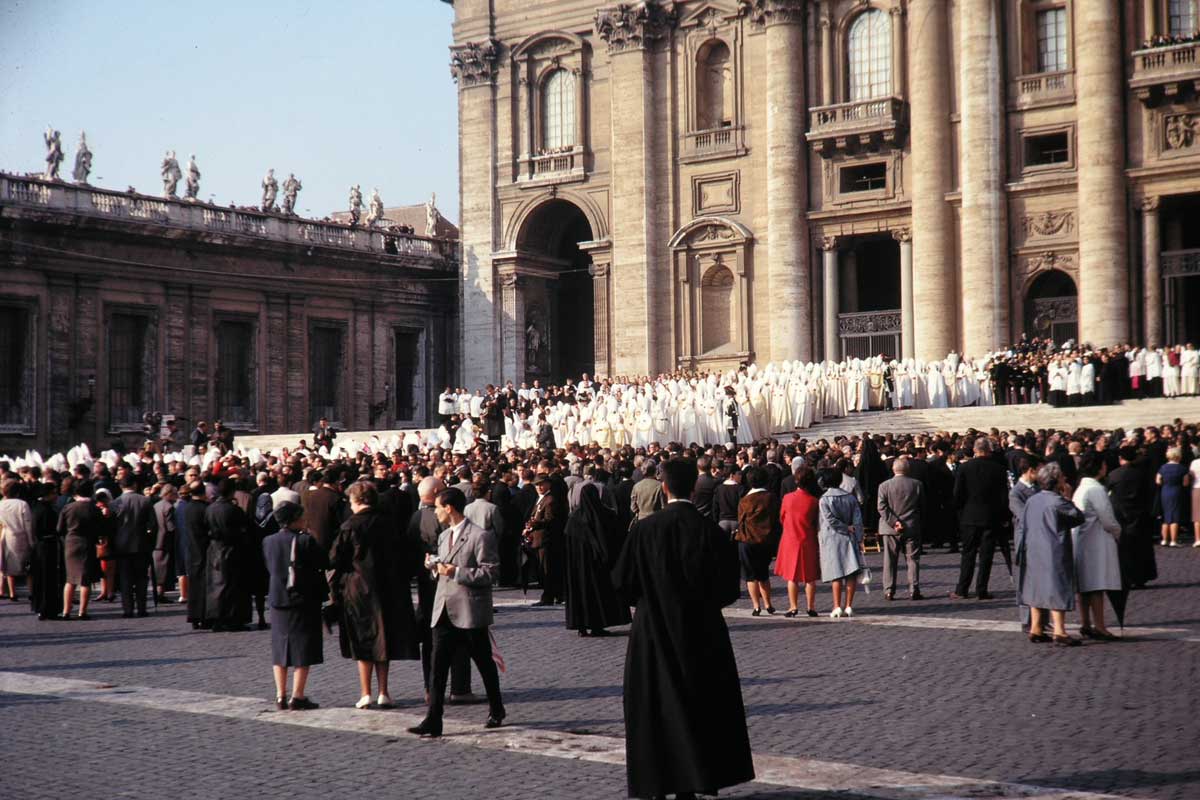
By way of contrast, the Second Vatican Council famously attempted to articulate principled theological rationales for both ecumenism and religious liberty. The Council not only addressed both issues; they were at one point intended to be treated together, in a single document. There is clearly some warrant, then, for treating religious liberty itself as an ecumenical issue. But does it—or might it—constitute ecumenical common ground? Despite various disagreements between Protestants, Catholics, and Orthodox, do we—or can we—agree on religious liberty? And if so, how might the manner by which agreement is reached inform other ecumenical endeavors?
Certain difficulties prevent easy answers to such questions. Given disparities within Protestantism itself, for example, it is unlikely that one can speak of a single "Protestant doctrine" of religious liberty. Moreover, it's not clear that Orthodoxy or any Protestant tradition has a formal articulation of religious liberty in the vein of Dignitatis Humanae. As a preliminary way forward, though, we might simply focus on this and other magisterial Catholic documents, with a view toward their significance for ecumenical ventures.
Vatican II's Declaration
Dignitatis Humanae itself succinctly proclaims that "the human person has a right to religious freedom." Thus, "no one is to be forced to act in a manner contrary to his own beliefs. Nor is anyone to be restrained from acting in accordance with his own beliefs." This right, it explains, has "its foundation in the very dignity of the human person," and therefore it is "inviolable." Not without warrant, many applauded this Declaration on Religious Freedom in 1965.
And yet, even within Rome's orbit, not all applauded. Some Council fathers themselves did not. The Council proceedings make evident the prolonged controversy concerning the discussion of religious liberty; what would become Dignitatis Humanae went through nine drafts and hundreds of interventions, with a vote on the text being postponed until the very conclusion of the Council. The greatest source of controversy was quite simply the belief that the document forwarded a doctrine contrary to dogmatic tradition. Thus, Pope Paul VI himself insisted upon its assertion that it "leaves untouched traditional Catholic doctrine on the moral duty of men and societies toward the true religion and toward the one Church of Christ."
Left unstated, however, was the manner by which that assertion was justified. That is, the Declaration neglects to explain precisely how one might harmonize the perception that it departs from longstanding doctrine with its explicit claim that it does not. Indeed, the document's relator acknowledged this lacuna and frankly admitted that "this matter will have to be fully clarified in future theological and historical studies." Unsurprisingly, then, the half-century since Vatican II has witnessed a plethora of attempted—but incompatible—clarifications.
The Traditional Doctrine
These competing interpretations can be concisely summarized and categorized; but to understand why Dignitatis Humanae has spawned an industry of interpretation, the content of what it calls "the traditional Catholic doctrine" must first be made explicit. Many attempts to do so focus on the pronouncements of the nineteenth-century popes. Oft-cited examples include Mirari Vos, in which Gregory XVI calls "absurd and erroneous" the "proposition which claims that liberty of conscience must be maintained for everyone." He speaks dismissively of those who would "separate the Church from the state," and explains that princes have received their authority "especially for the defense of the Church."
In Quanta Cura, Pius IX says it is "against the doctrine of Scripture, of the Church, and of the Holy Fathers," to believe it best when civil powers have no duty of "restraining by enacted penalties, offenders against the Catholic religion." Such fosters the "insanity" of thinking that "liberty of conscience and worship is each man's personal right." Therefore, his Syllabus of Errors condemns the idea that "every man is free to embrace and profess that religion which, guided by the light of reason, he shall consider true," as well as the notion that "it is no longer expedient that the Catholic religion should be held as the only religion of the State, to the exclusion of all other forms of worship." Significantly for later questions, the Syllabus also condemns the proposition that "the Church has not the power of using force."
Korey D. Maas is an associate professor of history at Hillsdale College in Hillsdale, Michigan.
A Journal of Mere Christianity—Delivered to Your Door
- Essays on theology, culture, and the Church
- Contributors from across the Christian traditions
Six print issues (one year) of Touchstone, plus full online access and PDF downloads for only $39.95.
Get a one-year full-access subscription to the Touchstone online archives for only $19.95.
bulk subscriptions
Order Touchstone subscriptions in bulk and save $10 per sub! Each subscription includes 6 issues of Touchstone plus full online access to touchstonemag.com—including archives, videos, and pdf downloads of recent issues for only $29.95 each! Great for churches or study groups.
Transactions will be processed on a secure server.
more on Catholic from the online archives
more from the online archives
calling all readers
Please Donate
"There are magazines worth reading but few worth saving . . . Touchstone is just such a magazine."
—Alice von Hildebrand
"Here we do not concede one square millimeter of territory to falsehood, folly, contemporary sentimentality, or fashion. We speak the truth, and let God be our judge. . . . Touchstone is the one committedly Christian conservative journal."
—Anthony Esolen, Touchstone senior editor