





A Thousand Words
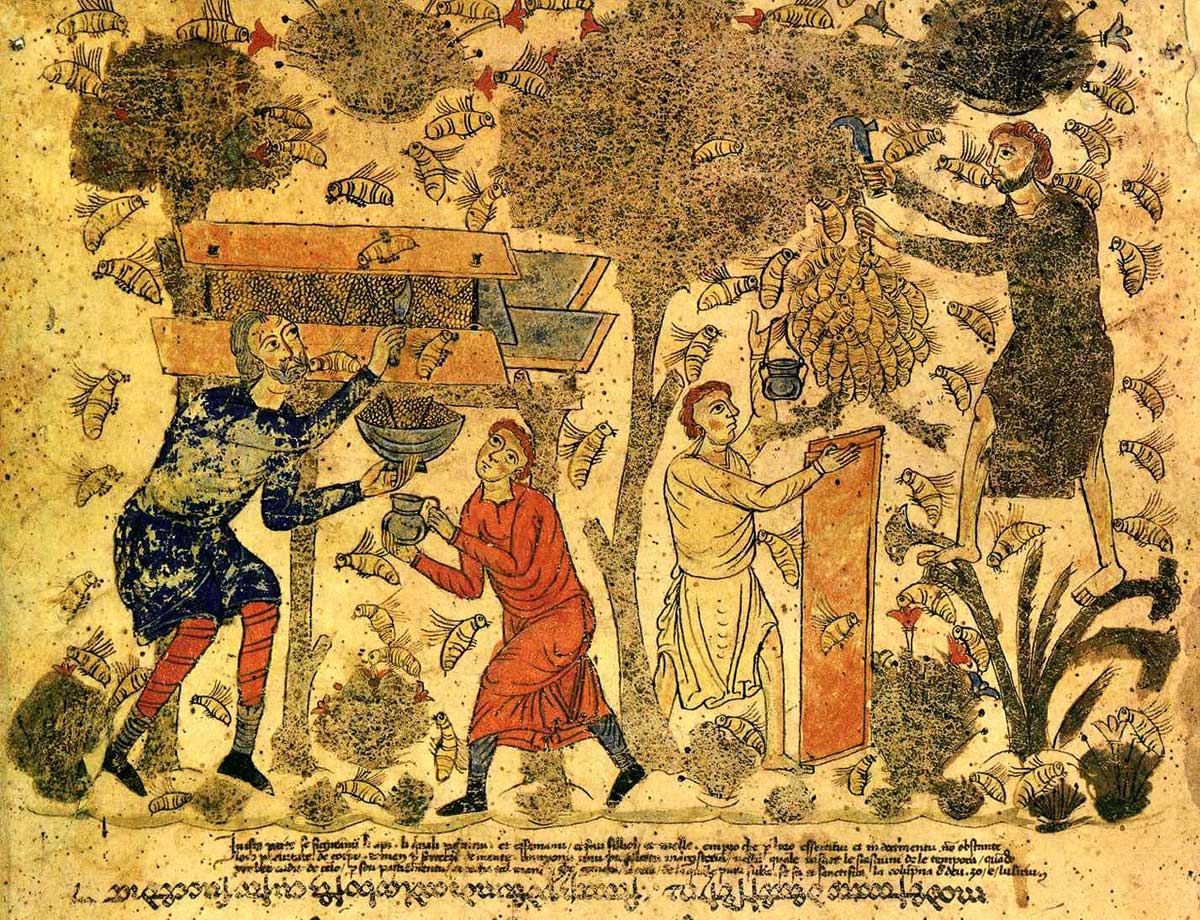
The Beekeepers—Exultet Scroll
by Mary Elizabeth Podles
This scene of medieval beekeepers demonstrates that beekeeping has remained virtually unchanged for a thousand years. At the left, a man in a blue tunic and fancy striped hose has opened a box hive identical to ones used today and is cutting honeycomb into an extractor. Beside him, a helper in red catches the honey in a jug. To the right, two barefoot men are capturing a swarm: one cuts the branch on which they cluster, while the other entices them into a box with a jar of honey. Bees as big as songbirds fill all the blank spaces and bury their faces in bright red flowers. The beekeepers all have rosy cheeks, which mark them as the products of an eleventh-century Benedictine scriptorium; presumably the red dots signify the healthy glow that comes of the monastic combination of work and prayer.
The beekeepers are not, as one might suppose, an illustration of secular life, such as one might find in a later Book of Hours. Rather, they are an illustration of a verse of the Exultet, the great song of praise sung after the lighting of the Paschal candle at the Easter Vigil, the apex of the liturgical year. Towards the end of the prayer, the deacon offers the Paschal candle, symbol of the risen Christ, to the Father:
THIS ARTICLE ONLY AVAILABLE TO SUBSCRIBERS.
FOR QUICK ACCESS:
Mary Elizabeth Podles is the retired curator of Renaissance and Baroque art at the Walters Art Museum in Baltimore, Maryland. She is the author of A Thousand Words: Reflections on Art and Christianity (St. James Press, 2023). She and her husband Leon, a Touchstone senior editor, have six children and live in Baltimore, Maryland. She is a contributing editor for Touchstone.
subscription options
Order
Print/Online Subscription
Get six issues (one year) of Touchstone PLUS full online access including pdf downloads for only $39.95. That's only $3.34 per month!
Order
Online Only
Subscription
Get a one-year full-access subscription to the Touchstone online archives for only $19.95. That's only $1.66 per month!
bulk subscriptions
Order Touchstone subscriptions in bulk and save $10 per sub! Each subscription includes 6 issues of Touchstone plus full online access to touchstonemag.com—including archives, videos, and pdf downloads of recent issues for only $29.95 each! Great for churches or study groups.
Transactions will be processed on a secure server.
more on art from the online archives
32.4—July/August 2019
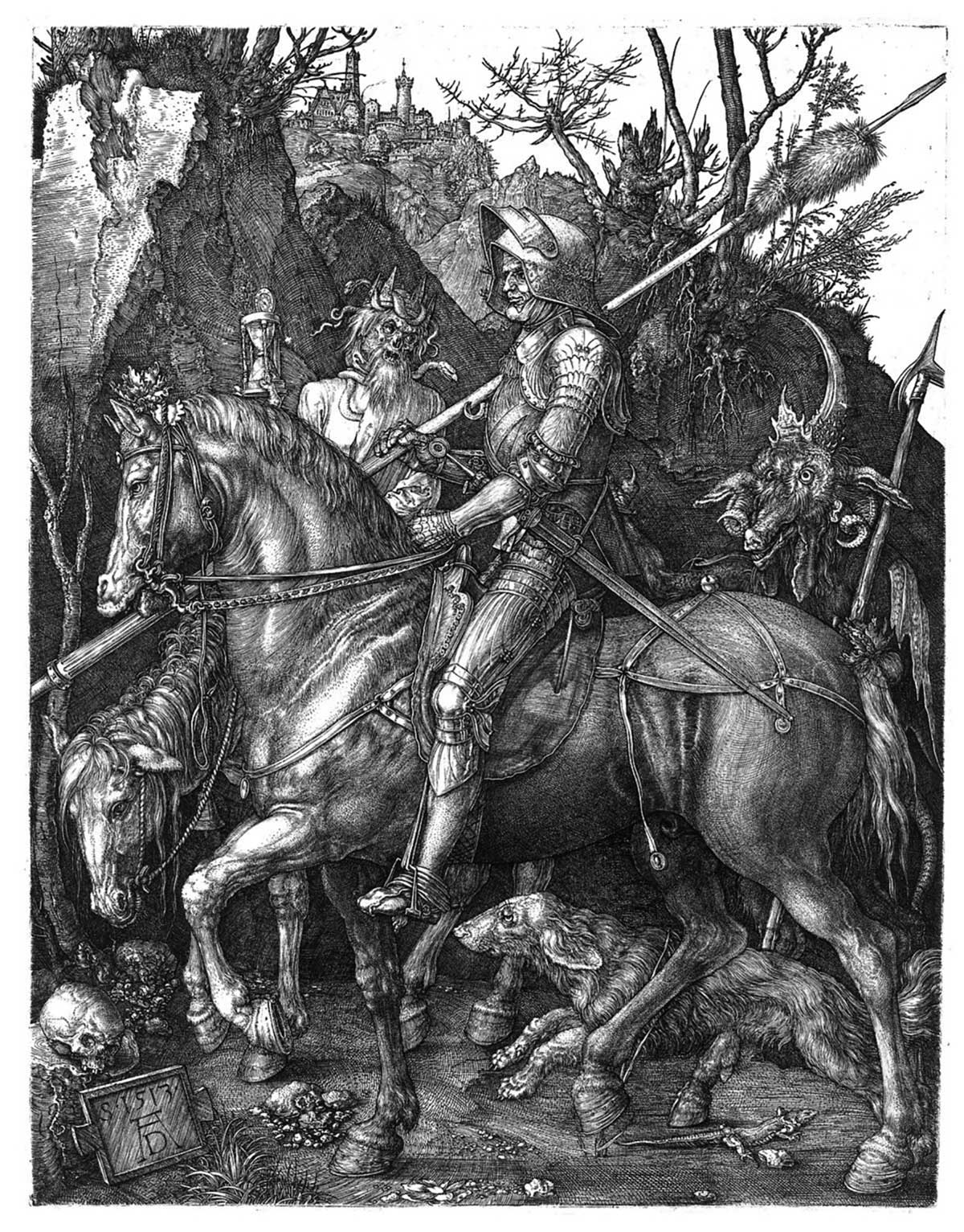
on Single-Mindedness in Durer's Ritter, Tod, und Teufel by Anthony Costello

33.2—March/April 2020
An Architectural Sign of Mere Christianity by Michael Ward
more from the online archives

27.6—Nov/Dec 2014
Tales of Forbidden Stereotypes
Real-Life Men & Women & the Tragic Loss of Human Comedy by Anthony Esolen
25.3—May/Jun 2012
Calls for Freedom, Democracy & Secularism End Up with None of the Above by Hunter Baker

calling all readers
Please Donate
"There are magazines worth reading but few worth saving . . . Touchstone is just such a magazine."
—Alice von Hildebrand"Here we do not concede one square millimeter of territory to falsehood, folly, contemporary sentimentality, or fashion. We speak the truth, and let God be our judge. . . . Touchstone is the one committedly Christian conservative journal."
Support Touchstone
—Anthony Esolen, Touchstone senior editor
