





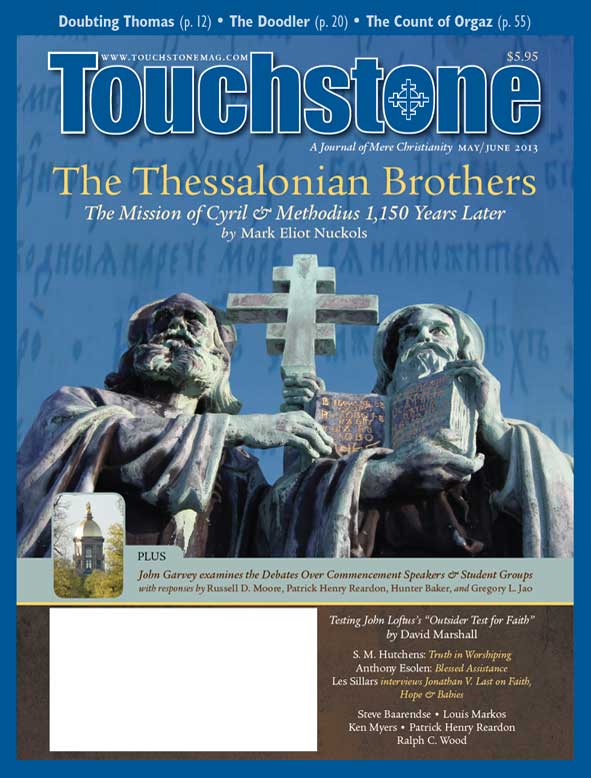
Passing It On
Benedict XVI's Fidelity on Behalf of the Faithful
At the election of Pope Benedict XVI in 2005, the Touchstone editors rejoiced because no one among the other candidates had made a firmer name for himself in standing for the "permanent things" of the Christian faith, the things that have always been our collective first concern, the things of "mere Christianity"—the doctrines of the Creed and their moral accompaniments, things that have been, according to the Vincentian canon, believed everywhere, at all times, and by all Christians.
The Christian faith itself in all these matters is an enduring offense, an offense that begins in our day with its unnegotiable patriarchalism: the insistence that the Father Almighty is Maker of heaven and earth, and going on from there through every scandal the confession of Christian belief has presented to the world from its earliest days. We knew Cardinal Ratzinger as a strong and reliable witness to these things, willing to be ill spoken of by the class of people—many of them claiming to be Christians and even Catholics—who hate not just traditional Roman Catholicism but all Christianity and all Christians, through the high and easy mark of the papal office.
Pope Benedict has now retired. The reason he gives is that he is too weary to perform the duties of his office properly. Clearly, he looks for a successor with the vigor that has fled him in old age. He has been, we think, quite careful not to say anything that would imply that the man who follows him should pursue any essentially different course than he or John Paul II have attempted.
Journalistic Aggression
One is not, perhaps, surprised to find that a good number of writers on religion do not believe him, and seem anxious to think this is some sort of admission of defeat in the face of overwhelming opposition to Benedict's own rejection of the anti-Christian aspects of modernity. Many speak of this rejection as though it were something new and not a concern of the papal office since the formal opening salvo was fired in Pius X's 1907 Pascendi Dominici Gregis, and indeed, found whenever and wherever, from the New Testament forward, the spirit of some age or place has provoked the opposition of the apostles and their heirs. Inflexibility in these matters is and has always been found in every Christian pastor worthy of his title.
Nor should it be a surprise to those who have witnessed the behavior of the mainstream media during the last American presidential campaign how such remarkable levels of careless aggression and supercilious ignorance have immediately been brought to bear by hostile journalists upon the pontificate of Benedict and the election of the next pope. Readers are faced with a wearisome barrage of changes rung on a failed papacy, summarized in the observation that the world has moved forward and the conservative old celibates who run the Catholic Church still cling to outmoded beliefs and make foolish and unnecessary demands, many of which have been rejected by their own captive audience, the Catholic laity.
It is therefore time, the pundits declare, for a pope sensitive and responsive to the beliefs of the new age: it is time for birth control, acceptance of gayness, of priestesses, the phasing out of patriarchal hierarchies, less concentration on doctrine and a damn sight more inclusiveness (presumed by people who have never read the Gospels to be the essential moral quality of Jesus), and a more realistic and forgiving attitude toward people trapped in unpleasant situations who feel they must commit what used to be called sin to make themselves happier. In other words, Catholics would have their Christianity greatly improved, and increase traffic in the aisles, if they became ceremonial Unitarians.
Disappointed Progressives
At the accession of Benedict XVI, Touchstone ran a View on the disappointment of progressive Catholics in particular that yet another "conservative" pope had been elected. In that View the author said,
The changes Catholic revisionists are proposing for their own church are not simply of the sort that offend conservative Catholics, but all Christians. At the base of the progressive mind as it reveals itself in the Catholic Church is a will to make it not a different kind of Catholic Church, but no church at all—if this involves "development of doctrine," it is not the kind approved by Cardinal Newman, who wished to defend Catholic teaching but hated theological modernism. This is recognized all too well by Christians outside the Roman communion who have dealt with this mind, and emphatically rejected it, in their own.
S. M. Hutchens is a senior editor and longtime writer for Touchstone.
A Journal of Mere Christianity—Delivered to Your Door
- Essays on theology, culture, and the Church
- Contributors from across the Christian traditions
Subscribe (Print + Online) 
Six print issues (one year) of Touchstone, plus full online access and PDF downloads for only $39.95.
Subscribe (Online Only) 
Get a one-year full-access subscription to the Touchstone online archives for only $19.95.
bulk subscriptions
Order Touchstone subscriptions in bulk and save $10 per sub! Each subscription includes 6 issues of Touchstone plus full online access to touchstonemag.com—including archives, videos, and pdf downloads of recent issues for only $29.95 each! Great for churches or study groups.
Transactions will be processed on a secure server.
more on Catholic from the online archives
24.5—Sept/Oct 2011
A Critical Memoir of Thomas Merton at Gethsemani Abbey by Patrick Henry Reardon
35.4—Jul/Aug 2022
The Death Rattle of a Tradition
Contemporary Catholic Thinking on the Question of War by Andrew Latham
29.3—May/June 2016
A Deathbed Reflection on Catholic Social Teaching & Our Future Prospects by Karl D. Stephan
more from the online archives
31.4—July/August 2018
on the Brevity & Theology of Her Recorded Words by Judith Anderson
31.2—March/April 2018
How Best to Face the Total War of the Anti-Culture by R. J. Snell
calling all readers
Please Donate
"There are magazines worth reading but few worth saving . . . Touchstone is just such a magazine."
—Alice von Hildebrand"Here we do not concede one square millimeter of territory to falsehood, folly, contemporary sentimentality, or fashion. We speak the truth, and let God be our judge. . . . Touchstone is the one committedly Christian conservative journal."
Support Touchstone
—Anthony Esolen, Touchstone senior editor
