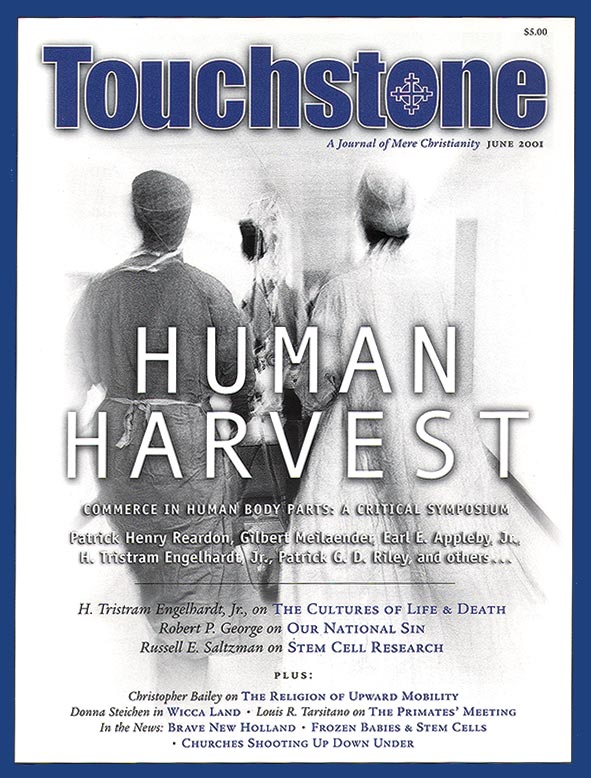
Human Harvest by Patrick Henry Reardon + Gilbert Meilaender + Earl E. Appleby, Jr. + John Eudes Bamburger + Paul A. Byrne + H. Tristram Engelhardt, Jr. + Mark Haverland + Patrick G. D. Riley
Human Harvest
Commerce in Human Body Parts: A Critical Symposium
presented by Patrick Henry Reardon
This symposium is formed of two parts, the first of which is a short article
of mine, “The Commerce in Human Body Parts: An Eastern Orthodox View,”
that appeared last year in Christian Bioethics: Non-Ecumenical Studies in
Medical Morality, a journal published in Holland. That article was itself
a response to several others that were printed in the same issue (Volume 6,
2000, No. 2), all of them dealing with the ethical questions raised by the prospect
of the commercialization of human body parts for purposes of medical transplant.
Of the articles in that particular edition of Christian Bioethics,
mine was the only one that argued, as a matter of uniform principle, against
such commercialization. My article is reprinted here with the permission of
Christian Bioethics.
The second part of the present symposium, which appears here for the first
time, is formed by seven responses to my article from other Christian thinkers
and writers enjoying some expertise of a moral and/or medical nature. These
include four Roman Catholics, one Lutheran, one Anglican, and one Eastern Orthodox.
The list likewise contains one bishop, one abbot, and three physicians. Unlike
those in the aforementioned edition of Christian Bioethics, all the
writers presented in this symposium stand opposed to the commercial use of human
body tissue. At the same time, as the reader will see, most of them do take
issue with some aspect or other of my own argument on this question, or with
one another. Several of these writers raise, in particular, the more radical
question of whether the very idea of transplanting vital organs from a dead
body is biologically possible, or whether it does not involve even a logical
contradiction.
I added some closing remarks at the end of these critical reflections.
The Commerce in Human Body Parts
An Eastern Orthodox View
by Patrick Henry Reardon
I do not intend, in these reflections, to provide full answers to the many
moral questions raised by the advanced surgical procedures and other medical
technologies that have, in recent years, rendered the transplanting of human
organs more available than even our immediate past could have imagined possible.
I have been asked, rather, to proffer an Eastern Orthodox response to the specific
proposals recently advanced.
In order to do this, I propose to provide what I think to be a necessary doctrinal
context in which Eastern Orthodox Christians typically assess matters of this
kind. That is to say, I will begin the ethical discussion with doctrinal theology.
Eastern Orthodox Christians have no trouble accepting the bon mot of Hans Urs
von Balthasar: “Ethics is an echo and a thanksgiving for theology.”
Narrative being my normal and preferred form of moral discourse, I plead to
begin this outline with a personal story. It involves a memory from distant
childhood—what was probably my first attendance at a funeral. I must have
been 6 or so, I think, and most of that liturgical service is a hazy blur in
my mind now. I recall vividly, nonetheless, that what struck me most about that
burial rite was its use of incense. I was quite surprised and more than slightly
puzzled to see our pastor, clothed in black brocade vestments, walking around
the casket three times, waving the smoking censer over the dead body repeatedly
with the deepest and most intentional reverence.
This action not only made a strong impression; it also posed to my young mind
a rather serious question of liturgical propriety. My experience of the liturgical
worship up to that point in my young life had prompted me to associate the burning
of incense solely with the veneration of the Holy Eucharist. I had never seen
a censer or the smoke of incense except in the context of the Blessed Sacrament
of the Altar. Why, then, I wondered, would a dead body be venerated with the
wafting of incense smoke, treated like the Holy Communion, as it were? What
could this ritual possibly mean in such a context? My father being away at the
time (making life hazardous for the Japanese army in such places as Guam and
Okinawa), I took this theological question to my mother.
I could not have done better. Nearly six decades have passed since then, but
to this day I cherish and hold the clearest memory of my mother’s very
correct answer. “Well, of course, the priest incensed the body,”
she said. “The bodies of Christians are the temples of the Holy Spirit.”
Her answer, I distinctly recall, was delivered without the slightest hesitation
or uncertainty, and it showed her intuitive grasp of the special dignity of
the Christian body in properly theological terms. She knew exactly why the body
of a Christian, whether living or dead, is properly venerated by the liturgical
use of incense. Quite simply, the Christian body is holy. It is the consecrated
dwelling place of the Holy Spirit.
As I reflect on the matter now, at a distance of more than half a century, I
find yet another thought inescapable by way of inference: What my mother told
me about the Christian body must have been a common understanding at that time.
She was not especially educated; indeed, she had not even finished high school.
Nor, when I was young, did my mother strike me as a particularly devout person,
though I am much disposed to question and correct that impression now. Anyway,
the point is that my mother’s theological assessment about the reason
for incensing the dead bodies of Christians, an assessment overwhelmingly confirmed
by all my later studies in dogmatic and liturgical theology, must have reflected
a rather widespread understanding among believers in those days. Back during
World War II, I suspect that many a child would have received exactly the same
answer to the same question, and with equal quickness and assurance.
The Temple of the Holy Spirit
According to Eastern Orthodox theology, the rhetorical question “Who shall
separate us from the love of Christ?” is one that pertains to the body
every bit as much as it pertains to the soul. While it is certain that the soul
leaves the body at the time of death, we Orthodox find no reason in Holy Scripture
for supposing that the Holy Spirit takes leave of the body simultaneously. Indeed,
why suppose that the Holy Spirit leaves the body at all? Were the Holy Spirit
to depart from the body at the time of death, what could it possibly mean to
say that death has been swallowed up in victory? Why should we imagine that
the corpse of a Christian has become less holy, less sanctified, than it was
five minutes before it died? On the contrary, we affirm that his body remains
forever the temple of the Holy Spirit.
This emphasis on the holiness of the Christian body is an essential feature
of Eastern Orthodox dogmatic theology (and, though they may express the matter
somewhat differently, I do not doubt that a perspective very much like this
is shared by Roman Catholics and many other Christians). We believe and confess
that the dynamisms, the energeiai, of the Holy Spirit are poured out,
through the sacraments, upon the Christian’s body, its corporeal substance,
in a divine action that is no less physical for being spiritual. By the transforming
presence of the Holy Spirit there is effected a spiritual, divinized alteration
in the very nature (physis) of the Christian’s flesh, the seed
of its future resurrection and immortality. In this sense, the alteration is
physical.
In Orthodox theology, moreover, we believe that the soul itself is sanctified
through the body. Holiness is experienced and thought of as quite physical,
meaning that it involves our entire physis, or nature. Sanctification
is not “spiritual” in the sense of non-material. It is spiritual,
rather, in the sense that divine grace transforms the entire human constitution,
including the very structure and organic composition of the body’s living
cells. The anatomy itself is spiritually altered. For the Orthodox, “spiritual”
does not mean “bodiless.” We believe that there is no part of human
experience—and most emphatically not the experience of holiness—that
is separated from the body.
According to Orthodox theology, then, salvation and holiness come to man through
his flesh. Just as Jesus’ dying in the flesh and rising again in the flesh
are the cause of man’s redemption, so this redemption comes to him through
the physical channels of the preaching and sacraments of the Church. Man’s
soul is saved and sanctified through his body. Divine grace reaches the human
spirit through the medium of human flesh. We have it on good authority that
even faith comes through something so physical, so carnal, as the act of hearing.
Tertullian’s famous sacramental dictum says it all: Caro cardo salutis,
“the flesh is the hinge of salvation” (On the Resurrection
8.2).
According to Eastern Orthodox theology, furthermore, what in the West is known
as the doctrine of “the mystical body of Christ” is not a simple
analogy. When, in 1 Corinthians 12:12, St. Paul says that “as the
body is one and has many members, but all the members of that one body, being
many, are one body, so also is Christ,” this is not understood in the
East as implying some merely metaphorical comparison of the social order to
the correct functioning of a living organism, a comparison such as one finds
in Cicero. Rather, it is the very bodies of Christians that are made “the
members of Christ.”
This interpretation is appropriate to the ethical context in which it appears
in 1 Corinthians. In fact, Saint Paul takes this principle of bodily holiness
to be a self-evident premise from which a number of moral inferences are necessarily
derived. “Do you not know?” he asks three consecutive times in this
context: “Do you not know that your bodies are members of Christ? . . .
Or do you not know that he who is joined to a harlot is one body with her? . . .
Or do you not know that your body is the temple of the Holy Spirit who is in
you, whom you have from God, and you are not your own?” (1 Corinthians
6:15,16,19) The body, in short, is “for the Lord, and the Lord for the
body” (6:13). The holiness of Christians, that physical sanctification
by which they can no longer even claim their bodies as their own property, is
treated as a standing principle that places definite moral limits on what sorts
of things can be done with those bodies (cf. also Romans 6:13).
The Drug of Immortality
As earlier noted, the childhood question that I put to my mother was spawned
by a sense that the corpse in the coffin was being treated in much the same
way that I had come to associate with the veneration of the Blessed Sacrament.
That seemed to my young mind very inappropriate. That is to say, while I knew
without doubt that the Holy Eucharist, as the true body and blood of Christ,
is worthy of the most profound veneration, it was not yet clear to me that participation
in the Sacred
Mysteries actually effected a change in the human body itself. My mother’s
answer to my question, then, served to throw a new light on the meaning of the
Eucharist. My later study of dogmatic and sacramental theology, also, would
in due course attest to the correctness of the instincts involved in my question.
There was more connection between the Holy Communion and the Christian’s
body than I had ever imagined.
According to this theology, just as the action of the Holy Spirit, whose descent
is sought in the Church’s epikletic prayer, transforms the nature (physis)
of the bread and wine to make them be the true body and blood of Christ, so
this sanctification passes into the very bodies of those who share in the blessed
Eucharist. The mystery of the Holy Communion is the foundational reason for
saying that the bodies of Christians are the temples of the Holy Spirit.
The Orthodox believe it is in the Holy Eucharist that we are incorporated into
the body of Christ: “The cup of blessing which we bless, is it not the
communion of the blood of Christ? The bread that we break, is it not the communion
of the body of Christ? For we, though many, are one bread, one body, for we
all partake of that one bread” (1 Corinthians 10:16f). According
to Orthodox dogma the very flesh and blood of Christians are sanctified, theologically
defined, by their living, sacramental contact with the flesh and blood of the
risen, perfected Christ, in whom they place their trust in life and in death.
Their members are thereby suffused with the dynamisms of the Lord’s resurrection.
Those very members will rise from the dead by reason of the Holy Communion:
“Whoever eats my flesh and drinks my blood has eternal life, and I will
raise him up at the last day” (John 6:54). That is to say, the Holy Communion
places within the believer’s body the dynamics of its ultimate resurrection.
This was the reason why that body in the coffin was being incensed by my boyhood’s
parish priest. That body shared in the transforming, mystic consecration of
the bread and wine by the outpouring of the Holy Spirit. That incensing was
a veneration of the indwelling Holy Spirit, who would continue to abide in that
fallen flesh, no matter what its state of decay and degradation, until the Lord
himself returned to call it from its resting place.
The goal of the Holy Eucharist is not the consecration of bread and wine,
but the consecration of human beings. The risen Christ does not assume the form
of the consecrated elements in order to hide in a tabernacle but in order that
he may abide in us and we in him (John 6:56). According to St. Justin Martyr
in the second century, “we have been taught that the food that is eucharisticized
(eucharistetheisan) by the prayer of the word that comes from Him,
by which our flesh and blood are fed by metabolism (kata metabolen),
is the flesh and blood of that Jesus who became flesh.” Hardly can our
bodies any longer be considered common bodies if it is true that “we do
not receive these as common bread and common drink” (First Apology
66).
This persuasion with respect to the sanctification of the flesh through the
Eucharist appears likewise in the ancient Church’s literature of martyrdom.
Thus, in the Martyrdom of Polycarp, a work contemporary with Justin,
we are told the blessed martyr referred to his own death as a sharing in the
cup of Christ (14.2), and the narrator describes his body, surrounded by the
flames of the pyre, as resembling a loaf baking in the oven (15.2). Even earlier
in the second century, Ignatius of Antioch, on his way to martyrdom at Rome,
had referred to the power of the Holy Eucharist with respect to the Christian’s
eternal transformation, speaking of the “one bread which is the drug of
immortality, the antidote that we may not die (pharmakon athanasias, antidotos
tou me apothanein) but live in Jesus Christ forever” (Letter
to the Ephesians 20.2). With specific reference to his own impending death,
Ignatius wrote of the Holy Eucharist in similar terms: “It is the bread
of God that I desire, which is the flesh of Jesus Christ, of the seed of David,
and for my drink I desire his blood, which is incorruptible love” (Letter
to the Romans 7.3).
By way of summary, it is the teaching of the Orthodox Church that (1) the bodies
of those in Christ are to be regarded as sanctified by the hearing of the Word
and faithful participation in the Sacraments, most particularly the Holy Eucharist;
(2) because of the indwelling Holy Spirit the consecrated bodies of Christians
do not belong to them but to Christ; (3) with respect to the indwelling Holy
Spirit there is no difference between the bodies of Christians before and after
death; (4) whether before or after death, the Christian body is also to receive
the same veneration; and (5) notwithstanding the physical corruptions that the
body endures by reason of death, there remains a strict continuity between the
body in which the Christian dies and the body in which the Christian will rise
again. That is to say, it is the very same reality that is sown in corruption
and will be raised in incorruption (1 Corinthians 15:42).
An Orthodox Analysis
The foregoing doctrinal considerations provide a brief but necessary setting
for understanding how the Orthodox Church deals with the moral questions attendant
on the uses of bodily members separated from their bodies.
Needless to say, in the light of the theological reflections just given, it
is not to be expected that an Orthodox theologian will agree with those who
argue in favor of commerce in human body parts. The Orthodox Church regards
as morally reprehensible the tattooing of a living body and, except under the
gravest and most compelling necessity, the cremation of a dead one. The notion
of “selling” an integral part of a human being is simply outside
the realm of rational comprehension. Indeed, it is profoundly repugnant to those
Orthodox Christian sentiments that are formed and nourished by the church’s
sacramental teaching and liturgical worship. One does not sell or purchase that
which has been consecrated in those solemn ways that the church consecrates
the human body.
That question settled, what further may be said about the surgical removal of
body parts at all? Two sorts of cases present themselves in this connection.
First, the surgical removal of a diseased part of the body for purposes of keeping
the whole alive. In these circumstances I am familiar with no teaching of the
Orthodox Church that would preclude such an intervention, nor has the conscience
of any Orthodox Christian, as far as I know, ever been troubled by the amputation
of gangrenous limbs or the removal of infected tonsils or the extraction of
rotting teeth.
Second, the removal of some “dispensable” part of the body for purposes
of donating it to another human being who has need of it. Inasmuch as the Orthodox
Church does not object to the donation of human blood, it would appear that
this instance provides adequate analogy for making the same determination about
other body parts.
Once again, there are two types of cases in which this latter determination
may be made. First, body parts from a living person. One thinks here of the
gift of bone marrow, a kidney, a portion of the liver. Provided that the donor
is under no coercion except that of charity, it is my view that this kind of
gift, which does not involve the death of the donor, is not only blameless but
even heroically generous.
Second, body parts from someone who has died. In this case, of course, the range
of possibility is much larger, involving such major organs as the heart and
lungs. Once again, it is my view that such donations are morally legitimate
for Christians as expressions of their love for others in Christ. Indeed, I
have already left instructions with my own family that, in the event of my meeting
the Lord somewhat ahead of schedule, the medical profession may remove any part
of my body that might be of service to someone in need. What must be strenuously
avoided, however, is any behavior suggesting that the body parts of a deceased
Christian are (to quote a recent author) “very much like other types of
things.” Most emphatically, they are not (as the same author wrote) “parts
of a former person.”
Finally, it must be remarked that the censure placed against commerce in human
body parts should not be taken to imply that there are to be no commercial aspects
to the transplanting of these members. That is to say, those who do this important
work may expect to earn their living thereby. What is reprehensible is the actual
sale of human organs (whether by the donor or by the agency that handles the
gift), not the paying of a reasonable fee for the services involved in the removal,
preservation, and transplanting of the organ.
Responses
Fundamental Agreement
by Gilbert Meilaender
I find myself in the uncomfortable position of agreeing with Fr. Reardon’s
chief claim—that commerce in human body parts is wrong and should be prohibited—but
unpersuaded by the doctrinal basis he provides to support that conclusion.
First, the theology: I am quite prepared to believe that the sanctifying power
of the Holy Spirit “passes into the very bodies of those who share in
the blessed Eucharist,” though I would have thought that it is baptism
which accomplishes this incorporation into Christ’s body (as Romans 6
seems to teach). But I admit to not understanding why this means that the Holy
Spirit should continue to dwell in the corpse, in the body’s “mortal
remains.” Still more, it seems peculiar to say that “with respect
to the indwelling of the Holy Spirit there is no difference between the bodies
of Christians before and after death.” There must be at least this much
difference: namely, that before death the Spirit indwells a living person and
after death (were Fr. Reardon’s doctrinal claim true) the Spirit would
indwell the body or bodily remains of one who had formerly been a living person.
In order to assert, as I would also want to assert, that Christians are—in
their bodies—incorporated into Christ, and in order to affirm that there
is continuity between this bodily life and the life that shall be ours in the
resurrection, it does not seem necessary to claim that the Holy Spirit dwells
in a corpse. The dead are truly dead, and ours is a God of the living, not the
dead. (To give Fr. Reardon his due, however, there are deep Trinitarian mysteries
involved here—in particular the relation of the entombed Jesus to the
Holy Spirit between Good Friday and Easter.)
It is, for me at any rate, sufficient to know that the newly dead corpse still
bears the human form of one who lived among us. To view that dead body not with
veneration but as simply a useful collection of organs available for salvage
and sale is to fall beneath even the best human wisdom of those who have not
known the light of Christ. One has to be dehumanized indeed to regard the corpse
as simply another natural object. If that corpse is no longer my person, as
it surely is not, it is, nonetheless, my mortal remains. To treat those mortal
remains with respect, to refuse to see them as merely in service of other goods,
is our last chance to affirm that the human person is not simply a “part”
of a human community and does not belong to us.
So Fr. Reardon is right about the buying and selling of bodily organs for transplant.
He is also right to see that, if organs are to be taken for transplant, they
should be given. Hence, one need not oppose all organ transplantation. Nor,
I think, need we oppose a definition of death as the irreversible loss of all
brain function, even if heart and lung activity continue to be mechanically
sustained (and, of course, without such a definition most transplantation could
not take place). A body that has permanently lost the capacity to integrate
those “vital” functions independently, though it will not look like
a corpse, is one.
But, at least by my lights, Fr. Reardon may be more positive about organ donation
than the facts warrant. I would not call organ donation “heroically generous.”
In our society we regularly oversell its possible benefits and regularly underplay
its often terrible costs. The “success rates” given for transplants
often conceal an enormous amount of suffering and frustration.
Perhaps the doctrinal point we really need here is slightly different from
that to which Fr. Reardon points us. The body of Christ which we eat in the
Eucharist is his broken body, given willingly into suffering by a man who preferred
a faithful life to a long one. Incorporated into that body we may gradually
learn to grasp for continued life with a little less desperation.
An Intrinsic Contradiction
by Earl E. Appleby, Jr.
I greatly appreciate the opportunity to respond to Father Reardon’s
article, because it provides an occasion to address a contradiction inherent
in much current thinking about the transplanting of human body parts. If I may
put the matter succinctly, it is not possible to harvest usable hearts and lungs
from “someone who has died.” Living organs are excised from living
persons, and the fraudulent concept of “brain death” was concocted
to rationalize this murderous practice. Tissues, such as corneas, may be taken
from “someone who has died,” but not vital organs.
In this respect, we would do well to remind ourselves of four axioms of the
Natural Moral Law: (1) Good ought to be done, and evil must be avoided. (2)
Good may not be withheld. (3) Evil may not be done. (4) Evil may not be done
that good might come of it. The transplantation of unpaired vital organs violates
each and every one of these axioms of the Natural Moral Law.
Pope John Paul II describes the nature of the evil to which I allude in these
words:
Vital organs which occur singly in the body can be removed only after death.
That is from the body of someone who is certainly dead. . . .
The requirement is self-evident, since to act otherwise would mean intentionally
to cause the death of the donor in disposing of his organs. (Address to International
Congress of the Transplantation Society, August 29, 2000)
This vital truth is indeed self-evident but it remains largely hidden from
public view by a pervasive propaganda campaign on the part of the transplant
industry that dehumanizes its victims in the style of Joseph Goebbels as today’s
Untermenschen, the “brain dead.”
Lincoln once pointed out that if someone called a horse’s tail a “leg,”
it would still have only four legs. Calling a tail a “leg” doesn’t
make it one. The truth is that for vital organs to be suitable for transplantation
they must be living organs removed from living human beings. Calling a living,
breathing human being with a beating heart “dead” through the lie
of “brain death” does not make him dead—unpaired vital organ
transplantation does.
Goebbels’s mentor, Adolph Hitler, boasted that a lie repeated often enough
is soon believed. Three decades of trumpeting the Madison-Avenue slogan “the
gift of life” has persuaded many naive, if well-intentioned, souls into
the ill-advised and anti-life act of signing organ donor cards, but how many
of these potential victims of utilitarian euthanasia know just how literal that
“gift” really is?
Consequently, persons condemned to death as “brain dead” are alive,
and the prohibitions imposed by God himself in the Natural Moral Law preclude
the transplantation of unpaired vital organs, an act that causes the death of
the “donor” and violates the divine commandment, “Thou shalt
not kill.”
More Nuance Required
by John Eudes Bamburger
There is agreement that certain tissues can be used when taken promptly from
a deceased person, the most common being the cornea. In view of the abuses connected
with the removal of vital organs in someone who is “brain dead,”
it is important to distinguish between the case of one who is “brain dead,”
yet whose vital signs remain functional, and one who is truly dead. The objection
that “brain death” is not an acceptable norm for pronouncing a person
“dead,” and so harvesting vital organs from such a person is not
ethically permissible, would seem to require a more nuanced treatment than Fr.
Reardon’s article provides. Whether vital organs can ever be harvested
from one who is truly dead, whose vital signs indicate full death, is a medical
question requiring more expertise than I possess. If Mr. Appleby is correct
in saying that they cannot be utilized, then his objection would seem to stand,
but that assertion pertains rather to medical than moral expertise. In any case,
his objection seems to me to be based on serious concerns and indicates that
a more nuanced treatment of this issue is needed than Fr. Reardon considered.
Victims of Propaganda
by Paul A. Byrne
We are bombarded with propaganda about organ transplantation. For those who
are thoughtful about “brain death,” death, and organ transplantation,
numerous occasions may arise that demand a moral decision in such matters. For
example, we are regularly required to make a decision about organ transplantation
when we apply for a driver’s license.
The first consideration ought to be that God creates the person, who is unique
and unrepeatable. The human person, made in the image and likeness of God, is
both corporeal and spiritual, and life is the unity of the corporeal and the
spiritual. The purpose of medicine is to protect life, furthermore, to preserve
life, to prolong life, to postpone death, and to enhance the sanctity and quality
of life. Life on earth, finally, is a continuum from conception until death,
and the life of the person must be respected from conception until death.
Thus, no one should be declared dead until and unless there is separation of
his soul and body. What is left after death is a corpse, an empty body. The
absence of life in the corpse is manifest by destruction, disintegration, dissolution,
and putrefaction. Therefore, the minimal legal and medical requirement ought
to be: “No one shall be declared dead unless respiratory and circulatory
systems and the entire brain have been destroyed.”
Organs for transplantation are taken commonly after a declaration of “brain
death.” “Brain death” is not death. For a heart to be suitable
for transplantation, it must be a beating heart. It takes about one hour of
operating to take a heart out for transplantation. It takes about three hours
of operating to take a liver out for transplantation. During the time of the
procedure for excision of these and other organs, the heart must be beating,
the blood pressure must be normal, and many internal organs and systems must
be functioning. It is common for a paralyzing agent, not an anesthetic, to be
used while the organs are being excised so that there will be no movement or
visible response during the procedure. At a leading university in the United
States of America, in all ten patients studied, there was an increase in heart
rate and blood pressure when the scalpel made the incision to remove the organs.
Could this increase of heart rate and blood pressure occur after death?
Morally, only one of a pair of vital organs or a part of a vital organ may
be transplanted. This may be done only as an act of charity after the donor
has been fully informed and when the excision of the vital organ or part of
the vital organ will not cause death or debilitating mutilation. Only living
organs are suitable for transplantation. Vital organs cannot be transplanted
from a dead body. Only tissues, such as corneas or heart valves, are suitable
for transplantation after the heart has stopped and there is no circulation.
The fictitious concoction of “brain death” is a fraudulent subterfuge
coined and expended to deprive defenseless persons of their God-given right
to life, often for profit. Removal of vital organs after a declaration of “brain
death” is precisely what causes the death of the patient whose vital organ
or organs are thus excised.
While this doubtless may prolong the life of the person receiving such organs
by transplant, the procedure does violate the moral principle that evil may
not be done that good might come of it. That is, a good end does not justify
an evil means.
This fundamental moral axiom should be brought to the attention of those tempted
to sign organ donor cards authorizing the removal of their vital organs for
transplantation. Many have been deceived in these serious matters.
The Empirical Evidence
by H. Tristram Engelhardt, Jr.
Certain metaphysical assumptions to the contrary notwithstanding, brain death
is the death of a person. Also, as St. Gregory Palamas (1296–1359) recognized,
these are not matters of revelation. One can appreciate the factual matters
at hand, as well as the significance of whole-brain death, by considering the
execution of the French scientist and politician, Antoine Laurent Lavoisier
(1743–1794). Lavoisier was concerned to determine how long a person remained
conscious after decapitation. He therefore arranged for those at his execution
to observe how long he would blink once he had been guillotined. If one imagines
that modern medical technology had been available and Lavoisier’s head
had at once been cannulated and perfused with oxygen-rich blood, he would have
continued to blink and communicate while his body decomposed. We would have
held Lavoisier to be alive, although his body was dead.
Or imagine that the executing authorities had cannulated and intubated the
body, preserving its vital functions while the head decomposed. We have come
to understand that our presence in this world is radically tied to our brains.
One can have liver transplants and heart transplants, but not brain transplants.
Were one to attempt a brain transplant, it would be tantamount to a body transplant
(not that I would morally celebrate such a technological feat).
All of this means that we have discovered empirical information about ourselves
and our embodiment. When the brain is dead, the person is no longer among us,
even though other levels of biological life can continue. Cultures of human
cells can be kept alive for decades after a person’s death. In the case
of our fictional consideration of Lavoisier’s body, long after his head
had decomposed and his soul gone to judgment, the French authorities could have
removed organs from the remaining heart-beating body, had such technology been
available. No doubt, Lavoisier would have been interested in the reflexes that
would persist in his now separated body (e.g., increases in heart rate and blood
pressure with the surgical removal of organs). This gruesome image is meant
as a heuristic device to bring across some empirical facts of the matter we
have learned, especially over the last two centuries. We could carry these further
by imagining that, after .357 bullets had been shot into a person’s heart
and head, the body was cut in half so that the liver could be perfused and maintained
long after the heart had stopped beating and the brain been destroyed. That
is, one can conjure circumstances in which organs can be removed from bodies
lacking either intact brains or beating hearts. The point is that we have come
to understand the signal importance of the whole brain, as well as the need
to recognize how various levels of human biological life can continue in organs
and cells long after a person’s death.
I commend Dr. Paul Byrne for attempting to revivify a Thomistic account of
the soul as the form of the body. Also, I surely join him in being concerned
about being an organ donor due to non-heart-beating-donor criteria for death,
but not because of concerns about the appropriateness of whole-brain death.
Following a Safer Path
by Mark Haverland
Most of Fr. Reardon’s article is lucid and unexceptionable. For example,
I agree completely with him that human beings should not be treated as objects
of commerce and that their bodies should be treated as befits the creation of
God and temple of the Holy Ghost.
My problem is with the final paragraph of his article, which contains a petitio
principii. That is to say, Fr. Reardon begs the question: Is the “donor”
of a unique (“unpaired”) vital organ, such as the heart, in fact
dead?
When a clear moral duty, such as the duty not to take innocent human life,
is known and is involved in a moral choice before us, we are obliged to take
the morally safer path, even if doing so may bring some losses. So, for instance,
the hunter in the woods is not free to blast away at a moving object unless
he is certain that that object is a deer and not a human being. The obligation
not to take innocent life obliges us not to shoot at what might be a person,
even if that means going hungry. It obliges us not to abort a fetus, even if
we are not certain at what point ensoulment occurs, even if the birth of the
child may result in various hardships.
Similarly, unless we are morally certain that ensoulment has ceased in the
case of a “brain dead” person, we are not justified in removing
anything vital to his continued existence. The burden of proof, therefore, rests
firmly with those who argue for such removal and for the transplantation system
that rests on its macabre “harvest.” In fact, however, they have
not shouldered the burden; indeed, they have studiously ignored the moral dilemma.
The Deeper Moral Dilemma
by Patrick G. D. Riley
Organ transplantation is a revolutionary advance of modern medicine, but the
moral problems surrounding it are as old as mankind. I believe a Greek legend
from the mists of pre-history gets to the heart of those problems.
The heroine of this legend is Antigone, immortalized by the playwright Sophocles.
This young woman defies a royal edict not to bury the body of her outlawed brother.
For disobeying the law, she is condemned to death. But Antigone holds that she
has obeyed a higher law, from heaven itself. For that matter, an unjust law
is no law at all.
Antigone’s argument has echoed down the centuries. The play can be considered
the first treatise on Natural Law, as well as the most moving. It was framed,
after all, by a Sophocles.
The premise of the argument is that respect for bodily remains, especially of
a loved one, is a demand of human nature. If such respect is an inclination
of all mankind, it meets a classic criterion for a precept of Natural Law. The
reasoning here is that Almighty God, in creating the universe, could not help
stamping everything he made with his own rationality, his own purposefulness.
Nature does nothing in vain, because its Maker does nothing in vain.
What gives the play relevance to commercial traffic in body parts is that Antigone’s
quarrel with the king turns on respect for the body, indeed for a corpse. And
the special relevance of the play to Patrick Henry Reardon’s appeal to
symbol is the key role it gives a symbolic gesture, the seemingly trivial gesture
of throwing dust on a corpse.
The king fully understands that the dust constitutes the burial he forbade to
Antigone’s brother. When she threw dust on her brother’s body, she
knew it would be ineffective against putrefaction or wild beasts, yet nobody
in the grip of this play doubts the meaning of the dust, or doubts that principles
are at stake.
Respect for the dead demands expression, yet its fullest expression lies beyond
the power of words. Hence it demands gestures, symbols. We are driven to such
symbols even when we scarcely understand them. Yet everybody understands the
drama of Antigone, much as it depends on symbol. She braves death for a symbol
in obedience to a profound law of our nature, when civil law rides roughshod
over pietas.
None of these considerations militates against the morality of transplanting
body parts, most strikingly in saving eyesight or life itself. What is morally
objectionable is trafficking in them. Instinctively we discern the gross disrespect
for the human body in exploiting it for profit. The parallel to prostitution
springs to mind.
Here I make no argument beyond simple human revulsion, universal natural revulsion,
itself a kind of knowledge. Of course, natural revulsion can be uprooted by
propaganda or by practice. Since the ’60s, ever-lurking contempt for finer
feelings has cast off its mask for the first time, I believe, in Christian history.
It has infected our world and sickened it. The coarsening of feeling, of behavior,
and of society itself is here for all to see and to suffer.
Nowadays, if anything can be done, no matter how revolting, it will be done.
If the practice is countenanced, it eventually will be flaunted. Think of sodomy
(if you can). Profiting from body parts must lead to technologies too inhuman
to contemplate and may already have done so. If countenanced, they too will
be flaunted.
Just as pornographers now pose as First Amendment patriots, body-parts profiteers
will posture as selfless humanitarians. Indeed they are already doing so. They
will brand their opponents narrow, heartless, and bigoted; indeed, they are
already doing so. Such revilement has been the lot of pro-life people for a
generation. Such may be their fate for generations to come. Unless, that is,
Antigone comes to the rescue. Or better yet, faith itself.
Final Comments
While I express my gratitude to each of the foregoing writers for his critical
comments, it would seem useful to draw attention to certain general aspects
of this discussion.
First, I did not anticipate that all of these respondents would agree with
my opposition to the commercialization of human body parts as a matter of uniform
principle. As I noted at the beginning, I was the only writer (among five, two
of them Roman Catholic and two Protestant) in that edition of Christian
Bioethics to take such an unbending negative stand on the question. Since
I enjoy no expertise in either moral theology or medical ethics, I confess it
is somewhat heartening to find myself supported by those who do.
Second, I fully expected to be criticized for basing my position entirely
on the foundation of sacramental theology; indeed, among the writers discussing
this question in Christian Bioethics, I was the only one to do so.
Taking such a position, nonetheless, would seem to render my argument useless
for purposes of civil law and public policy. Much safer, in this respect, would
appear to be the normal Roman Catholic practice of basing moral decisions on
Natural Law. I expected, then, that one or other of my respondents, perhaps
one of the four Roman Catholics in the group, would raise that question. In
fact, however, Dr. Gilbert Meilaender is the only one to challenge my sacramental
theology at all, but even he does not dispute my using sacramental theology
as the basis for moral decisions.
Third, it is obvious that I had not given adequate (or any!) consideration
to the major objection raised by several of my critics, namely, whether the
notion of removing vital organs from bodies truly dead is even possible. Thinking
that the concept of “brain death” was commonly accepted among moral
theologians and somewhat aware that it was defended by an institution so prestigious
as the National Catholic Bioethics Center, I had not foreseen that my argument
would be subject to attack from that direction. Now that this question has been
raised so pointedly, however, it is obvious that I must give further serious
thought to the matter. I am hardly free to ignore the fact that the official
statement of Citizens United Resisting Euthanasia (CURE), which disputes
the very notion of “brain death,” has been signed by an impressive
international array of experts and scholars.
Finally, I confess that my own “practical” view on the question
of organ transplants has changed radically. Shortly after I wrote that original
article, but prior to its publication, the Chicago Tribune featured
a series of popular reports (in several issues in late May 2000) that spelled
out in gruesome detail exactly how extensive and utterly market-driven is the
commerce in body parts. It has become obvious to me that a subject that I had
been considering in the quiet and relative detachment of our editorial office
takes a dramatically different shape in a world dominated by purely selfish
and mercantile considerations. In actual practice, whether or not a “donor”
is remunerated for his organs, his organs are effectively sold to the highest
bidder on an open market subject to precious little governmental regulation.
A person whose driver’s license indicates that he is an “organ donor”
should have no doubts on this matter. His cadaver will probably be harvested
down to its last useful tissue cell for use in everything from kneecap replacements
and cosmetic surgery to the testing and manufacturing of new drugs. While the
transplanting of vital organs, such as the heart, is subject to close governmental
supervision, this is not the case with respect to “tissue,” a medical
euphemism for any other part of the body, such as bones, skin, veins, and corneas.
At current prices, the average body is worth about $80,000 to the “cadaver
industry,” which finds lucrative uses for the roughly 130 pieces of body
tissue that are extracted, sterilized, cut up, and put on the market. How is
it that companies like Cryolife, Regeneration Technologies, Allograft Resources,
and so forth, which deal exclusively with products that cannot legally be bought
and sold, manage to make such a killing on the New York Stock Exchange?
While federal law does prohibit the sale or purchase of such tissue, the remuneration
given to hospitals and clinics for the “processing” of it is lucrative
indeed. In a matter of just a few minutes, for instance, a hospital’s
surgical staff can snip off and package a patellar tendon, but this little two-inch
strip from the knee will bring up to $5,000 when it goes to repair a sports
injury. A few years ago the standard “processing fee” for a human
liver was about $500, but a competitive market has jumped that figure up to
$7,000. Similarly, a family that agrees to donate the skin of a departed loved
one to a skin bank, thinking it will be used for burn treatment, would be shocked
to learn that certain cash inducements caused their charitable gift to be sidetracked
for other surgical procedures. Penis enlargement, for example.
Anyway, when I recently applied for an Illinois driver’s license and
was asked if I were an “organ donor,” I answered in the negative
for the first time in my life.
Gilbert Meilaender holds the Duesenberg Chair in Christian
Ethics at Valparaiso University. He has recently edited a volume titled Working:
Its Meaning and Its Limits (Notre Dame Press, 2000).
Earl E. Appleby, Jr., is the Director of Citizens United
Resisting Euthanasia (CURE), Ltd., in Berkeley Springs, West Virginia.
The Right Reverend John Eudes Bamburger, O.C.S.O., M.D.,
is the abbot of Our Lady of the Genesee Abbey in Piffard, New York.
Paul A. Byrne, M.D., a neonatalogist and pediatrician
in Toledo, Ohio, is a past president of the Catholic Medical Association.
H. Tristram Engelhardt, Jr., Ph.D., M.D., teaches philosophy
at Rice University and medicine at Baylor College of Medicine.
The Right Reverend Mark Haverland, Ph.D., is bishop of
the Diocese of the South, Anglican Catholic Church.
Patrick G. D. Riley has been a newspaper editor, a lecturer
in Philosophy at the Catholic University of America and Governmental Affairs
Director of the Catholic League for Religious and Civil Rights. He is the author
of Civilizing Sex: On Chastity and the Common Good (T&T Clark,
2000).
Gilbert Meilaender holds the Duesenberg Chair in Christian Ethics at Valparaiso University and is a member of the President?s Council on Bioethics. His most recent books are the second edition of his Bioethics: A Primer for Christians (Eerdmans), and the just published Oxford Handbook of Theological Ethics (Oxford University Press), of which he is the co-editor. He is a Lutheran. Patrick Henry Reardon is pastor of All Saints Antiochian Orthodox Church in Chicago, Illinois. He is the author of Christ in the Psalms, Christ in His Saints, and The Trial of Job (all from Conciliar Press). He is a senior editor of Touchstone. |