





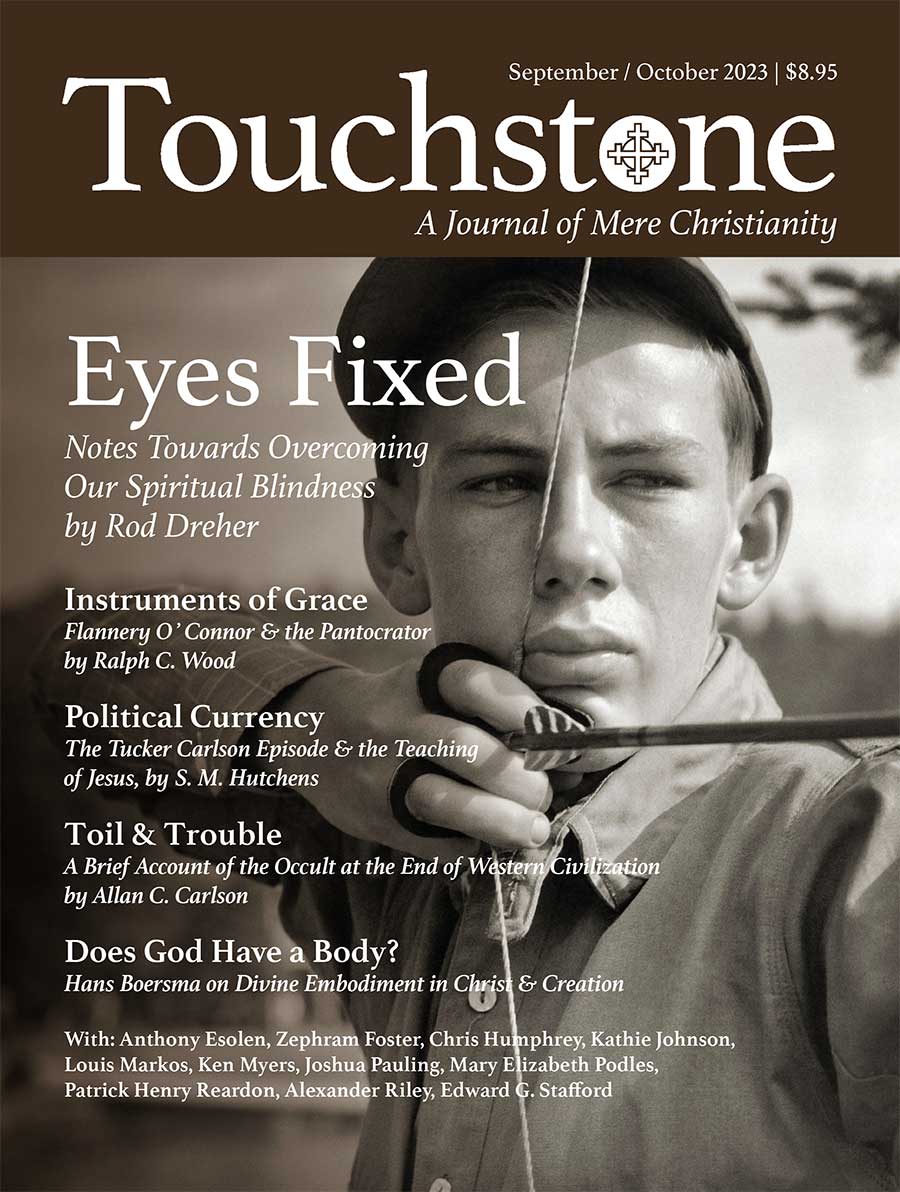
Over to Europe
The Church’s first historian, when he came to tell of the gospel’s passage from Asia to Europe, included details unique to this story, and even a personal note. Referring to Paul and his companions, the text of Acts says,
They traveled through the region of Phrygia and Galatia, having been forbidden by the Holy Spirit to speak the Word in Asia. Approaching the border of Mysia, they tried to go into Bithynia, but the Spirit of Jesus would not let them. Having passed through Mysia, they came down to Troas. During the night, a vision came to Paul: There was some man of Macedonia, who stood and pleaded with him, saying, “Cross over to Macedonia and help us.” Once he had seen this vision, we immediately arranged for passage to Macedonia, concluding that God had summoned us to evangelize them. Setting sail from Troas, we made a straight run to Samothrace and, on the morrow, Neapolis. (Acts 16:6–11)
Prominent among the details in this account are the two interventions of the Holy Spirit to guide the missionaries along a particular geographical path. After young Timothy had joined the group at Lystra, Paul had in mind to move directly west, toward the province of Asia, but the Holy Spirit said “no.” He then attempted to travel north to Bithynia, but the Holy Spirit closed that door, too. It was then that Paul decided to go northwest. This time the Holy Spirit did not hinder them.
THIS ARTICLE ONLY AVAILABLE TO SUBSCRIBERS.
FOR QUICK ACCESS:
Patrick Henry Reardon is pastor emeritus of All Saints Antiochian Orthodox Church in Chicago, Illinois, and the author of numerous books, including, most recently, Out of Step with God: Orthodox Christian Reflections on the Book of Numbers (Ancient Faith Publishing, 2019).
A Journal of Mere Christianity—Delivered to Your Door
- Essays on theology, culture, and the Church
- Contributors from across the Christian traditions

Six print issues (one year) of Touchstone, plus full online access and PDF downloads for only $39.95.

Get a one-year full-access subscription to the Touchstone online archives for only $19.95.
bulk subscriptions
Order Touchstone subscriptions in bulk and save $10 per sub! Each subscription includes 6 issues of Touchstone plus full online access to touchstonemag.com—including archives, videos, and pdf downloads of recent issues for only $29.95 each! Great for churches or study groups.
Transactions will be processed on a secure server.
more on history from the online archives
15.6—July/August 2002
Things Hidden Since the Beginning of the World
The Shape of Divine Providence & Human History by James Hitchcock
31.1—January/February 2018
on Ragnarök, an Extreme Weather Event & the Paths to Conversion by Timothy J. Burbery
14.6—July/August 2001
The Transformed Relics of the Fall
on the Fulfillment of History in Christ by Patrick Henry Reardon
more from the online archives
32.4—July/August 2019
Does Biblical Language for Man Matter? by Stephen F. Noll
calling all readers
Please Donate
"There are magazines worth reading but few worth saving . . . Touchstone is just such a magazine."
—Alice von Hildebrand
"Here we do not concede one square millimeter of territory to falsehood, folly, contemporary sentimentality, or fashion. We speak the truth, and let God be our judge. . . . Touchstone is the one committedly Christian conservative journal."
—Anthony Esolen, Touchstone senior editor
