




The Church of Santa Prisca
Taxco, Mexico
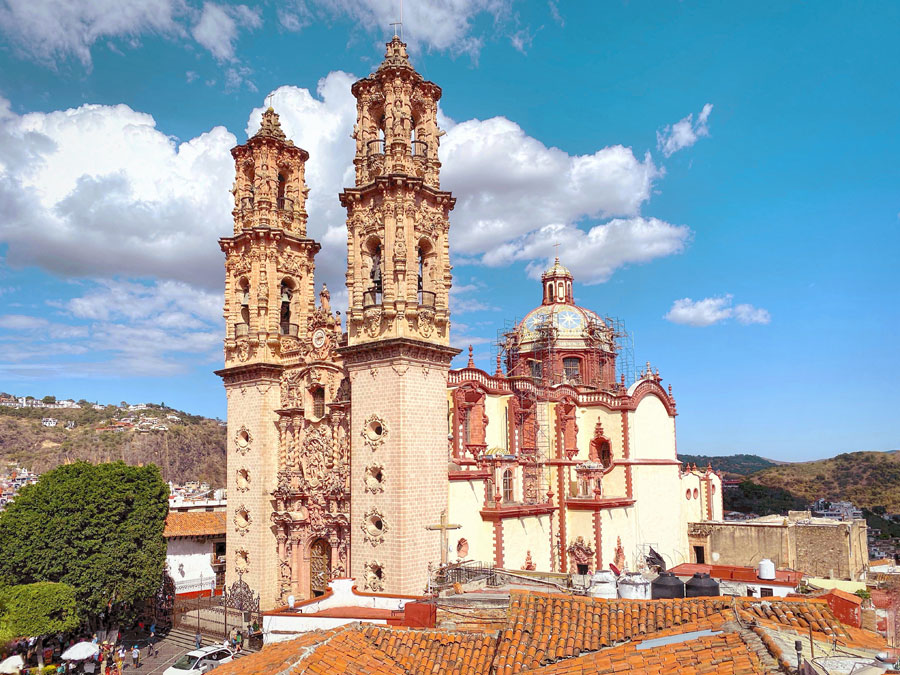
The Church of Santa Prisca in Taxco, Mexico, is a monument of the Spanish Colonial school, which is not nearly so well known as its character and quality warrant. Santa Prisca, with its twin towers of pink sandstone and its star-studded dome, is an exemplar of the Rococo Churrigueresque style, a highly decorated Mexican outgrowth of the Spanish Baroque.
And highly decorated it is. The flat facades of the twin towers feature alternating round and quatrefoil windows and are relatively plain. However, they frame an elaborately carved facade with a central Baptism of Christ, surrounded by twisted columns, prophets, saints, angels, shells, flowers, a clock, and, at the top, the Assumption of the Virgin. From there, the carving shifts to the towers and continues up to dominate the skyline of the town of Taxco. The church is relatively narrow due to the site constraints of the hilly town, which enhances the soaring silhouette of the spires.
Silver & Lightning
It is because of the Taxco hills that the church was built at all: the mountains here contain the richest vein of silver in Mexico. Hernando Cortés first discovered silver in Taxco in 1512, and opened the King's Mine, which, until the end of the sixteenth century, was Europe's largest producer of silver. The surface veins eventually played out, however, and richer ones were found elsewhere in Mexico, so that Taxco slipped into obscurity until 1716.
At that point, further deposits were unearthed, and the city once again began to flourish. José de la Borda, on whose land the new veins were discovered, proposed in 1751 to build the Church of Santa Prisca as an ex-voto expression of gratitude. (The more cynical sources say, as an expression of his wealth and power, and as a suitable venue for his son Manuel, a priest, to demonstrate his status. Few motives are unmixed.) The local Catholic hierarchy, thinking no doubt of the text, "For which of you, desiring to build a tower, does not first sit down and count the cost, whether he has enough to complete it?", required José to mortgage his estate and assets before embarking on the project. It nearly bankrupted him, but fortunately for us, the church was brought to completion in 1758.
But not, apparently, without heavenly intervention, at least according to local legend. As the story goes, José de la Borda was called away during the first year of the church's construction, leaving the site in the care of the builders. A terrible storm arose, the sky turned black, and icy winds whistled through the unfinished towers. A huge lightning bolt struck and seemed to reveal a dark shape swooping down on the church while the terrified workers huddled inside. Another huge bolt struck the cupola, which began to shine with strange flickering lights revealing the text, "Glory to God in the highest." The entire town fell to its knees in prayer, and a beautiful woman, presumed to be Saint Prisca, appeared in the sky, calmly catching the lightning bolts in her hands until the storm passed on. The blue and gold tiles on the roof of the cupola depict the flashing lights of the legend as brilliant stars against a darkened sky.
Exuberance & Martyrdom
However elaborate and bright the carved and colored exterior may be, it pales beside the extravagance of the church's interior. Inside, practically every inch of the walls and ceiling is carved, painted, gilded, or colored. Architecture and sculpture blend into one. Light from the dome glitters over the surfaces and makes of them a dancing, sparkling whole. It is an ornate and fantastical vision, still dazzling even to the jaded modern eye. One can only imagine the impression it must have made on the miners of eighteenth-century Taxco.
The architects were Spaniards, but, removed from Spain, they were somewhat unfettered, and drew cheerfully upon the carving skills and exuberant color sense of indigenous craftsmen. It was a happy marriage of the Old and the New Worlds. If the intent was to impress and overwhelm, it is jubilantly successful. As one art historian describes the experience of the Rococo church, "It is intended to give us a foretaste of the glory of Paradise . . . it envelops you and stops all questioning. You feel you are in a world where our rules and standards do not apply."
After the initial shock of astonishment, though, a darker theme emerges beyond the extravagant paradisal jubilation. The full name of the church is La Parroquia de Santa Prisca y San Sebastian, dedicated to the two Roman martyrs of the early Church. As we take in the nine elaborate altarpieces and parse the symbols carved and molded around them, the theme of martyrdom recurs, in the painted stories of the saints, in the laurel crowns of victory, and in the scallop shells that, to a Spaniard, would recall the long pilgrimage to the martyr's tomb at Santiago. Perhaps Paradise is not so easily attained.
And yet it is made clear that we are not to be left unaided. All the martyred saints have gone before us and won their crowns. And from the brilliantly colored tilework of the dome, Santa Prisca smiles down upon us as she protects her church on its way.
Restoration & Festivity
Over the years since its completion, the fabric of the Church of Santa Prisca has not entirely escaped the need for some earthly protection. The Taxco mine runs underneath the church and is still worked today. Vibrations from mining blasts, earthquakes, and auto traffic have cracked the vaults, necessitating a major stabilization and restoration project. Work was begun in 1997 and is nearly done. A large American corporation furnished the funds to complete the project; presentation of the check for the final grant money launched a full day of festivity and a night of fireworks.
Mary Elizabeth Podles is the retired curator of Renaissance and Baroque art at the Walters Art Museum in Baltimore, Maryland. She is the author of A Thousand Words: Reflections on Art and Christianity (St. James Press, 2023). She and her husband Leon, a Touchstone senior editor, have six children and live in Baltimore, Maryland. She is a contributing editor for Touchstone.
A Journal of Mere Christianity—Delivered to Your Door
- Essays on theology, culture, and the Church
- Contributors from across the Christian traditions

Six print issues (one year) of Touchstone, plus full online access and PDF downloads for only $39.95.

Get a one-year full-access subscription to the Touchstone online archives for only $19.95.
bulk subscriptions
Order Touchstone subscriptions in bulk and save $10 per sub! Each subscription includes 6 issues of Touchstone plus full online access to touchstonemag.com—including archives, videos, and pdf downloads of recent issues for only $29.95 each! Great for churches or study groups.
Transactions will be processed on a secure server.
more on art from the online archives
33.2—March/April 2020
An Architectural Sign of Mere Christianity by Michael Ward
32.4—July/August 2019
on Single-Mindedness in Durer's Ritter, Tod, und Teufel by Anthony Costello
more from the online archives
35.2—Mar/Apr 2022
on Fatigued Christians Deciding to Engage the Culture by Keith Lowery
30.6—Nov/Dec 2017
on Benedict XVI on the Fairest of the Sons of Men by Michael Martin De Sapio
28.3—May/June 2015
Of Bicycles, Sex, & Natural Law
Describing Human Ends & Our Limitations Is Neither Futile Nor Unloving by R. V. Young
calling all readers
Please Donate
"There are magazines worth reading but few worth saving . . . Touchstone is just such a magazine."
—Alice von Hildebrand
"Here we do not concede one square millimeter of territory to falsehood, folly, contemporary sentimentality, or fashion. We speak the truth, and let God be our judge. . . . Touchstone is the one committedly Christian conservative journal."
—Anthony Esolen, Touchstone senior editor
