The Francis Effect
The Failure & Confusions of a More Accommodating Faith
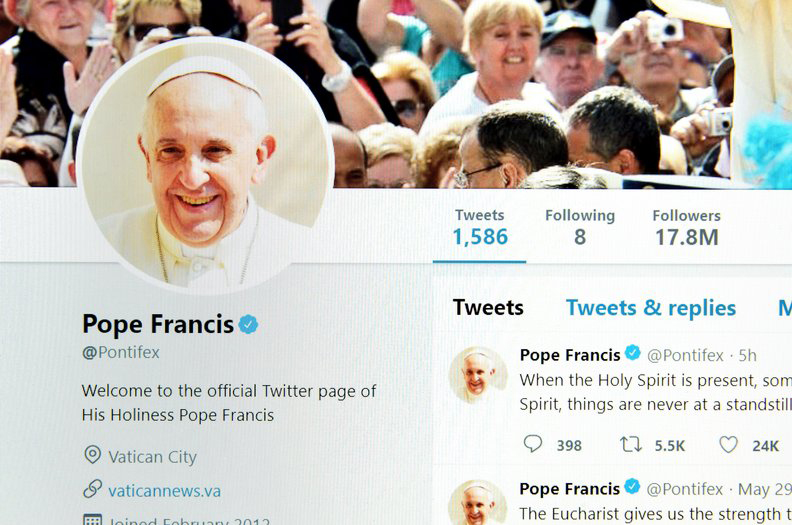
Very soon after the election of Jorge Bergoglio as Pope Francis, there was a good deal of talk of "the Francis effect": the ability of this popular, charismatic figure to reinvigorate the spirit of aggiornamento, which animated the Second Vatican Council and which, implicitly, had been suppressed in the dour papacies of Francis's two immediate predecessors. Writing for the Catholic News Service (March 6, 2015), Cindy Wooden cited in support of this view a number of participants at a conference at Georgetown University, "Renewing the Church in a Secular Age" (March 4–5, 2015).
One participant, Charles Taylor, credited Pope Francis with "living the Gospel and reaching out" and distinguished between "seekers" and "dwellers," clearly favoring the former: "The seekers—baptized Christians or not—continue to question. The dwellers have found a home in a church and may have a tendency to nest there so thoroughly that they seldom reach out to others and only accept those who believe exactly as they do." Professor José Casanova is quoted as sharpening this opposition: "We were concerned by what could be called a self-referential church that had been too concerned about what could be called a 'moral confessionalism' in which being Catholic was defined by certain moral criteria more than criteria of dogma or belief in doctrine."
An Ineffective "Effect"
Seven years later, it is reasonable to judge how well these lofty expectations have been fulfilled. Evidently, the papacy of Francis was supposed to rekindle enthusiasm among Catholic "seekers" who had been discouraged and alienated by the "moral confessionalism" that had prevailed during the reigns of St. John Paul II and Benedict XVI, as well as to attract non-Catholics who would see a "welcoming" and "open" church in a wholly different light.
By this criterion, the "Francis effect" has had hardly any effect at all. Within a few years of the closing of Vatican II, the church began to lose members, influence, and credibility by every objective measure, and the papacy of Pope Francis has done nothing to arrest this trend. This ought to be of concern not only to faithful Catholics, but to faithful Christians of every confession, for the forces at work are not confined to the Catholic Church and its institution of the papacy.
An editorial in the archdiocesan newspaper of Indianapolis, for example, reports statistics that are pervasive in the contemporary Christian world: "For every convert who has been coming into the Church, about four are leaving. Besides that, the number of Catholics who are getting married in the Church fell from 352,458 in 1965 to 125,916 in 2016. And it keeps falling." The author then supplies similarly catastrophic figures regarding vocations to the priesthood, Mass attendance, students in Catholic schools, and so on and on and on.
It is also worth noting that none of the prominent skeptics and atheists whom the pope is credited with engaging by a paradoxical blend of humble simplicity and twinkling charm seem to have converted to the Catholic faith. In fact, high-profile conversions in recent years have occurred mostly among Anglican clergymen, including a number of bishops, already inclined toward a more conservative or traditional understanding of Christianity. The Vatican's studied silence on this development suggests at least indifference, if not outright disappointment.
Negligent & Ineffectual
Pope Francis seems to have embraced enthusiastically the notion that his principal duty, as the Vicar of Christ on earth, is "to accompany seekers" by making Catholicism more accommodating and agreeable, without much focus on the task of bringing converted sinners into the church. This has been a popular conception of the papacy since the Second Vatican Council, but it hardly squares with the official definition of the job. Vatican I's dogmatic constitution, Pastor aeternus, proclaims that the Roman pontiff, as the successor of St. Peter, is "given full power . . . by Jesus Christ our Lord, to rule, feed, and govern the universal Church" (III). Further, the same document declares that when the pope defines a doctrine of faith or morals to be held by the universal Church, he speaks with infallibility, guided "by the divine assistance promised him in Blessed Peter" (IV).
But the pope is accorded these extraordinary powers for very specific purposes. The aim of his governing authority is "so that the Church of Christ may be one flock under one supreme Pastor, through the preservation of unity, both of communion and of profession of the same faith, with the Roman Pontiff" (Pastor Aeternus III). Similarly, the goal of authority to teach infallibly is to preserve unity in faith and morals: "For the Holy Spirit was not promised to the successors of Peter, that by His revelation they might make known new doctrine, but that by His assistance they might inviolably keep and faithfully expound the revelation or deposit of faith delivered through the Apostles" (IV).
The governing and teaching powers of the Holy See are thus designed to impart a certain (dare we say?) rigidity to the Body of Christ, just as the skeleton keeps an individual human body upright and firm. The pope's powers are not intended to turn our Lord's ecclesial Body into a gelatinous invertebrate.
The second Vatican Council by no means changes this. The Council Fathers reaffirm that the pope's governing and teaching authority in the service of "the unity of faith and of communion" (Lumen Gentium 18) does "not . . . admit of any new public revelation as pertaining to the divine deposit of faith" (Lumen Gentium 25). Hence, the Holy Father's untrammeled authority in ruling the Church and his infallibility in teaching the faithful are to be exercised with caution, with the aim of conserving a fragile unity of faith and belief, which are always under threat from the forces of disorder, deceit, and decay.
R. V. Young is Professor of English Emeritus at North Carolina State University, a former editor of Modern Age: A Quarterly Review, and the author of Shakespeare and the Idea of Western Civilization (Catholic University of America Press, 2022). He and his wife are parishioners at St. Ignatius of Antioch Church in Tarpon Springs, Florida. They have five grown children, fifteen grandchildren, and three great-grandchildren. He is a senior editor of Touchstone.
A Journal of Mere Christianity—Delivered to Your Door
- Essays on theology, culture, and the Church
- Contributors from across the Christian traditions

Six print issues (one year) of Touchstone, plus full online access and PDF downloads for only $39.95.

Get a one-year full-access subscription to the Touchstone online archives for only $19.95.
bulk subscriptions
Order Touchstone subscriptions in bulk and save $10 per sub! Each subscription includes 6 issues of Touchstone plus full online access to touchstonemag.com—including archives, videos, and pdf downloads of recent issues for only $29.95 each! Great for churches or study groups.
Transactions will be processed on a secure server.
more on Catholic from the online archives
more from the online archives
calling all readers
Please Donate
"There are magazines worth reading but few worth saving . . . Touchstone is just such a magazine."
—Alice von Hildebrand
"Here we do not concede one square millimeter of territory to falsehood, folly, contemporary sentimentality, or fashion. We speak the truth, and let God be our judge. . . . Touchstone is the one committedly Christian conservative journal."
—Anthony Esolen, Touchstone senior editor