





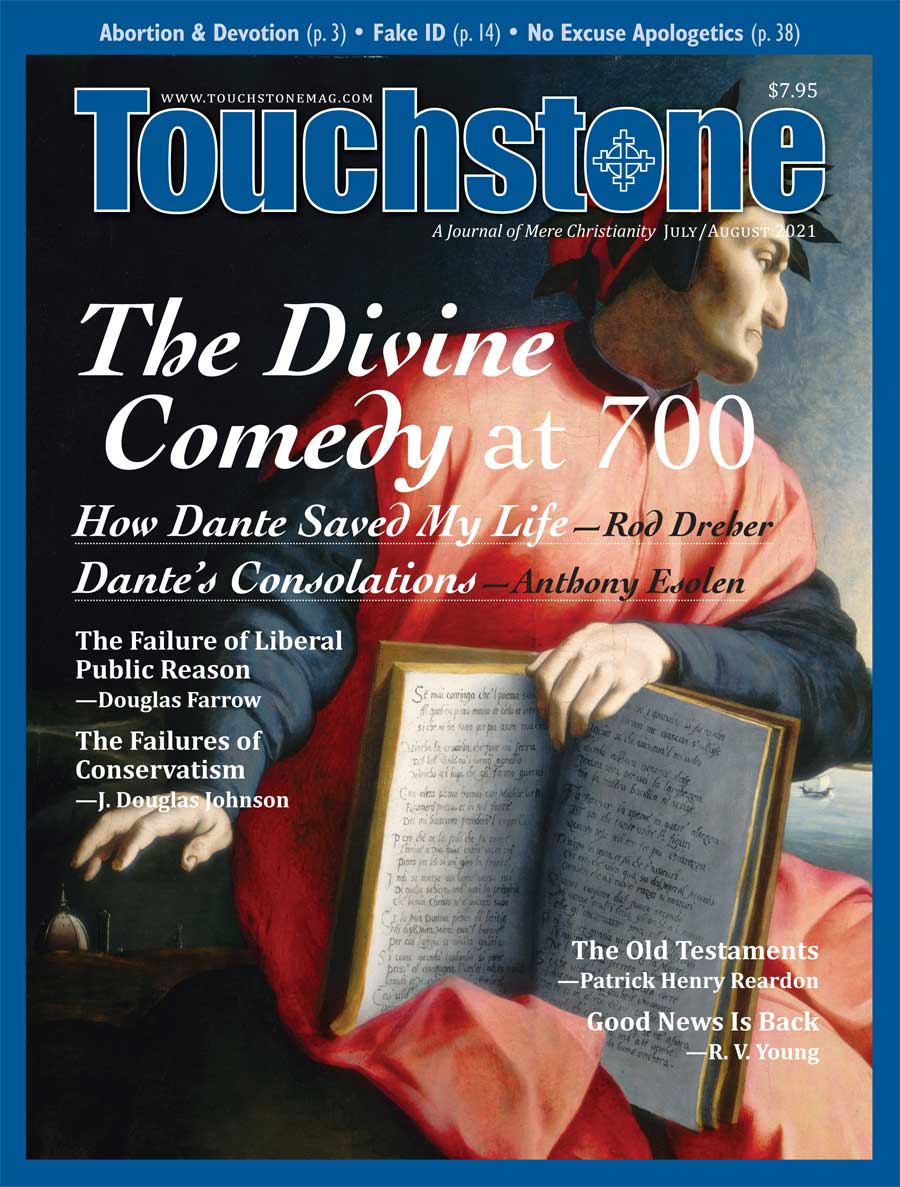
Our Suffering, Our Solace
Dante's Way of Boundless Love
This year marks the seventh centenary of the death, in 1321, of the poet Dante Alighieri, who completed the final canticle of his Commedia shortly before he died. It has since been a commonplace, in certain Catholic circles, to say that the hereafter is not as Dante imagined it, as if the poet ever meant to give us a photographic tour rather than the greatest epic of love ever written—of love betrayed, love revived and heartened, and love fulfilled. We have much to learn from him, especially, I think, in his treatment of that realm whose very existence many Christians doubt, while not necessarily doubting its purpose or its action.
I speak of Purgatory. We say that human beings should love—but we hardly know how; our hearts beat feebly, and the sinews of our souls are not used to exercise. Purgatory, as Dante sees it, is where, or we might say how, souls learn to suffer, and thus to love.
The Hunger of the Soul
When, in Purgatory, Dante meets his brother-in-law Forese Donati, who was a poet in a minor way and Dante's youthful drinking buddy, he can hardly recognize him at first. That is because Forese is in the ring of the gluttons, and their punishment, which is simply to hunger and thirst, has so wasted them to the bone that only the timbre of Forese's happy voice, when he cries, Qual grazia m'e questa!—"What grace for me is this!"—enables Dante to make out his features.
But the wasting away of the flesh brings up several questions, one of which is just why, in a realm where there are souls and no bodies, anyone should hunger at all, and why, in the experience of hunger, what is only quasi-corporeal, the shadow-like forms the souls bear about with them, should be made lean as if they were bodies indeed. We may also ask what the punishment is meant to achieve, and whether, if it has a goal, an aim, a fulfillment, it partakes in what transcends both the mountain where Purgatory is found, and the limitations of human nature. We are apt to think of Purgatory as more like hell than like heaven, because souls are punished there; but what if, in important ways, Purgatory is more like heaven than it is like hell, because it participates in the heavenly, or because its suffering is incomprehensible apart from love?
The immediate cause of Forese's hunger is a tall fruit tree placed in the ring, whose apples are inexpressibly sweet to smell, while a little stream splashes upon the tree from above and sends the aroma down. The souls cannot reach the apples, but they do not attempt to do so; they are not like Tantalus, in the ancient mythology, who stole the food of the gods and was condemned to hunger and thirst forever, the fruit above him and the stream below him receding from his reach. But the souls in Dante's vision are indeed tantalized, and more than the old pagan sinner was. Listen to how Forese describes it:
The odor of the fruit and of the spray
splashing its fragrant droplets in the green
kindle desire in us to eat and drink.And many a time along this turning way
we find the freshening of our punishment,
our punishment—our solace, I should say,For that same will now leads us to the tree
as once led the glad Christ to say, "My God,"
when by his opened veins he set us free.
Dante, of course, knows very well that as soon as he has placed a fruit-laden and provoking tree amidst a band of sinners, we will think of the tree in Eden with the forbidden fruit. But this is not that tree. Adam and Eve did wrong to desire to disobey. To long for the fruit was already to set a fire amid the brush. But Forese and his fellows do long for this fruit and this water, and since grace protects the souls in Purgatory from committing sin, the least we can say about it is that it is not wrong for them to do so. But we can say more.
Anthony Esolen is Distinguished Professor of Humanities at Thales College and the author of over 30 books, including Real Music: A Guide to the Timeless Hymns of the Church (Tan, with a CD), Out of the Ashes: Rebuilding American Culture (Regnery), and The Hundredfold: Songs for the Lord (Ignatius). He has also translated Dante’s Divine Comedy (Random House) and, with his wife Debra, publishes the web magazine Word and Song (anthonyesolen.substack.com). He is a senior editor of Touchstone.
A Journal of Mere Christianity—Delivered to Your Door
- Essays on theology, culture, and the Church
- Contributors from across the Christian traditions

Six print issues (one year) of Touchstone, plus full online access and PDF downloads for only $39.95.

Get a one-year full-access subscription to the Touchstone online archives for only $19.95.
bulk subscriptions
Order Touchstone subscriptions in bulk and save $10 per sub! Each subscription includes 6 issues of Touchstone plus full online access to touchstonemag.com—including archives, videos, and pdf downloads of recent issues for only $29.95 each! Great for churches or study groups.
Transactions will be processed on a secure server.
more on literature from the online archives
24.1—January/February 2011
Ruminations on the Monstrous Envy of the Soul-Devouring State by Anthony Esolen
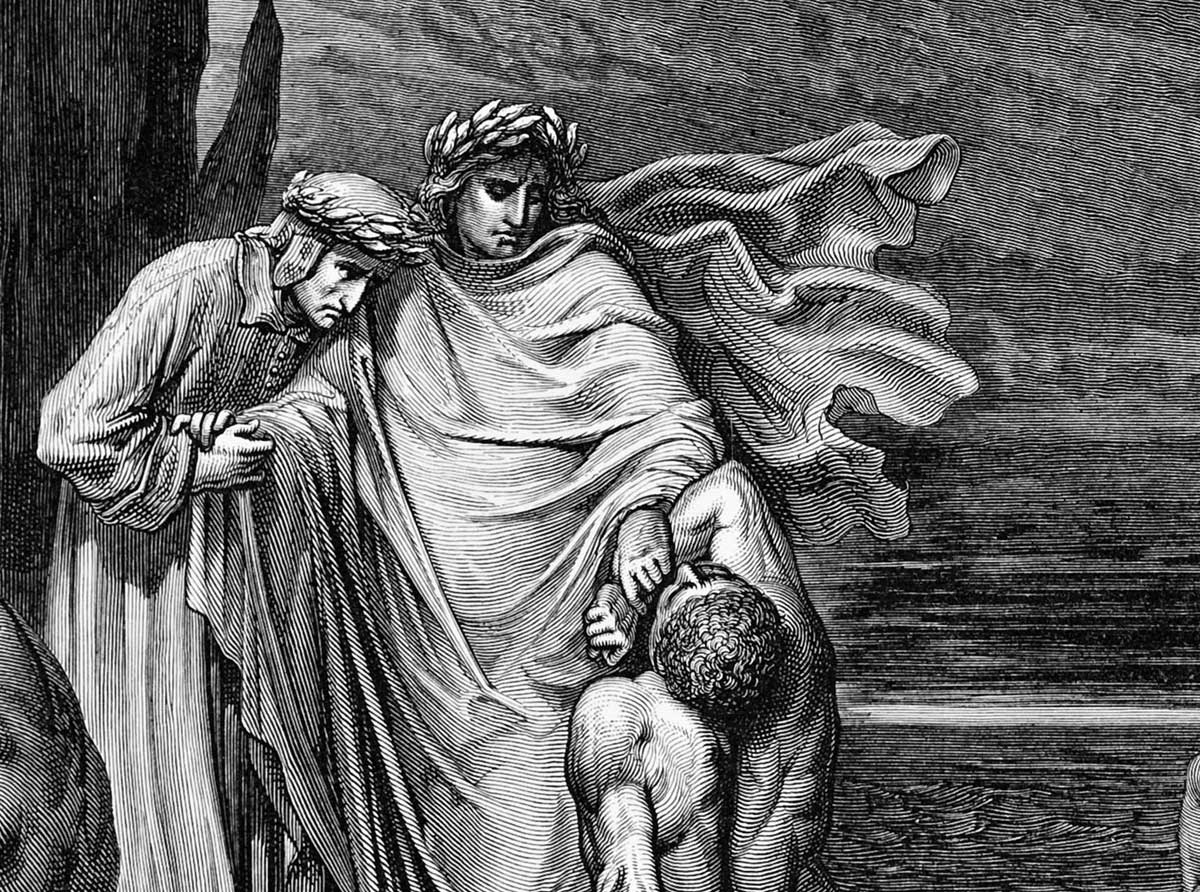
32.2—March/April 2019
Misguided Mercy & Dante's Infernal Purgation by Joshua Hren

more from the online archives
31.1—January/February 2018
on Ragnarök, an Extreme Weather Event & the Paths to Conversion by Timothy J. Burbery

18.3—April 2005
on Being a Free Narnian & the Joy of Subordination by Donald T. Williams
calling all readers
Please Donate
"There are magazines worth reading but few worth saving . . . Touchstone is just such a magazine."
—Alice von Hildebrand
"Here we do not concede one square millimeter of territory to falsehood, folly, contemporary sentimentality, or fashion. We speak the truth, and let God be our judge. . . . Touchstone is the one committedly Christian conservative journal."
—Anthony Esolen, Touchstone senior editor
