




Feature
Role Reversals
Sex, Women's Ordination & the Rejection of Hierarchy & Equality
Part I: Fundamental Theological Principles
Is there an irreducible theological connection between women's ordination and ethical normalization of homosexuality? Surprisingly, few attempts have been made to ground arguments here on fundamental theological principles, rather than on empirical evidence and intuition. Consequently, much of the controversy over women's ordination, including its possible relation to sodomy, exists precisely because many Christians do not start from such fundamentals, but instead short-circuit the process of theological reflection by starting at some point further down the line, with consequent errors in their reasoning. The issue can only be addressed by starting from often unarticulated, and hence unexamined, root assumptions, ultimately grounded in how we think about the very being of God, the Trinity, the Incarnation, and our resulting theological anthropology.
Every theological question ultimately is rooted in our received understanding from divine revelation of the nature and being of God himself. One of the most important and unique contributions of Judaism and Christianity, not found previously either in other religions or among ancient philosophers, is the identification of God with Being (existence) itself—the "I AM WHO I AM" (Ex. 3:14)—rather than as a being who merely exists among other existent things. In other words, existence is not a property or predicate of God as it is of created beings; rather, God is uncreated and eternal being, perfect, complete and self-sufficient.
From this conception of God, Christians draw several immediate and fundamental conclusions. First, since God is not an impersonal cosmic operative principle, but a personal being with consciousness and intelligence, Being (existence) itself is fundamentally, ultimately, and irreducibly personal, not impersonal or intellectually abstract. Second, all other existing things—which have their being derivatively and conditionally, as a consequence of being created by the uncreated God who is Being—by virtue of their created status necessarily reflect aspects of God in particular ways to greater or lesser degrees.
Third, since all derivative, contingent, finite created beings reflect aspects of God as original, self-sufficient, and infinite Being, God's creation of the universe is an act of divine self-disclosure, of revelation. Above all, man, by virtue of his singular creation in the image and likeness of God, is uniquely capable of receiving and -comprehending such revelation. Revelation is thus a unique form of knowledge vouchsafed from God to man; although reason, intuition, and the senses can receive and understand revealed knowledge, they are not capable of acquiring and correctly interpreting such knowledge on their own.
Trinity, Hierarchy & Equality
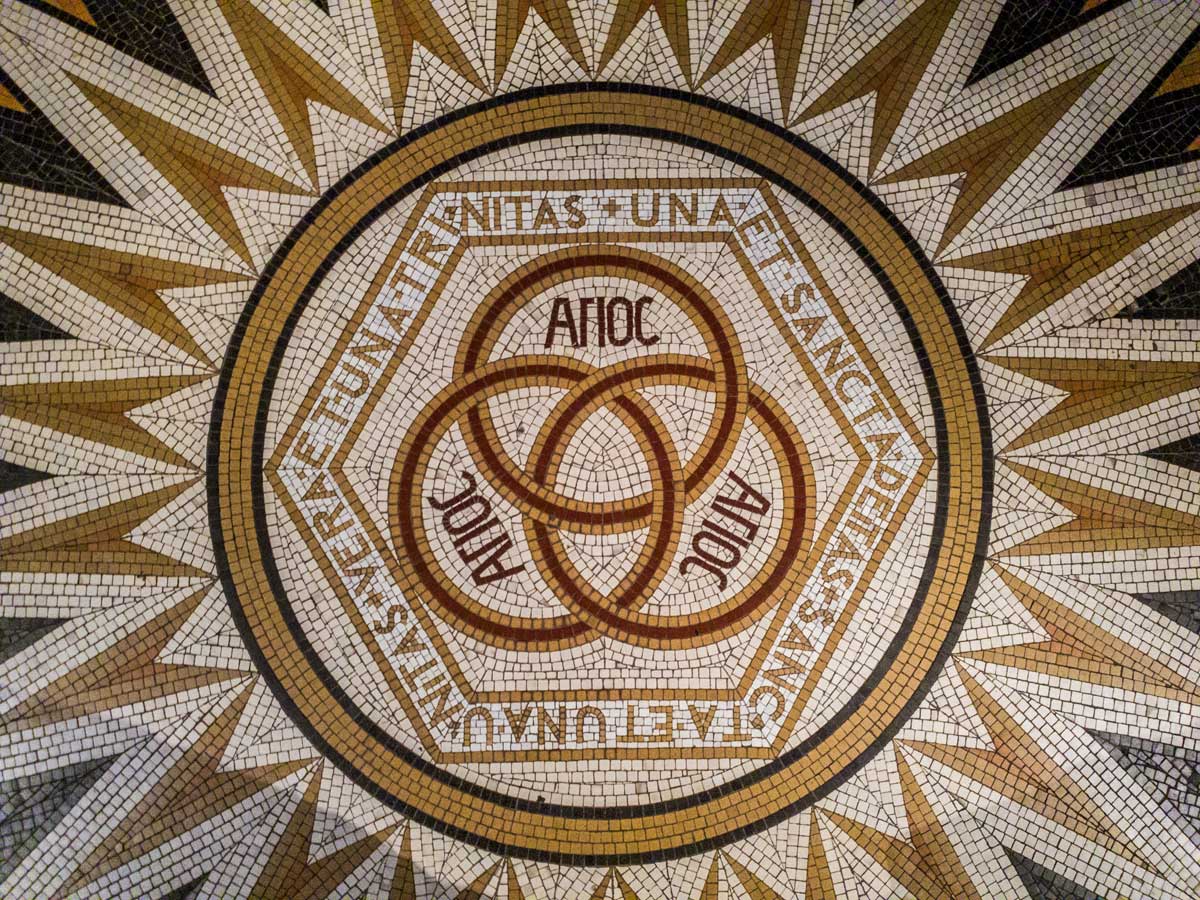
The most fundamental self-disclosure, or revelation, that God makes to man is that of his essentially Triune nature as three Persons—the Father, the Son, and the Holy Ghost. From this, too, Christians draw several immediate and fundamental conclusions. First, God as Being is essentially a complex and not a simple unity. He is not simple Being but Being-in-relation. To put it a bit differently, a person, as distinct from other entities, is by definition a being with capacities for consciousness and intelligence who exists in relation to other such beings. Personal relation is eternal and constitutive of God, and thus God is not reducible to an abstract, impersonal cosmic force. (Because God is uncreated and infinite, whereas man is created and finite, interpersonal relation exists within the one Being of the triune God, instead of between distinct creaturely beings.) Second, to be personal is to be particular and specific, not diffuse and generic. (The fundamental error of pantheism and panentheism is to deny the truly personal nature of God.)
Third, and especially important for the entire following argument, personal relations as particular and specific are ordered in nature. Personal relations have an essential, irreducible, and unalterable structure, pattern, purpose, meaning, and significance. The relations between the Father, the Son, and the Holy Ghost, and their actions as one God within the triune unity, are never random, accidental, arbitrary, insignificant, or interchangeable.
The revealed specific relations between the Father, the Son, and the Holy Ghost show us that those relations are simultaneously ones of equality and hierarchy. In contrast to assumptions in modern secular political and social thought, these two characteristics are not contradictory or mutually exclusive. Per the language of the Athanasian Creed, the Father, the Son, and the Holy Ghost are all equally God, sharing all the same essential attributes, and yet God is also one God, as a complex rather than a simple unity. The divinity of the Son and the Holy Ghost is not in any way inferior to that of the Father. And yet, within the one God, the Son is begotten of the Father, and the Holy Ghost proceeds from the Father through the Son. The Father is the arche, or foundational and originative principle (in a logical but not chronological sense), of the Trinitarian Persons and their relations. The Son is obedient and submissive to the Father; the Holy Ghost acts at the behest of the Father and the Son; and yet their interactive constitutive unity (perichoresis or "coinherence") is that of three equal Persons in perfect harmony of existence, thought, will, and action.
An analogy will illustrate this more clearly. Consider the ordered sequence of numerals 1, 2, 3, and so forth. The numeral 1 comes in sequence before the numeral 2, and 2 likewise before 3; and 2 and 3 are simple multiples of 1 and in that sense dependent on it. In sequence, 1 is thus superior to 2, and 2 to 3; but in quantity, 3 is greater than 2, and 2 greater than 1. And yet it would be absurd to say that 1 is somehow a "better" number than 2 because it comes first in sequence, or that 2 is a "better" number than 1 because it is double the quantity.
Equally important, the order is not interchangeable. Just as numerical order cannot be arbitrarily re-arranged to 3, 1, 2 or 2, 1, 3 or 2, 3, 1, or any other sequence, so likewise the Father cannot be begotten of the Son, and neither the Father nor the Son can proceed from the Holy Ghost. The same also applies to the constitutive elements of the order; just as 3 cannot be arbitrarily substituted for 2 or 1, or 2 substituted for 3 or 1, so likewise the Son cannot be interchanged with the Father or the Holy Ghost, or the Holy Ghost with the Father or the Son. Hierarchy and equality exist in perfect harmony.
James A. Altena is the associate editor of Fanfare magazine, a comprehensive bimonthly periodical for reviews of classical music recordings. He is a member of All Saints Episcopal Church in Wynnewood, Pennsylvania, and is pursuing a Ph.D. in church history at Westminster Theological Seminary in Glenside, Pennsylvania.
A Journal of Mere Christianity—Delivered to Your Door
- Essays on theology, culture, and the Church
- Contributors from across the Christian traditions

Six print issues (one year) of Touchstone, plus full online access and PDF downloads for only $39.95.

Get a one-year full-access subscription to the Touchstone online archives for only $19.95.
bulk subscriptions
Order Touchstone subscriptions in bulk and save $10 per sub! Each subscription includes 6 issues of Touchstone plus full online access to touchstonemag.com—including archives, videos, and pdf downloads of recent issues for only $29.95 each! Great for churches or study groups.
Transactions will be processed on a secure server.
more on ministry from the online archives

32.1—January/February 2019
Sex, Women's Ordination & the Rejection of Hierarchy & Equality by James A. Altena

more from the online archives

26.5—Sept/Oct 2013
The Perils of Pragmatism in Christian Attitudes Toward the Liberal Arts by Robin Phillips
29.1—Jan/Feb 2016
on Marriage, Moral Corruption & the Christian Duty of Witness by Regis Nicoll

calling all readers
Please Donate
"There are magazines worth reading but few worth saving . . . Touchstone is just such a magazine."
—Alice von Hildebrand
"Here we do not concede one square millimeter of territory to falsehood, folly, contemporary sentimentality, or fashion. We speak the truth, and let God be our judge. . . . Touchstone is the one committedly Christian conservative journal."
—Anthony Esolen, Touchstone senior editor
