The Problem of Pity by Joshua Hren

Feature

The Problem of Pity

Misguided Mercy & Dante's Infernal Purgation
by Joshua Hren

I, one man alone,
Prepared myself to face the double war
Of the journey and the pity.
—Dante, Inferno, Canto II

It is a pity that compassion has conquered our public conversations, our churches, and our hearts. (In this paper, I will at times use the words "compassion," "pity," and "mercy" as synonyms, even as I make necessary distinctions along the way.) Occasions for pity proliferate to the point that many of us experience what the protagonist of David Lodge's novel Therapy calls "compassion fatigue," which is "the idea that we get so much human suffering thrust in our faces everyday from the media that we've become sort of numbed, we've used up all our reserves of pity, anger, outrage, and can only think of the pain in our own knee." Alongside "compassion fatigue," others are plagued by misconstrued mercy, misplaced pity, and an abundance of attendant errors that are typically dignified by the claim that they are "pastoral."

The problem of pity brings to the fore our need to discriminate between poisonous pity and virtuous pity. Poisonous pity strives to persuade us that the emotional response that others elicit ought to be the lodestar of our ethical lives. Virtuous pity, or what Thomas Aquinas calls misericordia,is married to justice, regulated by reason, and structured by doctrine. Dante teaches us this necessary discrimination dramatically. In order to be cured of our pitiful plague of compassion, we must pass through The Inferno, putting ourselves under the tutelage of Virgil and Dante, and, more to the point, we must learn to measure our mercy against the just mercy of God.

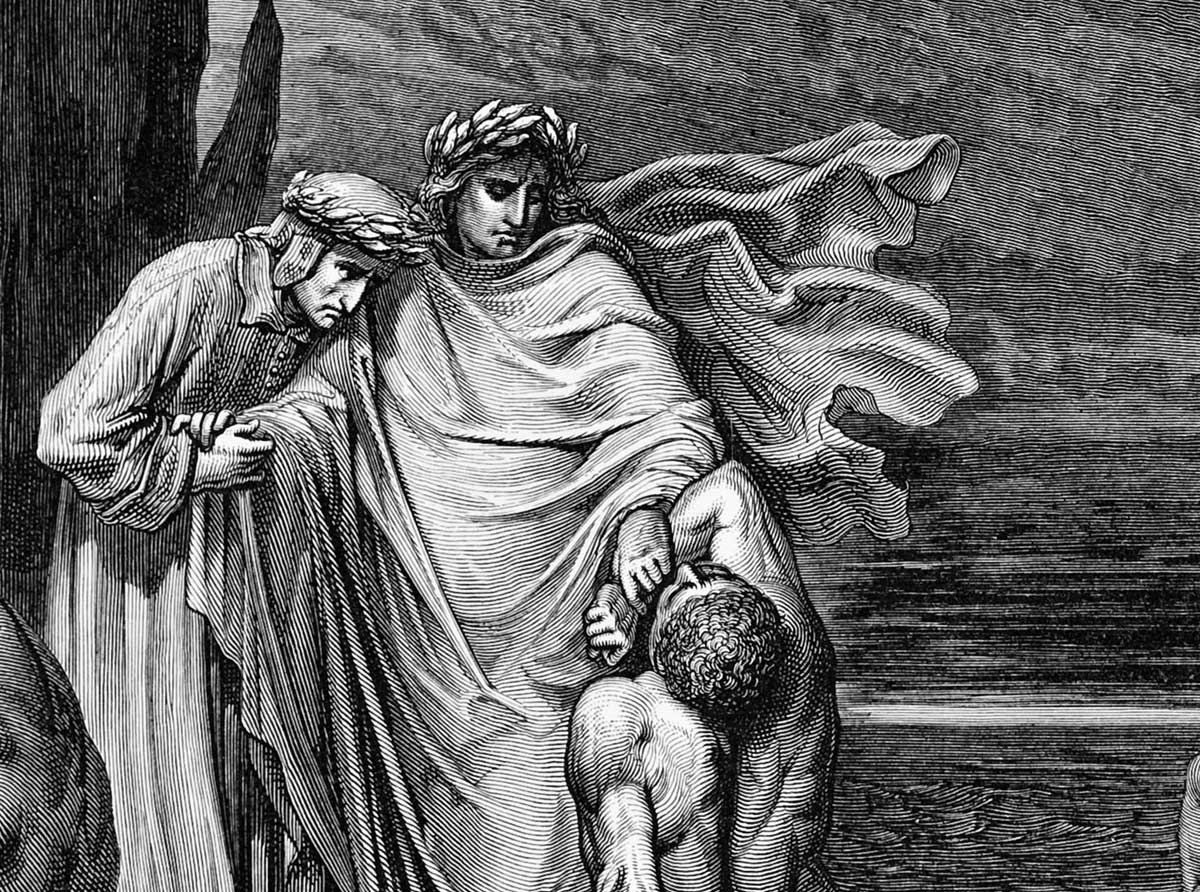
In Canto V of The Inferno, in the circle of the carnal, Dante meets the famed Paolo and Francesca; in consequence of their illicit affair, these lovers glide through Hell's whirl like grotesque mating doves. Seeing Dante, Francesca immediately recognizes his pity—and she pounces on it, telling her own "piteous tale." Anticipating his question as to how they ended up in the Inferno, she three times proclaims that love led them there. Having read the rhyme of Lancelot, she and Paolo, "alone with innocence and dim time," lost custody of their eyes until they could hardly read further, and "one soft passage overthrew" their caution and their hearts. As she tells this tale, "out of pity," she says, even though it will make her weep, Paolo stands by her side, himself crying "so piteously," Dante writes, that "I felt my senses reel / and faint away with anguish." He swoons, falling as a corpse might to Hell's floor.

As he begins his descent into the Inferno, Dante prepares himself "to face the double war / of the journey and pity." In other words, taking up the metaphor of war Dante himself gives us, pity is, in a certain sense, the enemy. As such, it would seem that our aim must be to conquer or banish it. However, as we will see, it is possible to win this war by pressing pity into the service of the highest faculties God has given us. But before we take a look at the way pity plays out in The Inferno, it will be necessary to parse out several of its types, its perils, and its conditional goodness.

Manent's Distinctions

In A World Beyond Politics? Catholic political philosopher Pierre Manent takes up the task of distinguishing between the different versions of humanism and humanitarianism, in large part to demonstrate their indebtedness to—and incompatibility with—Christian love of neighbor. Manent's aim is to unveil the paucity and fragility of modern humanism's moral foundations. For Jean-Jacques Rousseau, one of the fathers of this humanism, pity is a moral sentiment that is able to unify human beings in a world witnessing the death of the common good. Christian love, however, is never aimed at the neighbor in and of himself, but at the imago Dei that is found in every human being. Even Nietzsche, writes Manent, "though furiously anti-Christian, nonetheless says that to love the neighbor for the love of God is the most refined moral sentiment attained by human beings" (p. 188).

Manent helps us distinguish humanitarianism from Christian love in part through a linguistic analysis, for the foundation of humanitarianism is not agape (sacrificial love) or caritas (charity) as much as it is compassion, or pity, in the sense that Rousseau uses the word. For Rousseau, the capacity for pity is universal because all human beings have a body that is subject to the strong possibility of suffering; human beings are inevitably objects of suffering. Further, because of the universality of suffering, human beings will undoubtedly be subjects of suffering. "Physical suffering is immediately grasped or imagined," Manent writes. "One sympathizes with a toothache, a nervous colic, and two days without eating or drinking more easily than with a moral humiliation, an intellectual preoccupation, or a spiritual anguish" (189).

In sum, the physicality of pity, rooted as it is in the senses, allows us to "communicate immediately with the other, without the mediation of complex ideas. Pity can be relied on to bind people because it is a sentiment, an affect, or a disposition that does not demand any moral transformation or transcendence of self" (189).

The visible suffering of another says to me, "You, too, could undergo this," and therefore I make an effort to assuage his suffering. But, Manent notes, I do not in truth experience this suffering that I perceive so vividly: "I know well that I do not effectively experience it and so I rejoice that I am exempt from it. I experience the pleasure of not suffering. Therefore, there is nothing idealistic or utopian in pity as the foundation of social morality." As Manent maintains, altruistic pity is morally economical, demanding very little from mankind: "there is nothing in pity that is heroic, since its wellspring is the selfishness of each person. Rousseau was giving us the blueprint that has effectively prevailed in liberal democratic society" (190).


A Journal of Mere Christianity—Delivered to Your Door

  • Essays on theology, culture, and the Church
  • Contributors from across the Christian traditions

Subscribe (Print + Online)

Six print issues (one year) of Touchstone, plus full online access and PDF downloads for only $39.95.

Subscribe (Online Only)

Get a one-year full-access subscription to the Touchstone online archives for only $19.95.


bulk subscriptions

Order Touchstone subscriptions in bulk and save $10 per sub! Each subscription includes 6 issues of Touchstone plus full online access to touchstonemag.com—including archives, videos, and pdf downloads of recent issues for only $29.95 each! Great for churches or study groups.

Transactions will be processed on a secure server.


more on literature from the online archives
30.2—March/April 2017

Rescuing Cervantes

on Reading Don Quixote in Its Original Christian Context by Luis Cortest

35.6—Nov/Dec 2022

To Is or Not To Is

on E-Prime by J. Douglas Johnson

32.2—March/April 2019

The Problem of Pity

Misguided Mercy & Dante's Infernal Purgation by Joshua Hren


more from the online archives

31.4—July/August 2018

Mission or Submission?

The Difficulty of Apologetics for Dead Souls in the Real World by R. J. Snell

27.5—Sept/Oct 2014

The Hundred Years' War

The Culture of Death's Campaign Against the Catholic Church by Brantly Millegan

20.7—September 2007

Retaking Mars Hill

Paul Didn’t Build Bridges to Popular Culture by Russell D. Moore

calling all readers

Please Donate

"There are magazines worth reading but few worth saving . . . Touchstone is just such a magazine."
—Alice von Hildebrand

"Here we do not concede one square millimeter of territory to falsehood, folly, contemporary sentimentality, or fashion. We speak the truth, and let God be our judge. . . . Touchstone is the one committedly Christian conservative journal."
—Anthony Esolen, Touchstone senior editor

Support Touchstone

00