




A Thousand Words
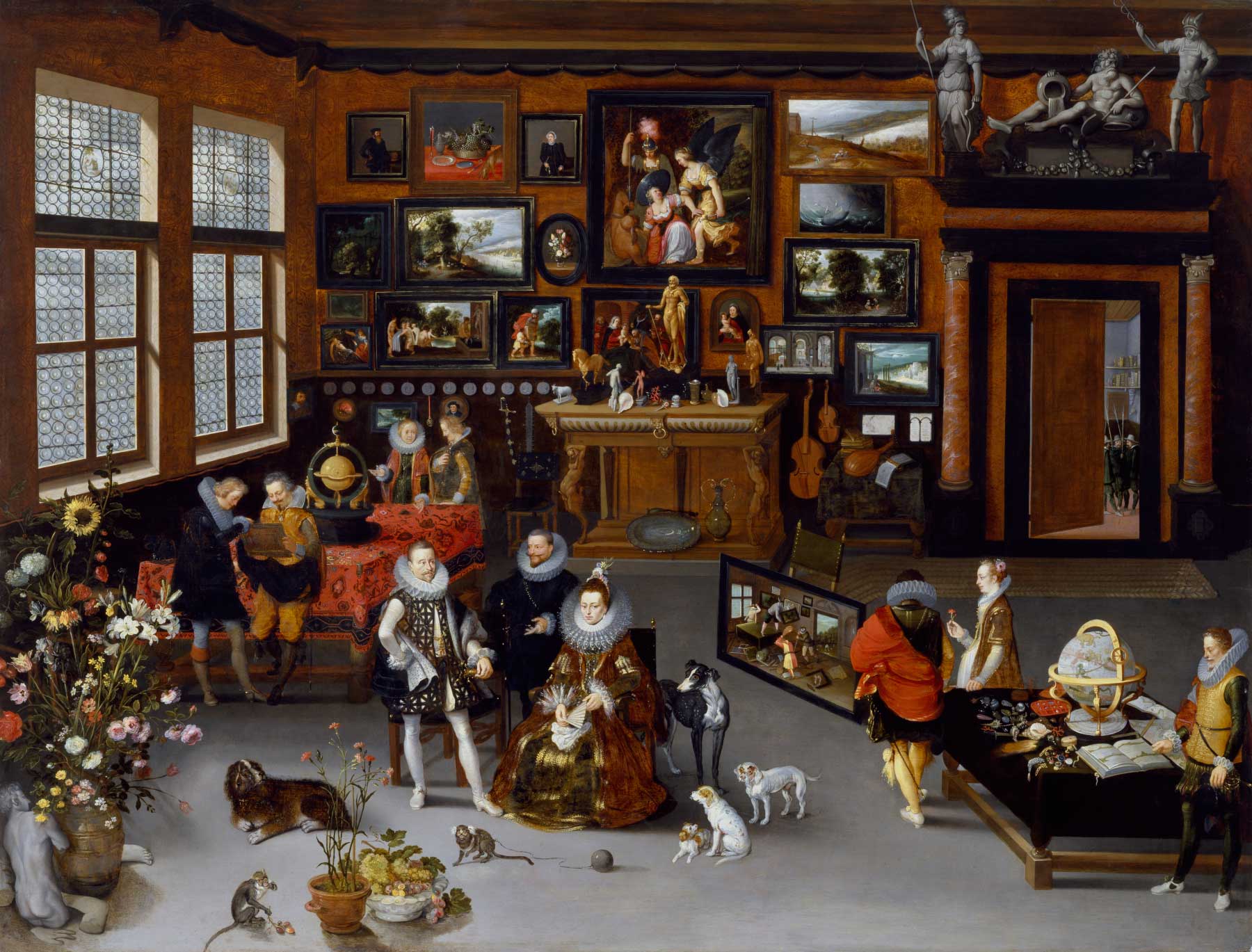
The Archdukes Albert and Isabella Visiting the Collection of Pierre Roose
by Hieronymus Francken II & Jan Brueghel the Elder
In this picture, painted in 1621–1623, the archdukes Albert and Isabella, the Hapsburg regents of the Southern Netherlands, have come to pay a visit to the collector Pierre Roose. More specifically, they have come to pay a visit to Roose's cabinet of curiosities. With the rise of bourgeois wealth and the mania for collecting and investing in art in the Low Countries, pictures like this became a minor specialty, and they often involved the collaboration of several artists. Not all of these paintings (in fact, very few) can be connected, as this one is, with a specific collector. Rather, such paintings often stood in for the actual assembly of such an encyclopedic collection: if you couldn't afford to build a collection yourself, you could at least have a painting that stood in for everything such an assembly implied.
For this painting is more than just a catalogue of Roose's holdings, or a pictorial guest book of an important visit; instead, the formation of such a collection and its organization carried a weight of (to us) hidden meaning. The encyclopedic collection of the seventeenth century was meant to represent the full scope of human knowledge, a rational, graspable reproduction of the world at large, a microcosm of the universe. The collection embraced art and science. In the ideal collection, Naturalia, viewed as the handiwork of creation and thus ultimately of God, were gathered from all the known seas and continents, as represented here by the map, the atlas, and the book of geography on the table at the right. The natural specimens themselves, flowers, plants, fruit, animals, a stuffed bird of paradise, seashells, coral, and mineral samples, range across the foreground from left to right.
Artificialia, works of man, fill the rest of this busy composition: paintings of every conceivable variety, sculpture, musical instruments, antiquities, and scientific instruments like clocks and watches, an astronomical globe, and a putative perpetual motion machine (on the table behind the Archduke. It turned out to be a form of barometer, moved by the invisible energy of air pressure.) Ethnographica, objects from exotic cultures, found their place among the artificialia too: the Persian carpet, for example, or the swords just visible to the left of the mantel. The decorative arts are here, too, in the form of glassware and ceramics; and architecture, in Giovanni Bologna's bronze personification, a seated woman crowned with a tiny city, on the mantel just to the left of the architectural painting. The sculptor, who mostly worked in Italy, was born in Flanders and may be tucked in here as a nod to local Flemish patriotic pride.
Steps to Acquiring Virtue
The painting is more than just a record—in fact, it is probably not a literal record at all—of Roose's collection. Among the benign Madonnas and painted landscapes are a disturbing number of scenes of explicit or implied violence: a shipwreck, a fiery conflagration, a biblical beheading and a thwarted infanticide, a classical Actaeon about to be dismembered, and in the middle ground, an allegory of iconoclasm in which an ass, a cat, and a monkey smash up musical and scientific instruments and works of art in a fit of unbridled rage.
But not all the passions are unfettered: in the foreground, the monkeys, symbols of our animal nature, are restrained by chains, and the sculptured satyrs flanking the mantel are held in check by the lintel they are forced to support. The vices, then, can be checked. On the rear wall hangs a tablet of the Ten Commandments, the first step in the redirection of the passions on the way to the acquisition of virtue.
To a seventeenth-century thinker, the next step on the way would have been the accumulation of knowledge, and from it, wisdom. And what was the purpose of the encyclopedic collection, if not to study the works of creation and the achievements of man? Particularly his achievements in the arts, which occupy pride of place in Mr. Roose's collection. Centered over the mantel hangs the monumental Allegory of Painting; in it, Pictura (Painting), wearing the mask of Imitation on her shoulder, is rescued from Ignorance by the goddess of wisdom, and helped to her feet by the figure of Fame. The painter is making a bold claim: without drawing and the visual arts, how could science advance out of ignorance? And what better way to instruct in the virtues than through the medium of painting? Pictura, he asserts, is the mainstay of both knowledge and virtue.
Princely Patronage & Good Governance
And so the archdukes enter the scene. The whole of the collection forms a frame for them and for the collector. The archdukes represent both princely virtue and patronage of the arts as a way station towards the achievement of public virtue. Over the doorway at the right rear, where the guardians of public order are waiting, sits a sculpted figure personifying the Scheldt, Antwerp's river, flanked by the goddess of wisdom and virtue, and Mercury, the god of eloquence (and also of commerce, Mr. Roose's worldly pursuit).
Under the good governance of the archdukes, then, Antwerp is seen to flourish and the virtues to thrive. At the far left, a fantastical bouquet of flowers is topped by a sunflower, a novelty newly imported from the New World, and a source of amazement in its ability always to turn its face to the sun. Here, however, it turns its face toward the trio in the middle, as if to say that, under their patronage, the arts, knowledge, wisdom, and virtue shall blossom and flourish.
Mary Elizabeth Podles is the retired curator of Renaissance and Baroque art at the Walters Art Museum in Baltimore, Maryland. She is the author of A Thousand Words: Reflections on Art and Christianity (St. James Press, 2023). She and her husband Leon, a Touchstone senior editor, have six children and live in Baltimore, Maryland. She is a contributing editor for Touchstone.
A Journal of Mere Christianity—Delivered to Your Door
- Essays on theology, culture, and the Church
- Contributors from across the Christian traditions

Six print issues (one year) of Touchstone, plus full online access and PDF downloads for only $39.95.

Get a one-year full-access subscription to the Touchstone online archives for only $19.95.
bulk subscriptions
Order Touchstone subscriptions in bulk and save $10 per sub! Each subscription includes 6 issues of Touchstone plus full online access to touchstonemag.com—including archives, videos, and pdf downloads of recent issues for only $29.95 each! Great for churches or study groups.
Transactions will be processed on a secure server.
more on art from the online archives
32.4—July/August 2019
on Single-Mindedness in Durer's Ritter, Tod, und Teufel by Anthony Costello
33.2—March/April 2020
An Architectural Sign of Mere Christianity by Michael Ward
more from the online archives

32.2—March/April 2019
Finding Him Again Through the Patriarchal Group by Anthony Esolen
33.2—March/April 2020
An Architectural Sign of Mere Christianity by Michael Ward
calling all readers
Please Donate
"There are magazines worth reading but few worth saving . . . Touchstone is just such a magazine."
—Alice von Hildebrand
"Here we do not concede one square millimeter of territory to falsehood, folly, contemporary sentimentality, or fashion. We speak the truth, and let God be our judge. . . . Touchstone is the one committedly Christian conservative journal."
—Anthony Esolen, Touchstone senior editor
