Pietro and Gianlorenzo Bernini's Fontana della Barcaccia by Mary Elizabeth Podles

A Thousand Words

Pietro and Gianlorenzo Bernini's Fontana della Barcaccia

by Mary Elizabeth Podles

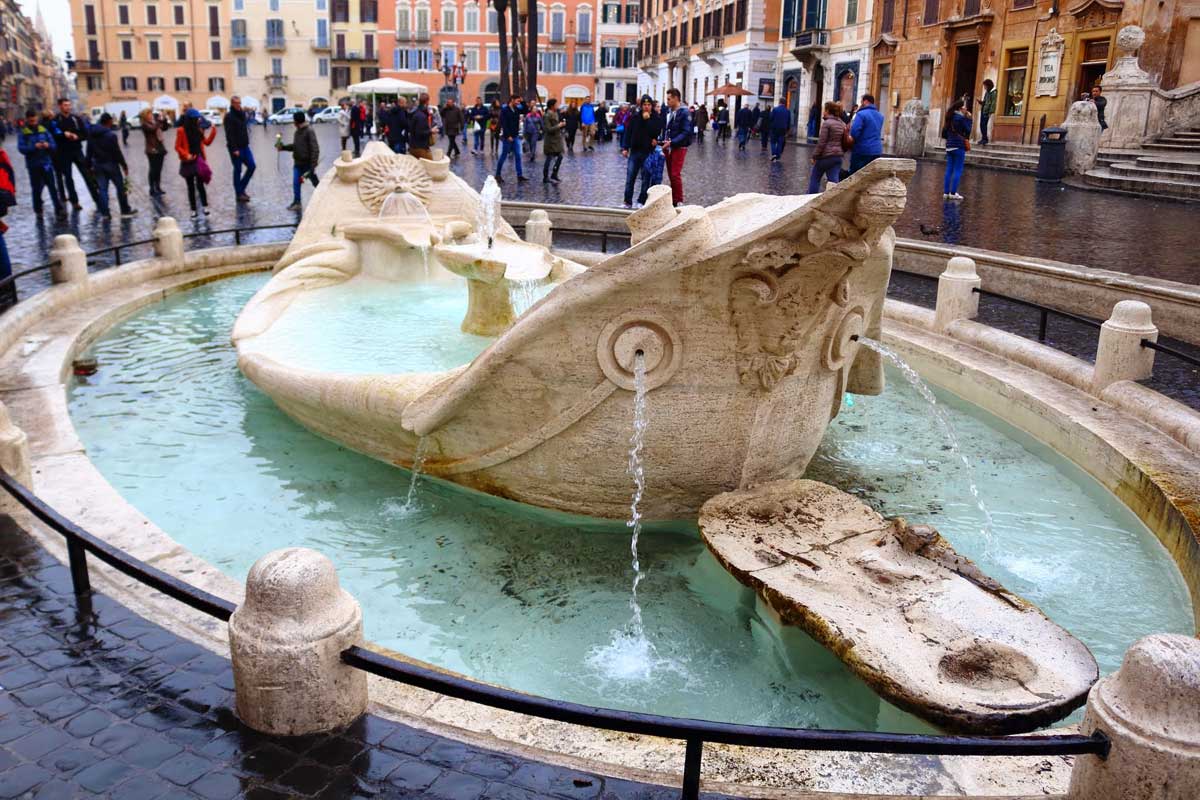
The Barcaccia fountain, at the foot of the Spanish Steps in Rome's Piazza di Spagna, is best known as a bustling urban meeting place for young people. It was not always this way. We would hardly recognize the city of Rome in the sixteenth century. In 1570, Pope Nicholas V conceived a plan to put a fountain of potable water in every open space in Rome. In 1598, a disastrous flood brought far too much water here from a nearby bend in the Tiber River; the waters rose so high that a cargo boat was beached at this spot. Thus was born the idea for the Barcaccia, literally the "Big Old Boat" fountain.

Continuing Nicholas's clean water initiative, in 1623 Pope Urban VIII undertook renovations to the Roman aqueduct called the Acqua Vergine. Originally built in 19 b.c., the aqueduct was repaired by Nicholas, and its range was extended by further renovations made under Urban. It feeds the Barcaccia, and, to this day, its waters are drinkable. Unfortunately, the Barcaccia's piazza is very near one of the aqueduct's distribution tanks, so that the water pressure is very low and rules out the more spectacular jets possible to fountains further downhill.

In 1627 Pope Urban awarded the commission for the fountain to Pietro Bernini (1562–1629) and probably his more famous son Gianlorenzo (1598–1680). They turned the site's disadvantages to imaginative gold. At the time, this site was an unpaved patch of open ground set against a wooded hillside. In place of the Spanish Steps, a twisting path threaded its way upward to a small church on the Pincian Hill. The neighborhood was an under-populated exurb of the once great ancient city; only with access to water could it begin to grow—and so it did.

The Berninis, then, conceived of the Barcaccia more as a garden ornament, curving and sculptural rather than urban and architectural. Ostensibly it commemorates the broad-beamed, shallow-draught cargo boat left here by the flood. Set in a below-ground basin, the boat is flooded to its gunwales and seriously leaking. Water spouts into it through the mouths of two sun masks, and outward into the basin over the edges of the boat and through its gun ports. The center jet, such as it is, suggests a mast, but one that is broken off close to the deck.

Unraveling the Symbolism

But a boat is seldom just a boat. There have been various efforts to unravel the Barcaccia's underlying symbolism. In a political age, some scholars make of it a blatant assertion of papal power and authority. Prow and stern are adorned with Urban VIII's papal arms. They incorporate his own family crest, the bees of the Barberinis, which in their turn represent sweetness and industry. Their prominent placement reminded the citizens of Rome who had brought them water: Urban VIII. Urban, who aggressively enlarged the Papal States through diplomacy and overt military action, was also a religious reformer and a poet of some stature. His Latin distich, which translates roughly,

The pontifical war machine does not spew forth flames,
But, to extinguish the fire of war, sweet water.

might read as a possible explanation of the design of the fountain. The Barcaccia might then be read as a metaphor for the Counter-Reformation under Pope Urban, quenching heresy and pacifying religious strife, bringing peace and plenty, sunlight and the waters of grace to a thirsty world.

Underlying such a politicized reading, however, is an implicit understanding of the Church as the Barque of Peter. From Early Christian times it served as a disguised symbol (the mast was secretly a cross), and the image persists throughout the writings of the Church Fathers. Peter, the first pope, holds the apostles and all of Christ's disciples in his boat, which carries us through the rough seas of our earthly pilgrimage. The barque is "swept by the waves," says St. Ambrose, "but it can never sink, because Christ is there." In the Middle Ages, the vaulting of a church's main body was built to resemble an upended ship, whence the nave, from the Latin navis, ship, which would carry the faithful from earth to heaven.

The Barcaccia, though, is not precisely a fishing boat like Peter's, but more closely resembles the cargo boats that carried wine from the seaports at the mouth of the Tiber upriver to Rome; to a contemporary audience, it might have signaled wine with all its freight of Christian symbolism. In his sculpture elsewhere, especially at St. Peter's, the younger Bernini frequently included the sun and its rays as a symbol of the divine light: here, it is water that pours from the sun faces into the boat.


Mary Elizabeth Podles is the retired curator of Renaissance and Baroque art at the Walters Art Museum in Baltimore, Maryland. She is the author of A Thousand Words: Reflections on Art and Christianity (St. James Press, 2023). She and her husband Leon, a Touchstone senior editor, have six children and live in Baltimore, Maryland. She is a contributing editor for Touchstone.

A Journal of Mere Christianity—Delivered to Your Door

  • Essays on theology, culture, and the Church
  • Contributors from across the Christian traditions

Subscribe (Print + Online)

Six print issues (one year) of Touchstone, plus full online access and PDF downloads for only $39.95.

Subscribe (Online Only)

Get a one-year full-access subscription to the Touchstone online archives for only $19.95.


bulk subscriptions

Order Touchstone subscriptions in bulk and save $10 per sub! Each subscription includes 6 issues of Touchstone plus full online access to touchstonemag.com—including archives, videos, and pdf downloads of recent issues for only $29.95 each! Great for churches or study groups.

Transactions will be processed on a secure server.


more on art from the online archives
30.3—May/June 2017

St. Luke the Evangelist

by Mary Elizabeth Podles

32.4—July/August 2019

Sojourner Knight

on Single-Mindedness in Durer's Ritter, Tod, und Teufel by Anthony Costello
33.2—March/April 2020

Christ Chapel at Hillsdale

An Architectural Sign of Mere Christianity by Michael Ward

more from the online archives
28.5—Sept/Oct 2015

Who's Your Teacher?

on Our Sacred Duty to Teach the Devil to Death by Marcus Johnson

10.4—Fall 1997

Lessons from the Nursery

The Catholic Imagination Encounters Bambi by James L. Sauer

11.5—September/October 1998

Speaking the Truths Only the Imagination May Grasp

An Essay on Myth & 'Real Life' by Stratford Caldecott

calling all readers

Please Donate

"There are magazines worth reading but few worth saving . . . Touchstone is just such a magazine."
—Alice von Hildebrand

"Here we do not concede one square millimeter of territory to falsehood, folly, contemporary sentimentality, or fashion. We speak the truth, and let God be our judge. . . . Touchstone is the one committedly Christian conservative journal."
—Anthony Esolen, Touchstone senior editor

Support Touchstone

00