View
Feral Sexuality
Anthony Esolen on the Inhuman Transformation of Transgenderism
Imagine that you are a time traveler, two hundred years in the future.
It is August, and beastly hot in this sinkhole of humidity that was once called Rome. Here and there you hear the bark of a feral dog, or the shouting and laughter of feral children. Ivy and nightshade creep up the sides of the buildings roundabout. Some of those buildings are two thousand years old. They are holding up better than those more recently built. In the old ones, marble facing crumbles away to reveal brick. In the new ones, brick facing crumbles away to reveal sticks and chalk and empty space.
You enter one of the older buildings, once a chapel. You have to clear away thickets of weed and scrub pine to do so. The stench of wetness, rat droppings, and mold almost makes you give it up. But eventually you get inside.
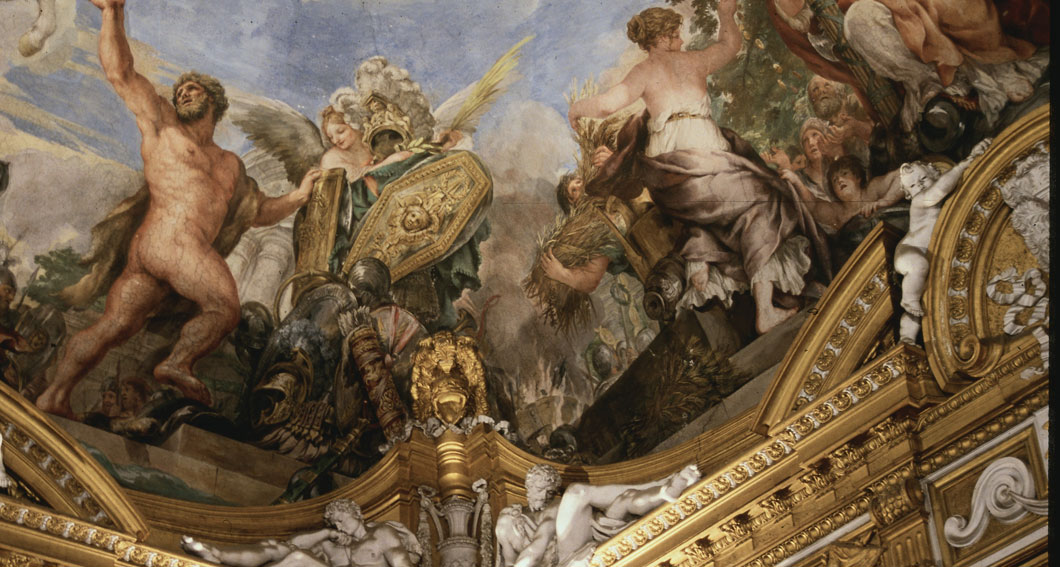
You look up at the ceiling. You had told yourself that you wouldn't, but you do. There you see the ruins of painted scenes that you can hardly identify, partly because nature has begun to reclaim them too, partly because you yourself are like a stranger in a strange land and do not understand the signs, and partly because they have been grotesquely vandalized with black and red spray paint.
How the boys did it, you have no idea. But it is so. The nude figures, colossal and noble, have been scrawled over with obscenities and foolishness. Adam, waiting for the finger of God to touch him to life, has been made over into a Priapus. So has Eve. Everywhere you turn, it is contempt, stupidity, and the darkened imagination of unhappy man: bodies mangled, exaggerated into cartoons of lust, made hideous; men that are not men, and women that are not women.
A pope long ago—and what was a pope, anyway?—said of these paintings that they offered a veritable theology of the body, of man made in the image of God, male and female, each sex to be made complete by the other. You cannot see it. You see parts, as of machines; holes and things that plug them up. Perhaps the people who made art like this were merely sentimental. For you can call upon nothing in your experience that would justify this reverence of the body, this sense that the sexes are beautiful, and that they long like Adam and Eve for the one who is like them but not like them, a mutual longing. If you believed in anything, you might shed a tear. You don't. But your eyes swim for a moment anyway.
What We Have Lost
What am I describing? Not something that might happen. It is something that has happened. We have lost what even fallen man used to know. We have lost a sense of the exalted beauty of each sex. I am not saying that people are no longer attracted to their spouses. I am saying that when it comes to this beauty that characterizes each sex in and of itself, we do not feel it. We must not feel it, because we do not talk about it; it inspires no art, no folk music, no sweet customs whereby we teach young people how to see it and appreciate it.
Picture in your mind a healthy boy of eight or nine years. He does not have the pallor of someone who has lived under fluorescent lamps all his life. His hair is cut in a boyish way, and it has that slight craziness about it that you get when the hair is a little thick and unruly. His shoulders are broad by comparison with his hips. He has what Marilynne Robinson happily called "skinny boy strength." He is a little man.
Now, what sort of hideous imagination could look at that boy and hope that one day his skull will be whittled down, his voice, already showing the signs of tenor and bass, will be thwarted by mechanical and pharmaceutical means, his body will be pumped up with carcinogens so that it will resemble a poor imitation of a girl, and his developing manhood will be lopped off, and his crotch eventually carved up and troweled out to provide a receptacle for seed that goes nowhere? It is a hideousness that might give Josef Mengele second thoughts.
Anthony Esolen is Distinguished Professor of Humanities at Thales College and the author of over 30 books, including Real Music: A Guide to the Timeless Hymns of the Church (Tan, with a CD), Out of the Ashes: Rebuilding American Culture (Regnery), and The Hundredfold: Songs for the Lord (Ignatius). He has also translated Dante’s Divine Comedy (Random House) and, with his wife Debra, publishes the web magazine Word and Song (anthonyesolen.substack.com). He is a senior editor of Touchstone.
A Journal of Mere Christianity—Delivered to Your Door
- Essays on theology, culture, and the Church
- Contributors from across the Christian traditions

Six print issues (one year) of Touchstone, plus full online access and PDF downloads for only $39.95.

Get a one-year full-access subscription to the Touchstone online archives for only $19.95.
bulk subscriptions
Order Touchstone subscriptions in bulk and save $10 per sub! Each subscription includes 6 issues of Touchstone plus full online access to touchstonemag.com—including archives, videos, and pdf downloads of recent issues for only $29.95 each! Great for churches or study groups.
Transactions will be processed on a secure server.
more on sex from the online archives

27.6—Nov/Dec 2014
Tales of Forbidden Stereotypes
Real-Life Men & Women & the Tragic Loss of Human Comedy by Anthony Esolen
more from the online archives
calling all readers
Please Donate
"There are magazines worth reading but few worth saving . . . Touchstone is just such a magazine."
—Alice von Hildebrand
"Here we do not concede one square millimeter of territory to falsehood, folly, contemporary sentimentality, or fashion. We speak the truth, and let God be our judge. . . . Touchstone is the one committedly Christian conservative journal."
—Anthony Esolen, Touchstone senior editor