Henry Ossawa Tanner's Annunciation by Mary Elizabeth Podles

A Thousand Words

Henry Ossawa Tanner's Annunciation

by Mary Elizabeth Podles

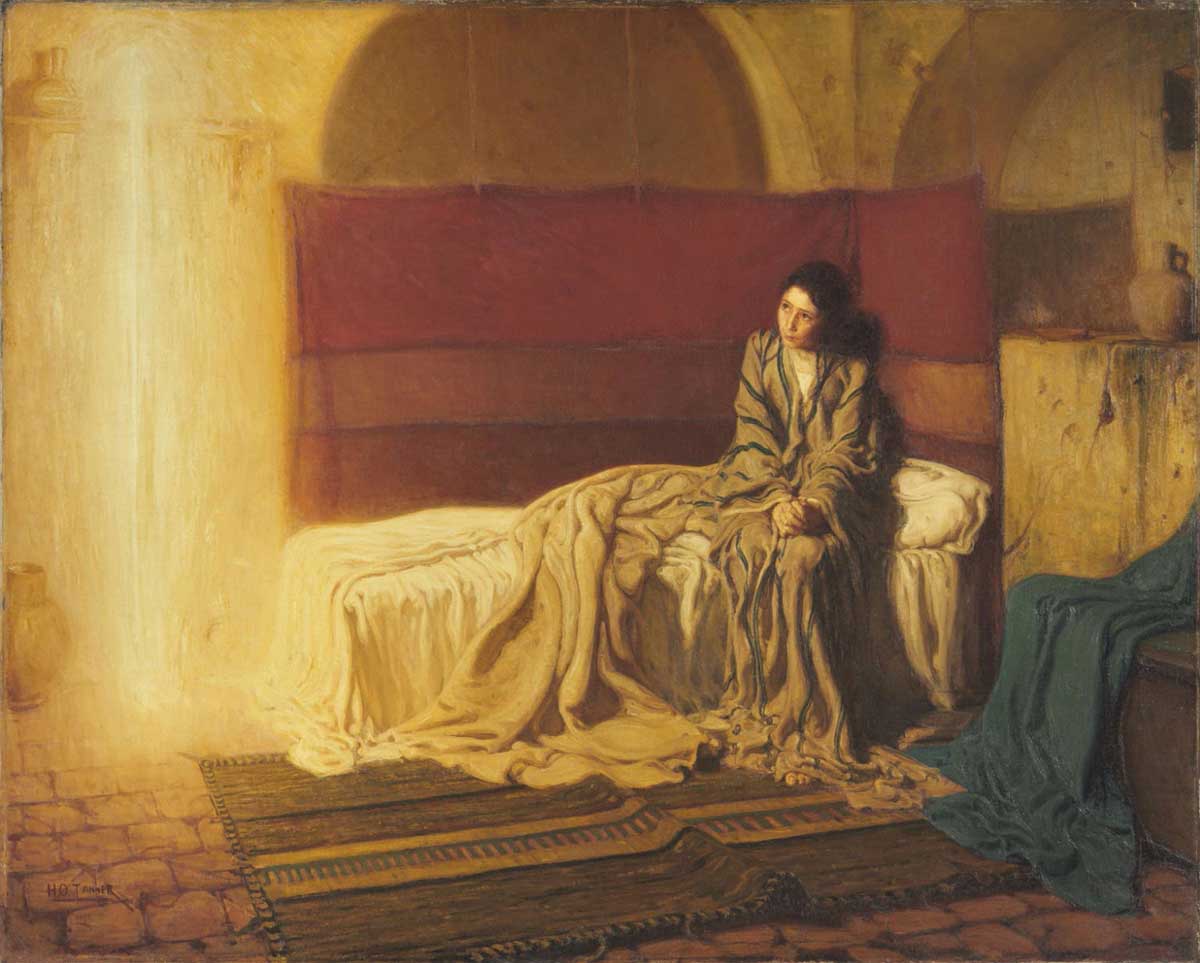
This is no conventional Annunciation, with a winged, white-nightied angel and richly robed, serene Madonna. Instead, Henry Ossawa Tanner (1859–1937) gives us a frowning, barefoot Middle Eastern teenager and a shaft of brilliant light, a startling innovation but an image no less profound than any traditional version of the same subject. A most unusual composition, it was brought about by an extraordinary confluence of events and persons.

The Artist

Of central interest is the painter, Henry Ossawa Tanner. He was the son of a bishop in the AME (African Methodist Episcopal) Church, and showed an early interest in and talent for art. His father, wishing to discourage Henry from a difficult career, set him to work in a flourmill; Henry, however, was asthmatic, and the job was not a congenial fit. He persevered in his study of art and enrolled in the Pennsylvania Academy of the Fine Arts in 1879, as its only African-American student.

At the school, Henry worked closely with the modern Realist Thomas Eakins (who painted Tanner's portrait—see Figure 2). There, he received a thorough academic grounding and acquaintance with the Old Masters, particularly with Rembrandt, whose warm palette, thickly impastoed surfaces, strong lighting effects, and concentration on the inner states of his biblical subjects all influenced the Annunciation. At the same time, Eakins urged his students to shrug off old Academic practices and to study anatomy and paint from live models. Tanner left school before graduating and mounted a one-man exhibition at the AME Board of Education in Cincinnati; unfortunately, none of his paintings sold. But Bishop Joseph Crane Hartzell, recognizing Tanner's talent, bought all the paintings and enabled the young artist to travel to Paris, to see the Old Master paintings in the Louvre, and to enroll in the Académie Julian.

The Académie was a hub for forward-thinking artists. There, Tanner came into contact with Impressionists, Post-Impressionists, Symbolists, and Orientalists, and drew from them new concepts of color and abstraction, new insights into the representation of mystical and spiritual experience, and a taste for exotic settings. All the while, he continued to paint biblical scenes, for, as he explained, "I preach with my brush." His preaching led to further success: upon viewing Tanner's Rembrantesque Raising of Lazarus in 1896, the critic Rodman Wanamaker paid for a trip to the Holy Land so that Tanner might make his religious paintings more true to life.

The results are evident in the Annunciation (Figure 1) painted in the following year.

The Painting

A look at the preliminary sketch (see Figure 3), measuring little more than 8.5 by 11 inches, shows Tanner's first conception of the composition. From the start, Tanner set the scene in an actual Palestinian house, with thick whitewashed walls, high arches and striped rugs, jugs and a candlestick, and a simple bed in a corner, all of which he had seen in the Middle East. In the final large canvas (57 by 71.25 inches), they are all there, but transformed. The patterns of the rugs are simplified and abstracted, and their colors heightened in Post-Impressionist fashion, to focus attention on the two figures. The red rug hanging behind Mary now functions like a modern version of the Madonna's traditional cloth of honor, and with the blue rug draped on the right frames her in her traditional colors. The angelic light turns her rumpled bedclothes to cloth of gold, recalling the Psalm phrase applied to Mary, "the king's daughter arrayed in gold." The jugs might refer to the Marian praises "vessel of honor" and "singular vessel of devotion," though it has been suggested that the three might signal the presence of the Trinity.

At the far right, a candle burns on the ledge, though its light is dim compared to the angel's. In traditional representations of the Annunciation, the candle is just extinguished and still smoking: the lesser light goes out as the greater light enters the world at the Incarnation. In Tanner's version, we have perhaps not reached that point. In the sketch, Mary seems to be seated calmly with her head turned slightly away from the angel, but in the finished painting, she is posed more tensely and looks intently toward the light. Following Eakins's mandate, Tanner painted from a live model, the singer Jessie Olsson. Presumably her operatic training had taught her the dramatic body language and facial expression necessary to enter effectively into the role of Mary; she certainly had an effect on the artist. They were married in the following year.

Her expression is key to our understanding of the painting. She leans forward, serious, intelligent, intent: this is perhaps the Mary who questions, "How can this be?" We know from Luke's Gospel that the angel has told her, "He will be great, and will be called the Son of the Most High," but Tanner has filled in more of the story for us via his representation of the angel Gabriel. The angel is most significantly changed from the early sketch, where it appeared as a translucent human figure, with head and arms suggested by the simplest of paint strokes. In the large canvas the angel is dramatically transformed into a shaft of pure light illuminating the whole scene in the glow of pure spirit breaking into the earthly realm.


Mary Elizabeth Podles is the retired curator of Renaissance and Baroque art at the Walters Art Museum in Baltimore, Maryland. She is the author of A Thousand Words: Reflections on Art and Christianity (St. James Press, 2023). She and her husband Leon, a Touchstone senior editor, have six children and live in Baltimore, Maryland. She is a contributing editor for Touchstone.

A Journal of Mere Christianity—Delivered to Your Door

  • Essays on theology, culture, and the Church
  • Contributors from across the Christian traditions

Subscribe (Print + Online)

Six print issues (one year) of Touchstone, plus full online access and PDF downloads for only $39.95.

Subscribe (Online Only)

Get a one-year full-access subscription to the Touchstone online archives for only $19.95.


bulk subscriptions

Order Touchstone subscriptions in bulk and save $10 per sub! Each subscription includes 6 issues of Touchstone plus full online access to touchstonemag.com—including archives, videos, and pdf downloads of recent issues for only $29.95 each! Great for churches or study groups.

Transactions will be processed on a secure server.


more on art from the online archives
33.2—March/April 2020

Christ Chapel at Hillsdale

An Architectural Sign of Mere Christianity by Michael Ward

32.4—July/August 2019

Sojourner Knight

on Single-Mindedness in Durer's Ritter, Tod, und Teufel by Anthony Costello
30.3—May/June 2017

St. Luke the Evangelist

by Mary Elizabeth Podles


more from the online archives

25.6—Nov/Dec 2012

Clashing Symbols

The Loss of Aristotelian Logic & the Social, Moral & Sexual Consequences by Peter Kreeft

31.1—January/February 2018

Vikings Under the Son

on Ragnarök, an Extreme Weather Event & the Paths to Conversion by Timothy J. Burbery

18.6—Nov/Dec 2005

Lesson Plan

on Fifteen Principles of Christian Parenting by Paige Patterson

calling all readers

Please Donate

"There are magazines worth reading but few worth saving . . . Touchstone is just such a magazine."
—Alice von Hildebrand

"Here we do not concede one square millimeter of territory to falsehood, folly, contemporary sentimentality, or fashion. We speak the truth, and let God be our judge. . . . Touchstone is the one committedly Christian conservative journal."
—Anthony Esolen, Touchstone senior editor

Support Touchstone

00