




View
Tragedy & Transcendence
Patrick Henry Reardon on Futility & the Open Door to Deliverance
Although no period of history ever provided as much raw tragedy as the past hundred years, relatively few works have translated that experience into adequate literature and drama. When we consider the bloodshed and starvation of the Russian, Spanish, and Chinese revolutions; the two world wars; the atomic bomb; and the wholesale torture and slaughter of targeted ethnic groups in Europe, Africa, and the Far East, is it unreasonable to crave a modern equivalent of The Trojan Women or The Book of Job? Why settle for The Death of a Salesman and Waiting for Godot?
This inadequate literary and artistic expression does not surprise us, however, because the very idea of tragedy presupposes the transcendence of the human soul, a transcendence systematically doubted during the century just before that fatal shot was fired in Sarajevo. If there is no God and no transcendent soul—if the universe is a closed system—if everything can be explained by natural causes, there really can be no such thing as "tragedy." Indeed, wrote George Steiner,
a tragedy without God, a tragedy of pure immanence, is a self-contradiction. Genuine tragedy is inseparable from the mystery of injustice, from the conviction that man is a precarious guest in a world where forces of unreason have dark governance (Language and Silence, 391).
Life as a Battlefield
The ancient Greeks observed that however slight the flaw in the fabric of a human life, implacable tragodia seemed ever to spy it out and rip that life to shreds.
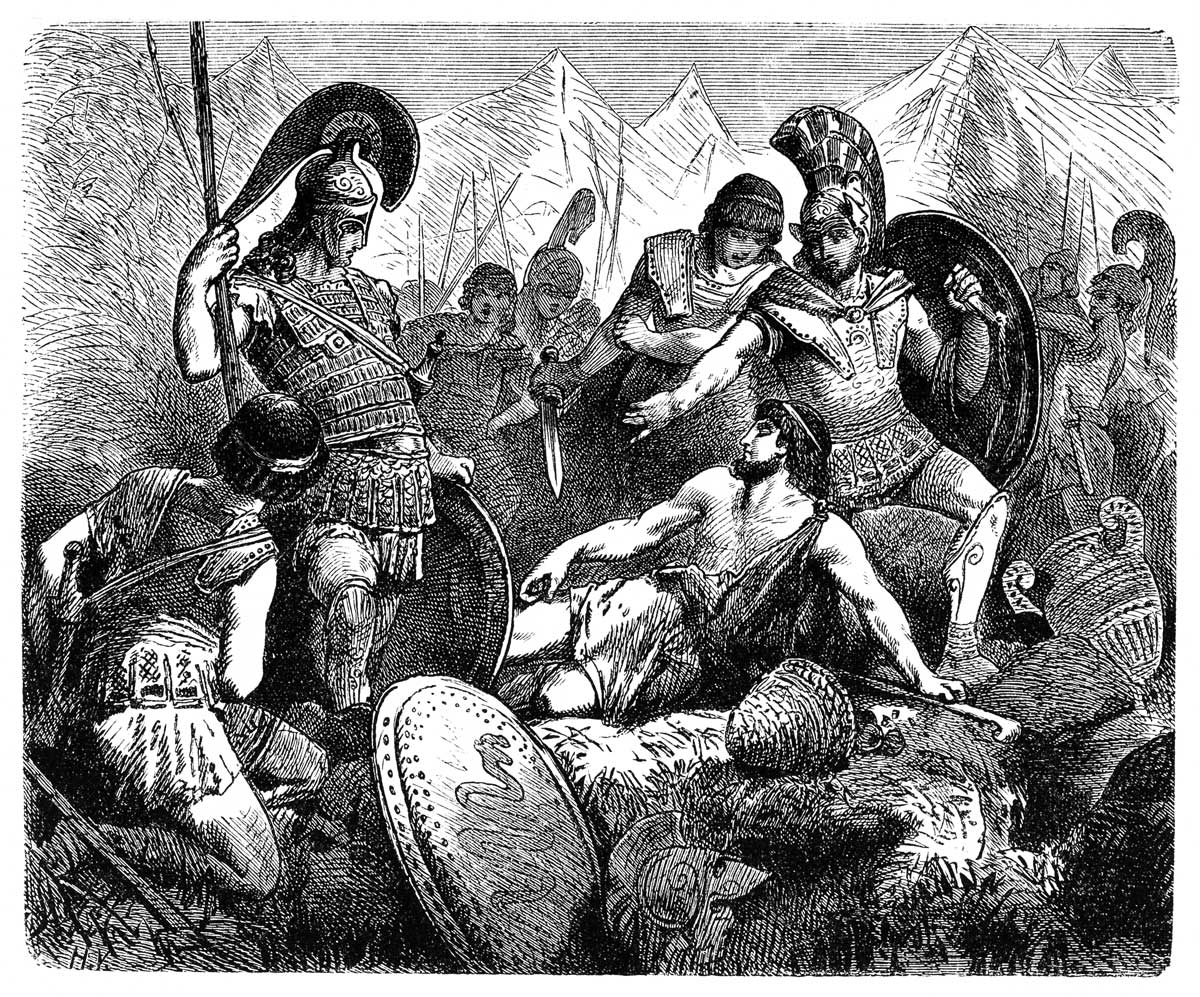
Thus, the hero Theseus, returning to Athens after slaying the Minotaur on Crete, neglected to alter his ship's sail from black to white, the color that his father Aegeus had instructed him to hoist, on his return, to signify his victory. When Aegeus, waiting on the shore, beheld instead the black sail atop his son's returning ship, he rashly presumed that Theseus had perished, and not waiting for confirmation of the matter, he flung himself in despair from a high precipice and was dashed to death on the rocks below. So Theseus, though triumphant over the menacing Minotaur, returned only to find that a more formidable and relentless foe, impossible either to envision or to resist, had turned his brief joy into lasting sadness (Plutarch, Lives, "Theseus," 22). The impetuosity of his father had conspired with his own slight and momentary inattention to devour the substance of his hope.
But even without the dramatic pangs of tragedy, the Greeks realized, life in this world was usually hard, very often a struggle, even a kind of combat. Young people needed to learn this lesson early, a need that explains why Homer's Iliad, which portrays life as a battlefield, served as an essential text of classical Greek education. The truer and deeper warfare portrayed in the Iliad, after all, is the struggle to excel, to be virtuous, aristevein (Iliad 6.208; 11.784).
Classical paganism's greatest moral effort to deal with the toughness of life, including its tragic sense, was the philosophy known as Stoicism. The Stoic, realizing that most events in life—virtually all things outside himself— lay beyond his ability to control, resolved to bring discipline and serenity into his soul by putting aside his passions, bridling the reckless ambitions of his mind and will, and striving for inner freedom. One of the more notable Stoics, Epictetus, remarked that it was solely by abandoning the desire to master things outside himself that a man could gain a mastery within. Only this inner mastery could mitigate the trials and misfortunes attendant on life.
The Key to Deliverance
The true reason for tragedy is found in St. Paul's assertion, "creation was subjected to futility" (Rom. 8:20). Holy Scripture, tracing all evil in the world, including especially death, to man's infidelity to God, normally uses the experience of evil as the occasion for calling man to repentance. This theme appears repeatedly in the Bible's historical and prophetic books. Job and Qoheleth, along with some of the Psalms, do include speculation about the structure of tragedy, but this line of thought remains exceptional in Holy Scripture.
Patrick Henry Reardon is pastor emeritus of All Saints Antiochian Orthodox Church in Chicago, Illinois, and the author of numerous books, including, most recently, Out of Step with God: Orthodox Christian Reflections on the Book of Numbers (Ancient Faith Publishing, 2019).
A Journal of Mere Christianity—Delivered to Your Door
- Essays on theology, culture, and the Church
- Contributors from across the Christian traditions

Six print issues (one year) of Touchstone, plus full online access and PDF downloads for only $39.95.

Get a one-year full-access subscription to the Touchstone online archives for only $19.95.
bulk subscriptions
Order Touchstone subscriptions in bulk and save $10 per sub! Each subscription includes 6 issues of Touchstone plus full online access to touchstonemag.com—including archives, videos, and pdf downloads of recent issues for only $29.95 each! Great for churches or study groups.
Transactions will be processed on a secure server.
more on theology from the online archives
31.6—November/December 2018
on Futility & the Open Door to Deliverance by Patrick Henry Reardon
33.2—March/April 2020
on How Bodily Resurrection Informs Social Justice by W. Ross Blackburn

31.4—July/August 2018
Life & Love Are Real Despite Theatrical Illusions by Anthony Esolen
more from the online archives

32.4—July/August 2019
on Probability, Death & the Existence of God by Graeme Hunter

27.5—Sept/Oct 2014
on Growing Vegetables as a Primer in Moral Philosophy by Rachel Lu

calling all readers
Please Donate
"There are magazines worth reading but few worth saving . . . Touchstone is just such a magazine."
—Alice von Hildebrand
"Here we do not concede one square millimeter of territory to falsehood, folly, contemporary sentimentality, or fashion. We speak the truth, and let God be our judge. . . . Touchstone is the one committedly Christian conservative journal."
—Anthony Esolen, Touchstone senior editor
