



A Thousand Words
The Chalice of Abbot Suger
by Mary Elizabeth Podles
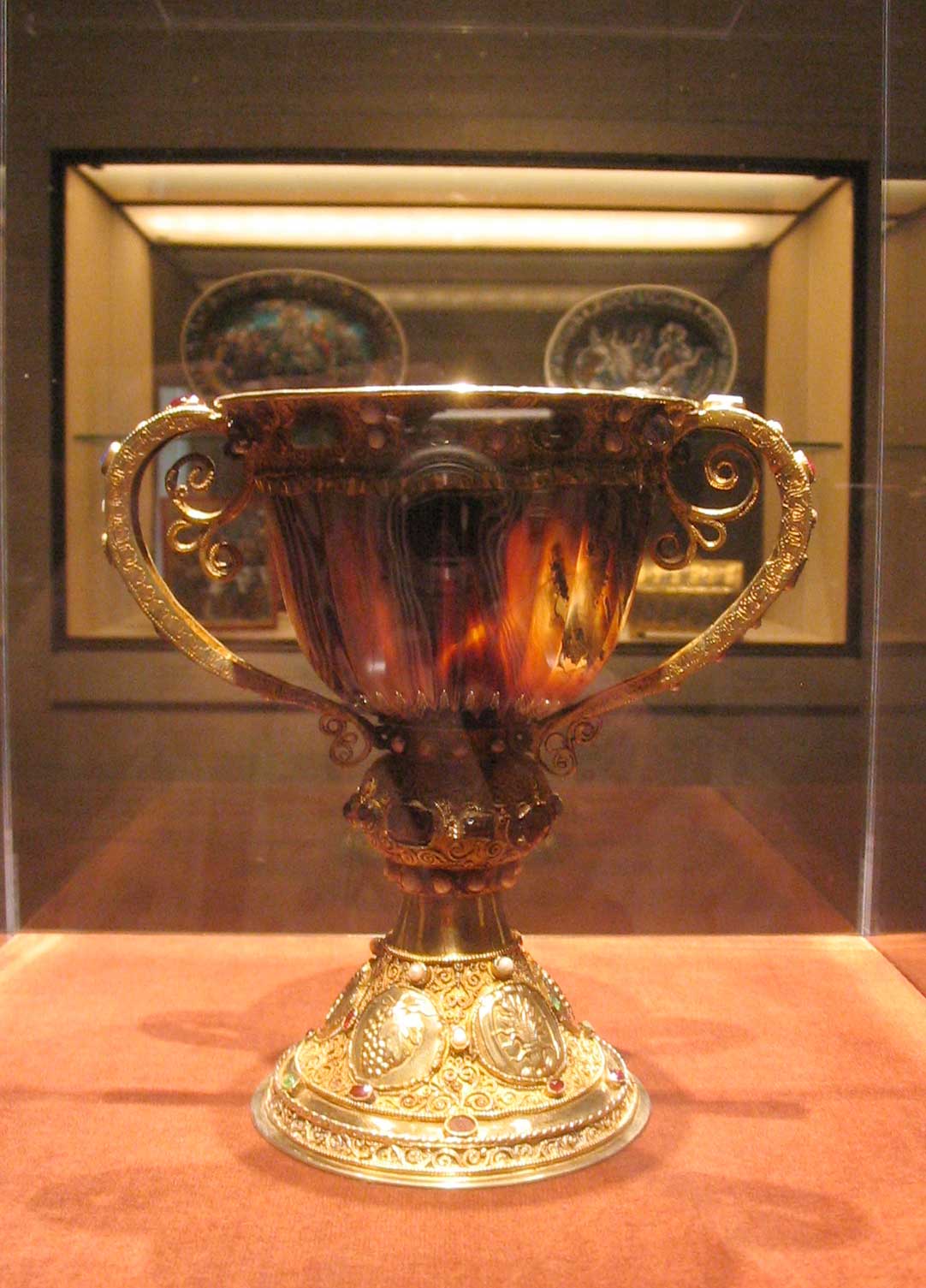
The Chalice of Abbot Suger was made in two parts, a sardonyx cup at the center, mounted in a heavily gilded and bejeweled rim and attached to a jeweled knob and base by a pair of curving handles. It is inscribed, "Suger Abbas": even without such an object to his credit, the Abbot Suger is worthy of attention in any history of art. The sardonyx cup at the heart of the chalice is cut from a single piece of semi-precious stone, carved thin enough to be translucent. The inside is smooth, but the outside is fluted to make a rippled effect of the veins of red and white that run through the stone.
By the twelfth century, when Suger set it within the chalice, the cup was already over a thousand years old. It is probably Egyptian workmanship of the second to first century b.c., and how it made its way to Paris no one knows. Some suggest that a naïve Suger might have thought a cup of such antiquity to be the Holy Grail, and indeed its photo graces a dreadful potboiler called The Grail Mysteries. But Suger was a man of great sophistication, and was no doubt self-consciously following the practice of the Byzantine emperors who collected and repurposed the treasures of Antiquity for Christian ends. The Byzantine connection is reinforced by the figure of Christ Pantocrator in the one remaining original medallion on the base (but it also bears the Western Alpha and Omega). The abbot, not a modest man, also used to ask travelers how they thought his abbey church, St. Denis, compared to Hagia Sophia.
The Gothic Style Is Born
The heavily gilded silver mountings are not exactly as they were in Suger's day. The chalice was in use at St. Denis for over six hundred years; then came the French Revolution and a tale of theft, smuggling, and illicit sale. Technical examination in the lab and a little detective work reveal the changes occurring over the centuries, but by and large the chalice is much as it was when it made its first appearance.
That first appearance was presumably at the consecration Mass for the newly rebuilt ambulatory and apse of the church of St. Denis, patron saint of France, in 1144. The guest list included King Henry VII and Eleanor of Aqui-taine, and eighteen bishops and archbishops, including the Archbishop of Canterbury.
For the new structure, Suger had employed (unnamed) architects who combined several building features to achieve a startling new effect. First, a vault structure permitted sturdy stone ribs to carry the weight of the roof outward and down, so that the wall between ribs, no longer load-bearing, could be thinner and be pierced by larger windows. Second, the pointed arch, probably of Arabic origin, allowed for greater height and still larger windows. Furthermore, instead of building a series of separate chapels in the Romanesque fashion, Suger used the new construction methods to create a single, light-filled space surrounding and illuminating the altar. Thus was born the Gothic style.
Light & Beauty
Think now of Suger's chalice in this new context. While photographs do not technically lie, modern museum lighting can be deceptive. When the chalice is lit from above, as it would have been at St. Denis, the central cup becomes translucent and glows with a fiery golden-red light, seemingly of its own.
At the Elevation it must have been sublime. Suger, in his writings, formulates a philosophy that combines the mystical experience with the Neo-Platonists' metaphysics of light and theories of beauty: for Suger, opulent and beautiful objects were appropriate to the honor of God in the liturgy. Moreover, the beautiful, as one of the transcendental qualities of the Godhead, elevates the mind and heart to the contemplation of the divine light.
The Abbot lived in interesting times. His philosophy, and his extravagance, drew down the wrath of the ascetical St. Bernard of Clairvaux. "O vanities of vanities," wrote Bernard, "What is gold doing in a sanctuary? . . . We know that the bishops . . . use material beauty to cause the devotion of a carnal people because they cannot do so by spiritual means." Suger, to our benefit, elaborated his arguments, and bitter words were exchanged. Eventually the two reconciled, and after hearing of Suger's death, Bernard wrote, "If there is a precious vase adorning the palace of the King of Kings, it is the soul of the venerable Suger."
Mary Elizabeth Podles is the retired curator of Renaissance and Baroque art at the Walters Art Museum in Baltimore, Maryland. She is the author of A Thousand Words: Reflections on Art and Christianity (St. James Press, 2023). She and her husband Leon, a Touchstone senior editor, have six children and live in Baltimore, Maryland. She is a contributing editor for Touchstone.
A Journal of Mere Christianity—Delivered to Your Door
- Essays on theology, culture, and the Church
- Contributors from across the Christian traditions
Six print issues (one year) of Touchstone, plus full online access and PDF downloads for only $39.95.
Get a one-year full-access subscription to the Touchstone online archives for only $19.95.
bulk subscriptions
Order Touchstone subscriptions in bulk and save $10 per sub! Each subscription includes 6 issues of Touchstone plus full online access to touchstonemag.com—including archives, videos, and pdf downloads of recent issues for only $29.95 each! Great for churches or study groups.
Transactions will be processed on a secure server.
more on art from the online archives

32.4—July/August 2019
on Single-Mindedness in Durer's Ritter, Tod, und Teufel by Anthony Costello
33.2—March/April 2020
An Architectural Sign of Mere Christianity by Michael Ward
more from the online archives
20.4—May 2007
A Short & Surprising History of Protestantism & Contraception by Allan C. Carlson

30.6—Nov/Dec 2017
on C. S. Lewis, Brideshead Revisited & the Middle Things by Ben Reinhard

18.10—December 2005
on an Apostle’s Encounter with the Son’s Children by Anthony Esolen
calling all readers
Please Donate
"There are magazines worth reading but few worth saving . . . Touchstone is just such a magazine."
—Alice von Hildebrand
"Here we do not concede one square millimeter of territory to falsehood, folly, contemporary sentimentality, or fashion. We speak the truth, and let God be our judge. . . . Touchstone is the one committedly Christian conservative journal."
—Anthony Esolen, Touchstone senior editor