The Votive Crown of King Recceswinth by Mary Elizabeth Podles

A Thousand Words

The Votive Crown of King Recceswinth

by Mary Elizabeth Podles

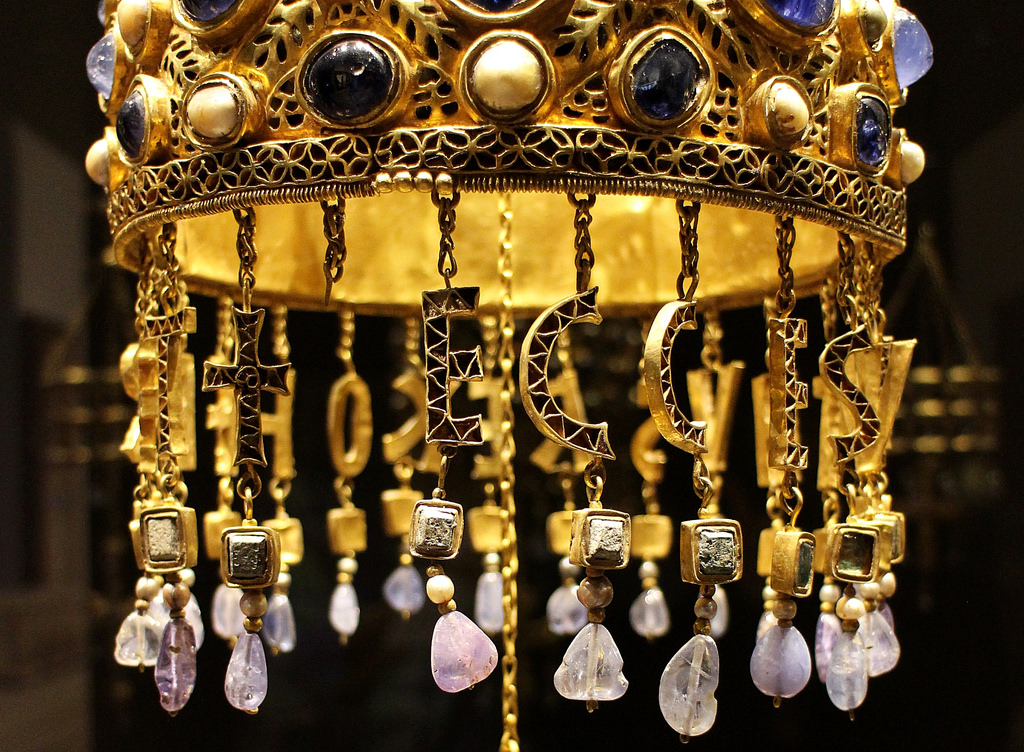
This extraordinarily costly and elegant object is the Crown of Recceswinth, King of the Visigoths in seventh-century Spain. The main body of the piece is a circular diadem of thirty sapphires and thirty pearls from the Far East set in golden filigree; it hangs from a rock crystal finial via openwork, heart-shaped links, and from it are suspended garnet-inlaid pendants spelling out “RECCESVINTHUS REX OFFERET” (“Recceswinth the King offered [this]”). Underneath it hangs a golden cross, also inlaid and hung with jewels. In view of such a splendid object, it is clear that we need to revise our understanding of the terms “Dark Ages” and “barbaric”; there is nothing dark, crude, or primitive about Recceswinth’s crown.

The Visigoths

A little review of Recceswinth’s history might be in order for those of us who have forgotten the details. The Visigoths were a migratory people who settled in Romania and parts of Ukraine around the third century. By the fourth century, contact with the Eastern Roman Empire led to the Visigoths adopting Arian Christianity. Their continued westward migration brought them into an uneasy relationship with the remains of the Western Empire, ending in 410 with Alaric’s unfortunate sacking of the city of Rome. From there, the Visigoths moved on to southwestern Gaul (now France), until they in turn were pushed out by the Franks. They settled in Spain and Portugal and founded the Visigothic Kingdom.

In the fifth century, they renewed contact with the Byzantine Empire as a part of Justinian’s attempt to reconnect the crippled Western Empire to the East and restore the full Empire; the Straits of Gibraltar were a key part of his strategy. Via the Byzantines, the Visigoths spread their mercantile nets around the Mediterranean, trading with Greece, North Africa, Egypt, and as far away as Lebanon and Syria.

The seventh century brought major political and cultural upheavals. In 628, King Leovigild expelled the Byzantines and expanded his kingdom over the entire Iberian Peninsula, establishing an empire on the Byzantine model, complete with pomp, splendor, and court ceremony. His son, Reccared, renounced Arianism and brought the Visigothic Kingdom into alignment with the Latin Church. It was at this time that the liturgy of the Visigothic Rite was established.

 This brings us to the reign of King Recceswinth (649–672). For the Visigoths, this was an era of relative peace and of prosperous trade. Under Recceswinth, the Visigothic code of law was revised to create a single system of law for everyone—of Roman and barbarian origin alike—from henceforth to be known as the Hispani. Under this system, church and state closely shared authority and balanced one another’s powers. Culturally, Recceswinth and the new law brought about a new union blended of Visigothic, Roman, and Byzantine elements, the finest exemplar of which might be Recceswinth’s crown.

The Crown

How are we to read and understand the crown in the context of its own times? Clearly it was never meant to be worn: it is too big, probably too heavy, and the pendants would obscure the wearer’s sight. Instead, it falls within the ancient and Byzantine tradition of the votive crown, offered by a king, emperor, or other important person to be hung over an altar, a statue, or a tomb. Justinian set twenty such crowns around the altar at Hagia Sophia; Recceswinth’s was one of at least ten.

Just as his court was modeled on Justinian’s, so Recceswinth’s crown incorporates numerous Byzantine elements, and there may have been Byzantine goldsmiths in his employ in Toledo. From the fourth century onward, the emperors crowned themselves with pearls and gems; protocols declared green and blue stones to be appropriate to the emperor alone. The pendants, or pendilia, are a feature of Byzantine crowns from the fifth century onward, and the heart-shaped links and pendants are motifs we know from Byzantine earrings. The pendant cross, too, is of Byzantine workmanship, and may have been a repurposed gift from the emperor to the king. The stones are what are known as “spolia,” spoils, gems reused in the Eastern fashion without alteration or recutting, so that, for example, some of the sapphires drilled as beads are set as cabochons.

But the crown could never be mistaken for Byzantine work. Now a part of the Latin Church, the Visigoths used Latin letters to spell out the Latin text, “Reccesvinthus Rex offeret.” Nor could it be Roman. The letters are made of thin pieces of garnet inlaid in a geometric gold framework, reminiscent of the Visigoths’ migratory period when wealth had to be lightweight and portable. Similarly, the leafy ornament in the circlet is distinctly Visigothic: static, geometric, and orderly, in contrast to the dynamic animal designs of other barbarian tribes. The crown is perhaps the pinnacle of Visigothic design, a visual propaganda piece proclaiming the Visigothic Kingdom to be the equal of Byzantium and logical successor to the empire of the West.


Mary Elizabeth Podles is the retired curator of Renaissance and Baroque art at the Walters Art Museum in Baltimore, Maryland. She is the author of A Thousand Words: Reflections on Art and Christianity (St. James Press, 2023). She and her husband Leon, a Touchstone senior editor, have six children and live in Baltimore, Maryland. She is a contributing editor for Touchstone.

A Journal of Mere Christianity—Delivered to Your Door

  • Essays on theology, culture, and the Church
  • Contributors from across the Christian traditions

Subscribe (Print + Online)

Six print issues (one year) of Touchstone, plus full online access and PDF downloads for only $39.95.

Subscribe (Online Only)

Get a one-year full-access subscription to the Touchstone online archives for only $19.95.


bulk subscriptions

Order Touchstone subscriptions in bulk and save $10 per sub! Each subscription includes 6 issues of Touchstone plus full online access to touchstonemag.com—including archives, videos, and pdf downloads of recent issues for only $29.95 each! Great for churches or study groups.

Transactions will be processed on a secure server.


more on art from the online archives
32.4—July/August 2019

Sojourner Knight

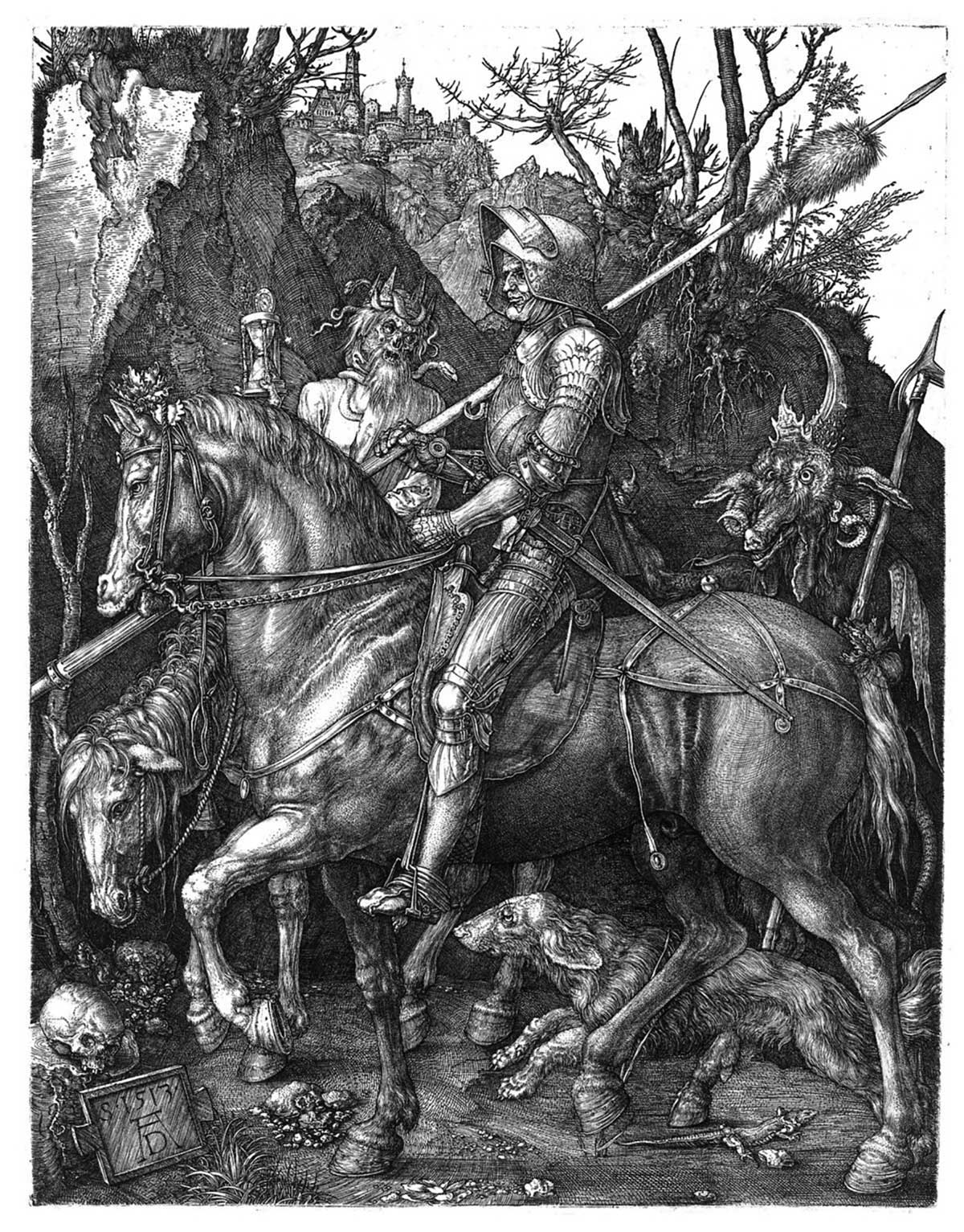
on Single-Mindedness in Durer's Ritter, Tod, und Teufel by Anthony Costello
33.2—March/April 2020

Christ Chapel at Hillsdale

An Architectural Sign of Mere Christianity by Michael Ward
30.3—May/June 2017

St. Luke the Evangelist

by Mary Elizabeth Podles


more from the online archives

30.5—Sept/Oct 2017

The Unforgotten

on Costly Grace in Breece D'J Pancake's Flyover Country by Casey Chalk

23.2—March/April 2010

Job’s Progress

on Maturity for a Rising Generation by Peter J. Leithart

29.3—May/June 2016

The Master's Voice

Our Choice Is Obedience or Jesus as Anti-Christ by Anthony Esolen

calling all readers

Please Donate

"There are magazines worth reading but few worth saving . . . Touchstone is just such a magazine."
—Alice von Hildebrand

"Here we do not concede one square millimeter of territory to falsehood, folly, contemporary sentimentality, or fashion. We speak the truth, and let God be our judge. . . . Touchstone is the one committedly Christian conservative journal."
—Anthony Esolen, Touchstone senior editor

Support Touchstone

00