






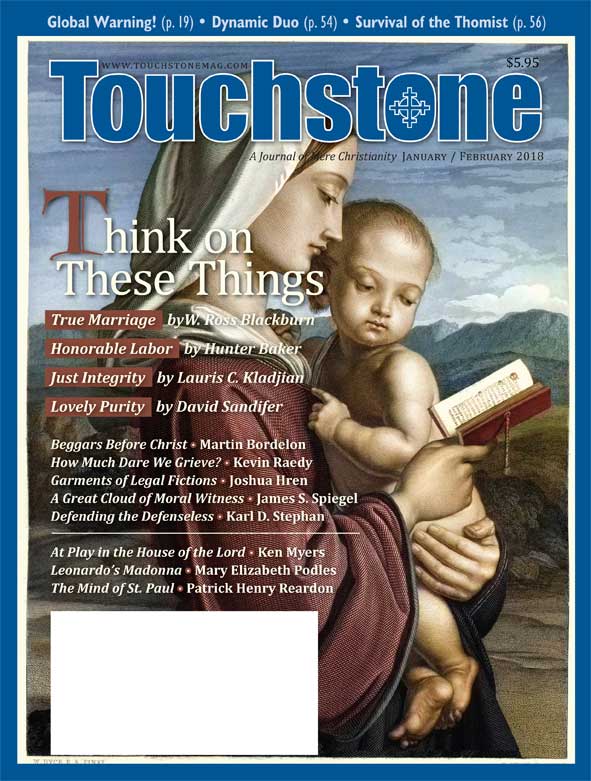
Editorial
Dealing with Trump
A Comfort Zone for Christians Remains Elusive by James Hitchcock
At the conclusion of my book, Abortion, Religious Freedom, and Catholic Politics, written in the spring of 2016, I finally saw that Donald Trump was likely to win the Republican nomination for president. But I also predicted that he would be defeated by Hillary Clinton, the Republicans might lose control of the Senate, and the Democrats would therefore be able to cement in place a pro-abortion judiciary that would last for decades.
On the other hand, I said, in the unlikely event that Trump should defeat Clinton, he appeared to lack both the knowledge and the will to address pro-life concerns, thereby bringing to a tragic end the courageous pro-life battle that had been waged for over four decades.
THIS ARTICLE ONLY AVAILABLE TO SUBSCRIBERS.
FOR QUICK ACCESS:
James Hitchcock is Professor emeritus of History at St. Louis University in St. Louis. He and his late wife Helen have four daughters. His most recent book is the two-volume work, The Supreme Court and Religion in American Life (Princeton University Press, 2004). He is a senior editor of Touchstone.
A Journal of Mere Christianity—Delivered to Your Door
- Essays on theology, culture, and the Church
- Contributors from across the Christian traditions

Six print issues (one year) of Touchstone, plus full online access and PDF downloads for only $39.95.

Get a one-year full-access subscription to the Touchstone online archives for only $19.95.
bulk subscriptions
Order Touchstone subscriptions in bulk and save $10 per sub! Each subscription includes 6 issues of Touchstone plus full online access to touchstonemag.com—including archives, videos, and pdf downloads of recent issues for only $29.95 each! Great for churches or study groups.
Transactions will be processed on a secure server.
more on politics from the online archives
32.2—March/April 2019
on Properly Rendering Things to Caesar & to God by Peter J. Leithart


37.5—Sept/Oct 2024
The Death of Conservatism & the Negative World by J. Douglas Johnson
more from the online archives
28.5—Sept/Oct 2015
on Our Sacred Duty to Teach the Devil to Death by Marcus Johnson
24.6—Nov/Dec 2011
on the Tyranny of Modern Freedom versus the Freedom of Jesus by Gillis J. Harp
29.3—May/June 2016
A Deathbed Reflection on Catholic Social Teaching & Our Future Prospects by Karl D. Stephan
calling all readers
Please Donate
"There are magazines worth reading but few worth saving . . . Touchstone is just such a magazine."
—Alice von Hildebrand
"Here we do not concede one square millimeter of territory to falsehood, folly, contemporary sentimentality, or fashion. We speak the truth, and let God be our judge. . . . Touchstone is the one committedly Christian conservative journal."
—Anthony Esolen, Touchstone senior editor
