The Transfiguration by Mary Elizabeth Podles

A Thousand Words by Mary Elizabeth Podles

The Transfiguration

by Theophanes the Greek

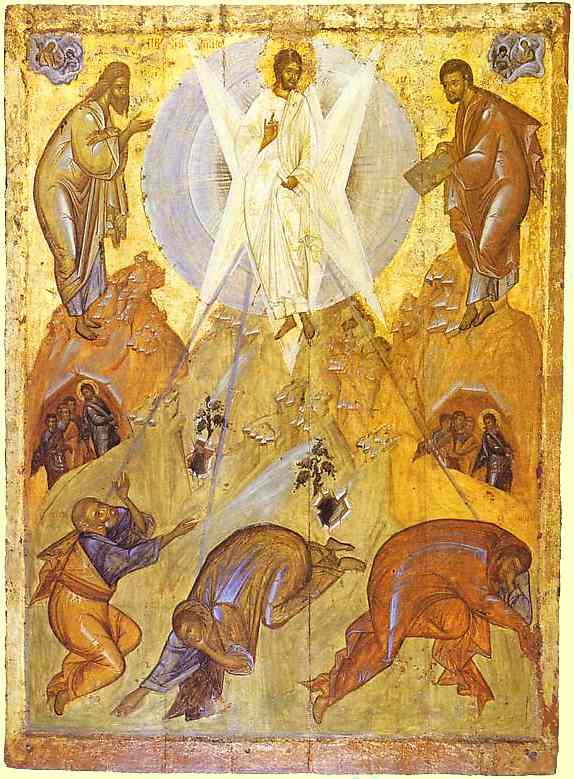
In the Orthodox tradition, the first image that an iconographer "writes" is one of the Transfiguration, since every icon he will make thereafter is to be a reflection of the transfigured Christ. This Transfiguration, by the accomplished Theophanes the Greek (c.1340–1405), was surely not his first; it might have been his last. Theophanes had studied art and philosophy at the University at Constantinople, but by the late fourteenth century, that city was a good place to leave. He travelled in 1370 to Novgorod, and in 1375 to Moscow (where this icon now hangs, in the Tretyakov Gallery). In Moscow, he was a teacher to the iconographer Andrei Rublev, and an important influence on the shape of Russian icons for centuries to come.

Traditionally, the Transfiguration icon is divided into two zones, the heavenly apparition above and the earthly realm below. Theophanes observes the convention, but has unified the two halves with an overall warm color scheme of gold, reds, and earth tones, as if to say that at this moment the two worlds have become one.

The Uncreated Light

Gold, in the Orthodox hierarchy of colors, was understood to represent the uncreated light, the very light that shone at Mt. Tabor. And so it does here, but within it, the haloed figure of Christ shines even brighter, as the very source of that light. Like gold, white and blue were considered celestial colors. Here, against the warm background, the white of Christ's garments, "glistening, intensely white, as no fuller on earth could bleach them," and the spiky outline of the radiant cloud around him leap out at the eye. Behind them, a blue circle shot through with stars and golden beams encloses
them.

The fact that there are three layers at the center (blue circle, star-shaped mandorla, and the figure of Christ) implies that this is actually a Trinity. The perfect circle of the cosmos represents the Father, the scroll held by the Son tacitly proclaims him to be the Word made flesh, and the jagged white spikes of the radiant cloud represent the explosive entry of the Holy Spirit (and now the Trinity) into the natural world. Jesus' dazzling garments are painted as flat, abstract, and dematerialized, while his hands and face are softly and naturalistically modeled. The two modes of representation are a visual equivalent of the two natures of Christ: human and touchable; divine and, until now,  remote.

The Visionaries & Eyewitnesses

Flanking the central Trinity are the figures of Elijah on the left, hand upraised in a speaking gesture, and Moses on the right, holding the book of the Law. Both look toward Christ, who is the fulfillment of the Law and the Prophets. Both are here as visionaries: in a small vignette in each corner, an angel summons them to their individual mountain peaks to view the glory of the Lord. And they serve as representatives of the living and the dead, for while Moses died and was buried, Elijah was taken up to heaven alive. They remind us of the eschatological implications of the Transfiguration: while "there are some standing here who will not taste death before they see the Son of man coming in his kingdom," the rest of us will have to wait until the
end times.

And what about those eyewitnesses to the Transfigured Christ? They are thrown into chaos and confusion at the bottom of the panel: Peter, at the left, raises his hand in a speaking pose like Elijah's; John, in the center, falls headlong down the hill; and James hunches over and covers his eyes at the right. They all wear brownish clothes: the earth tones rank lowest in the Orthodox hierarchy of colors. James, the first to be killed for his faith, wears the red of martyrdom.

For all their bewilderment, however, they cannot escape the vision: a ray of light blasts directly from the radiant cloud (and implicitly from the scroll of the Word) to the eyes of each. Their perception of everything from here on is changed irrevocably. The fourteenth century had seen a controversy within the Eastern Church concerning the nature and working of the uncreated light, and whether it might be perceived by man. Here, Theophanes comes down firmly—and scripturally—on the side of the visionaries.

Seeing God in All Time


Mary Elizabeth Podles is the retired curator of Renaissance and Baroque art at the Walters Art Museum in Baltimore, Maryland. She is the author of A Thousand Words: Reflections on Art and Christianity (St. James Press, 2023). She and her husband Leon, a Touchstone senior editor, have six children and live in Baltimore, Maryland. She is a contributing editor for Touchstone.

A Journal of Mere Christianity—Delivered to Your Door

  • Essays on theology, culture, and the Church
  • Contributors from across the Christian traditions

Subscribe (Print + Online)

Six print issues (one year) of Touchstone, plus full online access and PDF downloads for only $39.95.

Subscribe (Online Only)

Get a one-year full-access subscription to the Touchstone online archives for only $19.95.


bulk subscriptions

Order Touchstone subscriptions in bulk and save $10 per sub! Each subscription includes 6 issues of Touchstone plus full online access to touchstonemag.com—including archives, videos, and pdf downloads of recent issues for only $29.95 each! Great for churches or study groups.

Transactions will be processed on a secure server.


more on art from the online archives
30.3—May/June 2017

St. Luke the Evangelist

by Mary Elizabeth Podles

33.2—March/April 2020

Christ Chapel at Hillsdale

An Architectural Sign of Mere Christianity by Michael Ward
32.4—July/August 2019

Sojourner Knight

on Single-Mindedness in Durer's Ritter, Tod, und Teufel by Anthony Costello


more from the online archives
32.4—July/August 2019

A Case of Win-Win

on Probability, Death & the Existence of God by Graeme Hunter

37.5—Sept/Oct 2024

Great & Wonderful Days

The Death of Conservatism & the Negative World by J. Douglas Johnson

27.2—March/April 2014

Poetry Above Compulsion

Higher Education Should Advance the Glorious Liberty of the Sons of God by Anthony Esolen

calling all readers

Please Donate

"There are magazines worth reading but few worth saving . . . Touchstone is just such a magazine."
—Alice von Hildebrand

"Here we do not concede one square millimeter of territory to falsehood, folly, contemporary sentimentality, or fashion. We speak the truth, and let God be our judge. . . . Touchstone is the one committedly Christian conservative journal."
—Anthony Esolen, Touchstone senior editor

Support Touchstone

00