




A Thousand Words
Ara Pacis Augustae
The Altar of Augustan Peace
by Mary Elizabeth Podles
When the Roman legionaries embarked on a new military venture, they left the city via the Forum's Portal of Janus, the god of new beginnings (and endings), and the doors of the Temple of Janus were always kept open in times of war, while in peacetime they were closed. For nearly four hundred years, they stood open. They were formally closed in 29 b.c., again in 25 b.c., and finally and definitively around the year 13 b.c. The Pax Romana had begun, and in the year 9 b.c., the Ara Pacis, the Altar of Augustan Peace, was consecrated.
The altar itself, in proper Roman fashion, was open to the air, as sacrifice to the gods was a public event. There is no temple building containing cult statues and a treasury, as was usual, but rather a simple wall setting apart the sacred precinct, and a shallow flight of stairs that elevates it. The altar itself is carved with images that illustrate the lex aria, the rules governing proper ritual and sacrificial practices. The religion of Rome, with its ever-multiplying collection of deities, held as a premise that the correct performance of ritual assured Rome's favored status with the gods and its good fortune. Civic good was not differentiated from religious good: collective piety and the collective identity of Rome were not distinguished. There was no separation of church and state; the two were inseparable.
Altar Decorations
Thus, most of the decoration of the altar and its precincts refers to Rome, its origins, and its various gods in traditional ways, though the meanings of the images might be obscure to us now. The interior walls, for example, are decorated with bucrania, cow skulls, referring again to the practice of animal sacrifice, and are resplendent with garlands of fruits, the symbol of the abundance that the gods will send to pious Rome. Similarly, the decorative panels in the lower half of the outside enclosure bear an unfurling vegetal design to suggest the orderly growth and unfurling that peace will make possible.
The east and west ends of the enclosure are pierced by openings that give a view of the open-air altar. The panels on either side of the openings show mythological scenes that seem to refer to Rome, her origins, and the blessings of the gods upon her fortunes. These panels are in varying states of repair, and the content of the missing pieces has been hotly debated by scholars. The altar was built on the Campus Martius, the field of Mars, the god of war, which unfortunately is also the flood plain of the Tiber. Centuries of flooding had buried the altar in the mire. Some of it was rediscovered in the sixteenth century, and some in the nineteenth, but the major work of excavation and reconstruction was only done in the 1930s under Mussolini.
In any case, the panels on the east wall probably represent the personification of Rome as a goddess of peace seated on a pile of confiscated weaponry, and the goddess Pax (Peace) surrounded by favorable winds and signs of fertility and prosperity, including twins in her lap (Figure 1). On the west wall, where the steps gave access to the altar, are, plausibly, Romulus and Remus, mythical twin founders of the city, and Numa Pompilius, the second king of Rome, who built the Gates of Janus and subsequently closed them in peace.
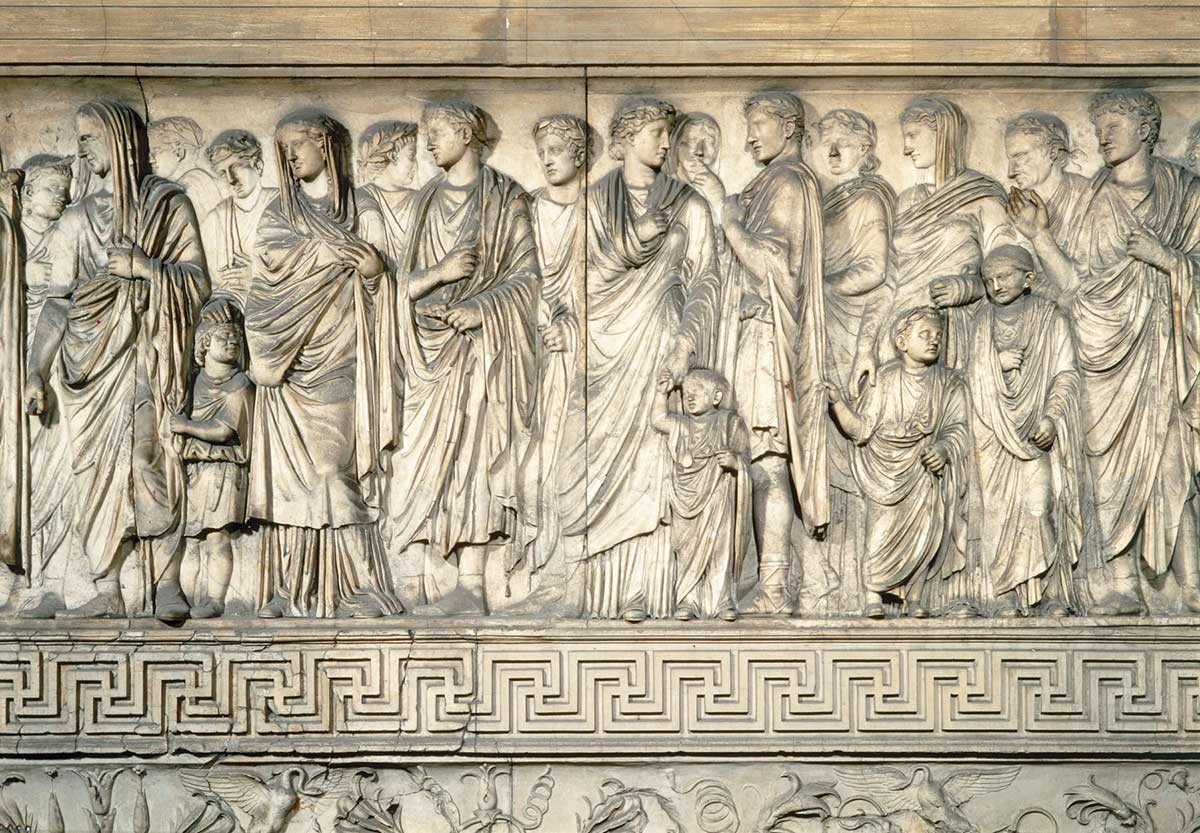
The north and south walls, the long unbroken sides of the enclosure, represent the ceremonial procession celebrating Augustus' triumphal return from military campaigns in Iberia and Gaul in 13 b.c. We know this kind of processional image from other monuments: similar processions appear on triumphal arches as religious celebrations with a distinctly martial flavor. Here, however, is no parade. On the north wall, priests, magistrates, senators, and other officials are not marching but rather gathering together before the procession, conversing informally while members of the imperial family and their children fall in behind them. Several children not in Roman dress are included in this procession. One scholar identifies them as young princes sent from Asia, Africa, and the barbarian north; under Augustus' peaceful rule, Rome has become the role model for good governance, where the world sends its young to be educated (Figure 2).
This almost messianic self-image of Augustus is even more fully expressed in the south wall panel, in which Augustus himself, surrounded by his immediate family, prepares to offer the sacrifice. If religion and politics in Rome were indistinguishable, then it is hard to know whether this is blatant political propaganda or a religious vision. Augustus hewed to a traditional pro-marriage and pro-natalist policy that would have pleased the most staid of the old Romans, so the inclusion of his extended family, including several charming children and a stern matron shushing them (Figure 3), would have held a conservative appeal. On the other hand, they can be seen as a manifestation of Augustus' plan to set up a dynasty of autocratic rulers, a piece of propaganda that would not have sat well with traditional Roman culture.
A Man Born for Peace
Mary Elizabeth Podles is the retired curator of Renaissance and Baroque art at the Walters Art Museum in Baltimore, Maryland. She is the author of A Thousand Words: Reflections on Art and Christianity (St. James Press, 2023). She and her husband Leon, a Touchstone senior editor, have six children and live in Baltimore, Maryland. She is a contributing editor for Touchstone.
A Journal of Mere Christianity—Delivered to Your Door
- Essays on theology, culture, and the Church
- Contributors from across the Christian traditions

Six print issues (one year) of Touchstone, plus full online access and PDF downloads for only $39.95.

Get a one-year full-access subscription to the Touchstone online archives for only $19.95.
bulk subscriptions
Order Touchstone subscriptions in bulk and save $10 per sub! Each subscription includes 6 issues of Touchstone plus full online access to touchstonemag.com—including archives, videos, and pdf downloads of recent issues for only $29.95 each! Great for churches or study groups.
Transactions will be processed on a secure server.
more on art from the online archives
33.2—March/April 2020
An Architectural Sign of Mere Christianity by Michael Ward
32.4—July/August 2019
on Single-Mindedness in Durer's Ritter, Tod, und Teufel by Anthony Costello
more from the online archives
31.4—July/August 2018
on the Brevity & Theology of Her Recorded Words by Judith Anderson

26.1—Jan/Feb 2013
Manly Chastity, Hedonism & the Law of Non-contradiction by Anthony Esolen
32.6—November/December 2019
on Taking Heed of the Parallels Between the Crises of Yesterday & Today by Korey D. Maas
calling all readers
Please Donate
"There are magazines worth reading but few worth saving . . . Touchstone is just such a magazine."
—Alice von Hildebrand
"Here we do not concede one square millimeter of territory to falsehood, folly, contemporary sentimentality, or fashion. We speak the truth, and let God be our judge. . . . Touchstone is the one committedly Christian conservative journal."
—Anthony Esolen, Touchstone senior editor
