




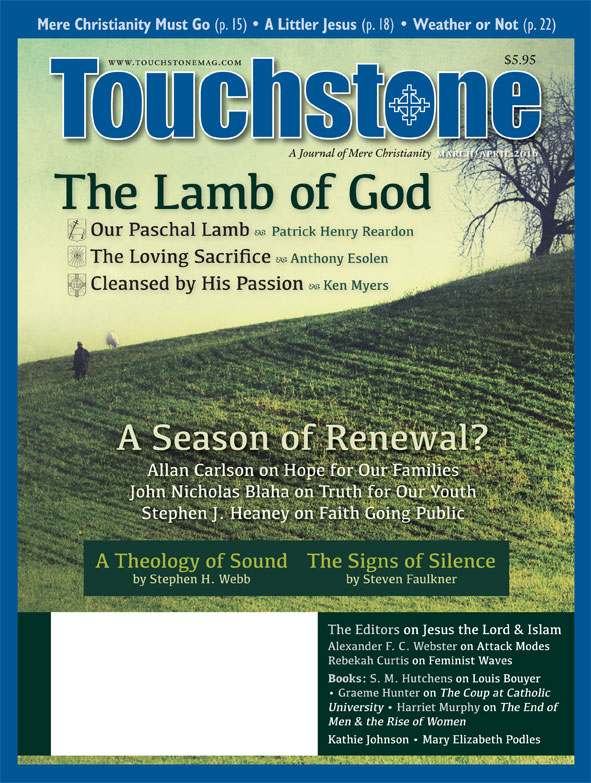
Mortal Remains
Mere Christianity Must Go
by S. M. Hutchens
The concept of "Mere Christianity" as put forward by C. S. Lewis seems to have a dual aspect in the world. In the one more amenable to conservative Protestantism but actually unarticulated by Lewis, it may be and has been read as standing for the historic faith of the Church, so that for those who cannot confess with confidence that their particular communion is the one, holy, apostolic Church of the Creed, satis est: mere Christianity, wherever they find it, "is enough," and pressing toward complete unity in doctrine among all the churches, while a pleasant notion, is not an acute concern. Mere Christianity is something to be celebrated and a place where one can rest.This, however, was not Lewis's view. He likened it to a common hallway in a house of many rooms, a house which we can tentatively say stands for the Church, entrance into which means submission to the single set of rules of faith and behavior that govern all rooms. One may take the rooms, generally speaking, to be "denominations," although Lewis, I think for subtle reasons that are beyond this discussion, does not explicitly identify them as such. He, like many of the biblical writers, is a master of felicitous ambiguity.
He is clear, however, that he does not believe one may rightly be satisfied staying in the hallway under the terms of mere Christianity:
If I have not directly helped the cause of reunion, I have perhaps made it clear why we ought to be reunited. . . . The hall is a place to wait in, a place from which to try the various doors, not a place to live in. For that purpose the worst of the rooms (whichever that may be) is, I think, preferable. It is true that some people may find they have to wait in the hall for a considerable time, while others feel certain almost at once which door they must knock at. . . . When you do get into your room you will find that the long wait has done you some kind of good which you would not have had otherwise. But you must regard it as waiting, not as camping. You must keep on praying for light: and, of course, even in the hall, you must begin trying to obey the rules which are common to the whole house. And above all you must be asking which door is the true one; not which pleases you best by its paint and paneling. [From the Preface, emphasis added.]
Lewis used the concept of mere Christianity to describe the common faith of a divided church, but as such it can only refer to a temporary condition that must give way to a full agreement and a full communion not simply reserved for the eschaton, but which is the ever-present demand of our Lord's prayer that his followers may be one as he and the Father are one. All divisions that call for light are due to error, and they must fall.
Evasion of Duty
This should go without saying, but it has been my impression in recent years that mere Christianity is being heavily used to justify and preserve illegitimate diversity in Christian teaching, and the evasion of what should be a first ecumenical duty of self-examination with the intention of abandoning the old, highly decorated, and strongly defended errors that created the guilty divisions in the first place, errors that can be identified and corrected within the group's broader canon of authority. Among Protestants (and I speak as a Protestant), these errors are almost always the result of self-serving, dishonest, sectarian interpretations of the Bible, errors that can be recognized and set right within a methodological structure that regards the Scriptures as self-interpreting. These evasions are often accompanied by a seemingly gracious willingness to repent of minor faults (Protestants are not alone in this!)—for example, the harboring of unreasonable prejudice or an uncharitable attitude—while the greater confessional ones that have historically defined the group remain unaddressed as "distinctives" that there is no need to abandon, especially once mere Christianity is embraced.
When someone gains the will to re-examine his confession, a common result is that he changes denomination, Protestants often going over to the two churches, Catholic and Orthodox, that have the most plausible claims to universality. Whatever one may think of these churches, in doing so the converts have followed the advice Lewis gives about finding which door is the true one—or such has been my uniform experience of the confessions of those who sincerely believe they have "come home" to one of the two ancient communions. Lewis says to those whose conscience does not allow this, however, that they cannot be satisfied with mere Christianity. They must persevere in praying for light and searching for the true door—the door leading to the communion of faith and practice for which the Lord himself prayed. Nothing else will do. •
S. M. Hutchens is a senior editor and longtime writer for Touchstone.
A Journal of Mere Christianity—Delivered to Your Door
- Essays on theology, culture, and the Church
- Contributors from across the Christian traditions

Six print issues (one year) of Touchstone, plus full online access and PDF downloads for only $39.95.

Get a one-year full-access subscription to the Touchstone online archives for only $19.95.
bulk subscriptions
Order Touchstone subscriptions in bulk and save $10 per sub! Each subscription includes 6 issues of Touchstone plus full online access to touchstonemag.com—including archives, videos, and pdf downloads of recent issues for only $29.95 each! Great for churches or study groups.
Transactions will be processed on a secure server.
more from the online archives

20.7—September 2007
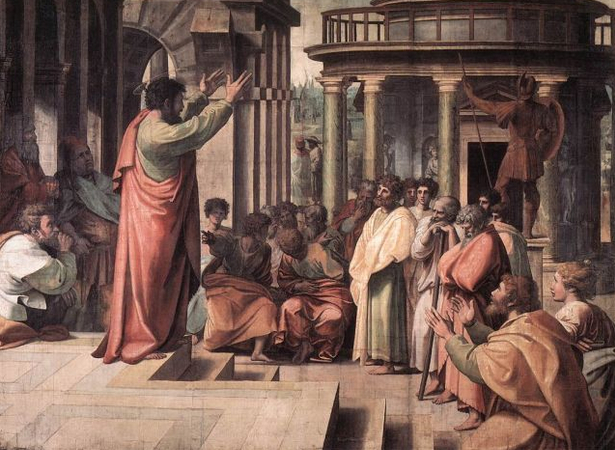
Paul Didn’t Build Bridges to Popular Culture by Russell D. Moore
calling all readers
Please Donate
"There are magazines worth reading but few worth saving . . . Touchstone is just such a magazine."
—Alice von Hildebrand
"Here we do not concede one square millimeter of territory to falsehood, folly, contemporary sentimentality, or fashion. We speak the truth, and let God be our judge. . . . Touchstone is the one committedly Christian conservative journal."
—Anthony Esolen, Touchstone senior editor
