Madonna di Ca' Pesaro by Mary Elizabeth Podles

Madonna di Ca' Pesaro by Tiziano Vecellio (Titian)

by Mary Elizabeth Podles

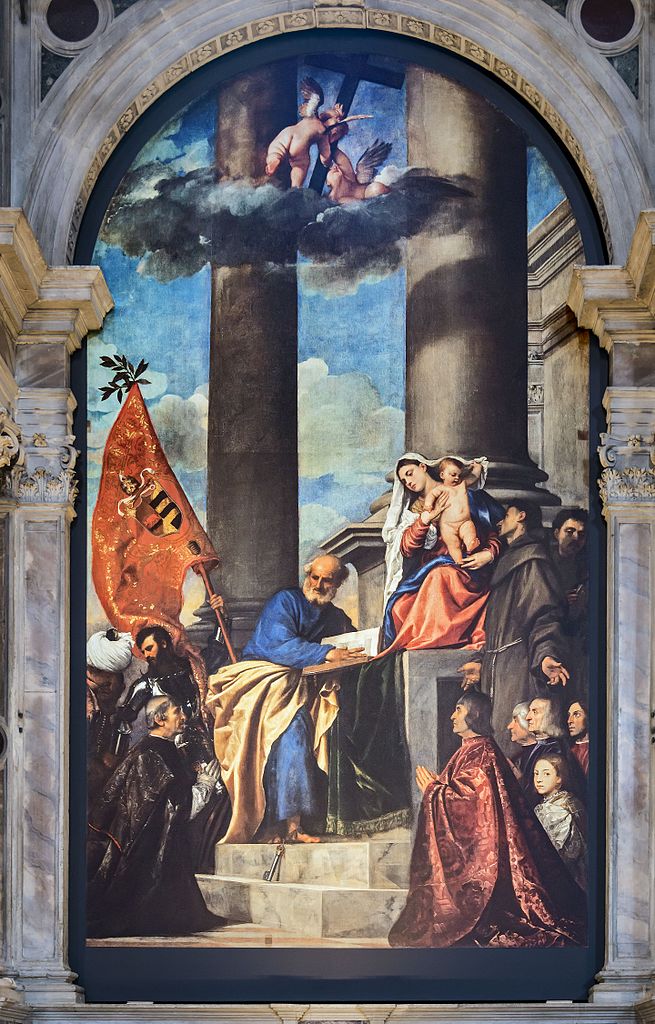
In 1518, the Pesaro family acquired a side chapel in the Basilica di Santa Maria Gloriosa dei Frari, the Franciscan church in Venice, to use as a funerary -memorial. Titian, who had just finished a glorious Assumption for the main altar, was seized upon to do the decoration. The altarpiece he designed, the Pesaro -Madonna, combines several types of pictures familiar to Venetians of the day into one. It is a Sacra Conversazione, in which the Madonna enthroned communes with a gathering of saints; it is an ex voto, an offering given in thanks for favors received; and it is a family portrait, a statement about the stature and character of the people portrayed.
If we start by identifying the cast of characters, we will quickly unravel what the painter had in mind. -Starting at the lower left, the kneeling figure in black is Jacopo Pesaro, who commissioned the altarpiece. Jacopo was bishop of Paphos on Cyprus and keeper of the Papal Galleys under Pope Alexander VI. In 1502, his ships scored a major victory over the Turks, for which the painting is a thank offering. Behind Jacopo stands a soldier unfurling a great red standard bearing both the papal and the Pesaro arms, and instead of a finial, the olive branch of peace. He turns his head toward a turbaned figure at the far left, presumably a captured Turk.

The soldier may be more than an ordinary soldier. He stands up a step from Jacopo, on a level with the saints, and may therefore be St. George, foe of heresy (usually represented as a dragon), but here turning amicably toward the heretical Muslim under the banner of peace, and presenting him to St. Peter, patron saint of the pope and the Church at large.

Paths of Intercession

St. Peter, seated up still another step and dressed in sumptuous blue and gold, keeps the key of heaven at his feet and holds a book, perhaps a ledger of those who may be admitted through the gates. He turns in a fluent pose from the Madonna to Jacopo and the Turk, offering reconciliation and a bridge to Mary and, through her intercession, to her Son. Together with St. George and the Pesaro family members at left and right, St. Peter forms the apex of a triangle that may signify the stability of the Church.

Above them, the figure of Mary sits at the apex of another, more soaring compositional triangle. As in the traditional Sacra Conversazione, she is raised up on a throne, but Titian has shifted her from her usual spot at the center upward and to the right. The shift gives more movement and depth to the painting than its more sedate predecessors, and makes reference to Mary as the Staircase to Heaven. Legend tells us that the painter gave this Madonna the face of his young wife who had died in childbirth; this may be sentimental twaddle, but there is no doubt that she is a graceful and lovely young woman, inclining her head in one direction and holding her baby, who looks in the other. The infant Jesus, in a charming and very human baby gesture, covers his head with her veil and plays peek-a-boo with the saint on the right.

He is, however, more than a mere baby. He poses with one arm upraised and one foot striding forward, the traditional pose of the resurrected Christ stepping forth from the tomb. So, implicit in the infant Christ of the Incarnation is also the triumphant Christ of the Resurrection. He focuses his attention downward and to the right, toward the figure of St. Francis and St. -Anthony behind him. This is another path of intercession, direct to Jesus: St. Francis experienced a vision of the crucified Christ, a lifting of the veil, as it were, between the human and the divine. The vision left its mark on his body in the form of the stigmata, a replica of the wounds of the cross. So the suffering Christ is here present, too, represented in the person of St. Francis. (Recall that the Frari was a Franciscan basilica.)

While he looks at Christ, St. Francis also gestures toward the Pesaros below and at the right, presenting them to Jesus with his wounded hands. With his right hand, he singles out the kneeling figure dressed in the gorgeous red robes of the Venetian Senate. This is Francesco Pesaro, who bears the name of his special patron, Francis. While Jacopo paid for the painting, it was Francesco who footed the bill for the Masses to be said at
the altar.

Francesco and the rest of the Pesaros kneel, solemn and unmoving, in a horizontal space between our own and that of the heavenly vision above. They are static and planar, in contrast to the swooping diagonals of the saints above. They seem to be frozen in an in-between state, not yet admitted into the heavenly zone. Only the little boy at the bottom right breaks away and turns his gaze toward us: this is Leonardo Pesaro, who at the time of the picture's completion in 1526 was the last of the depicted Pesaros still alive. His serious outward gaze seems to remind viewers that his dead are still in need of prayers of intercession.

Occasion of Prayer

The notion of intercessory prayer is reinforced by the architectural setting. The columns and clouds of the enormous portico were not a part of the original design. Originally, the scene was enclosed in an extension of the church's warm yellow walls, traces of which remain at the far right above the Franciscan saints. Careful reconstruction shows that Titian intended the divine vision to take place within the sacred space of the church.


Mary Elizabeth Podles is the retired curator of Renaissance and Baroque art at the Walters Art Museum in Baltimore, Maryland. She is the author of A Thousand Words: Reflections on Art and Christianity (St. James Press, 2023). She and her husband Leon, a Touchstone senior editor, have six children and live in Baltimore, Maryland. She is a contributing editor for Touchstone.

A Journal of Mere Christianity—Delivered to Your Door

  • Essays on theology, culture, and the Church
  • Contributors from across the Christian traditions

Subscribe (Print + Online)

Six print issues (one year) of Touchstone, plus full online access and PDF downloads for only $39.95.

Subscribe (Online Only)

Get a one-year full-access subscription to the Touchstone online archives for only $19.95.


bulk subscriptions

Order Touchstone subscriptions in bulk and save $10 per sub! Each subscription includes 6 issues of Touchstone plus full online access to touchstonemag.com—including archives, videos, and pdf downloads of recent issues for only $29.95 each! Great for churches or study groups.

Transactions will be processed on a secure server.


more on art from the online archives
30.3—May/June 2017

St. Luke the Evangelist

by Mary Elizabeth Podles

32.4—July/August 2019

Sojourner Knight

on Single-Mindedness in Durer's Ritter, Tod, und Teufel by Anthony Costello
33.2—March/April 2020

Christ Chapel at Hillsdale

An Architectural Sign of Mere Christianity by Michael Ward

more from the online archives
18.4—May 2005

The Absurd Reich

on the Politics of Demonic Nothingness by Gary Inbinder

17.4—May 2004

Supremely Modern Liberals

The Unhappy & Abusive Marriage of Liberalism & Modernism by James Hitchcock

14.6—July/August 2001

What Women Need

Three Bad Ideas for Women & What to Do About Them by Frederica Mathewes-Green

calling all readers

Please Donate

"There are magazines worth reading but few worth saving . . . Touchstone is just such a magazine."
—Alice von Hildebrand

"Here we do not concede one square millimeter of territory to falsehood, folly, contemporary sentimentality, or fashion. We speak the truth, and let God be our judge. . . . Touchstone is the one committedly Christian conservative journal."
—Anthony Esolen, Touchstone senior editor

Support Touchstone

00