




Communique
Transfigure or Die Trying
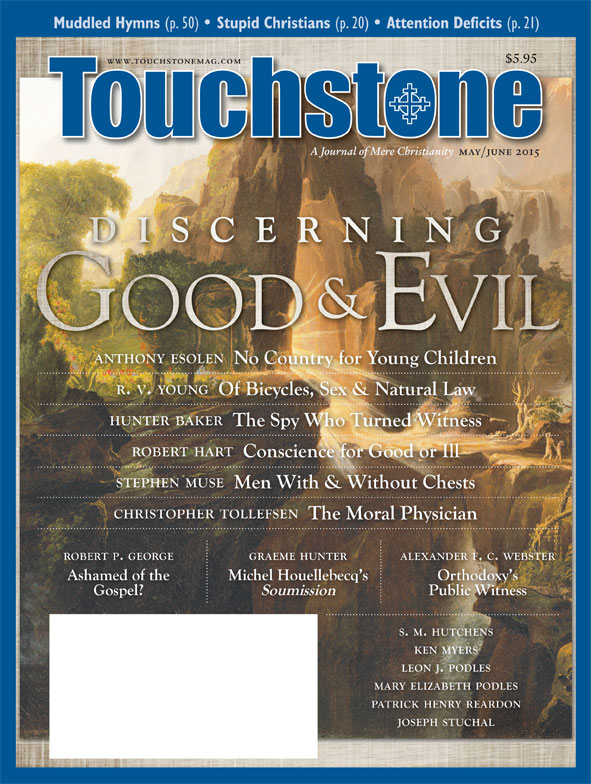
American Orthodoxy in the Public Square
by Alexander F. C. Webster
The prevailing political and cultural elites in America are succeeding, steadily and surely, in plunging our society into a post-Christian vortex that bears a striking resemblance in many ways to the formative centuries of the ancient Church. Faithful early Christians had to endure an inhospitable culture and a decadent ethos, as well as a hostile state.
America is arguably at the mercy of militant secular progressives hell-bent on subverting the cherished moral virtues of life, family, chastity, work, responsibility, and piety. Reaping an unprecedented harvest of more than 55 million legally aborted babies since 1973, our society is drowning in a sea of idolatrous self-worship, pursuing its own modern version of "bread and circuses" through increasingly violent and vulgar forms of entertainment and self-expression, a permanent welfare state from cradle to grave, unrestricted sex, artificially constructed sexual identities, and a push for publicly sanctioned "marriages" between persons of the same sex—a contra naturam abomination that even ancient Rome at its worst moments never imagined.
Until the emergence of the homosexualist juggernaut, one might have thought that Christians could engage a secular, pluralistic society with neither triumphalism nor significant religious compromise by revisiting the apologists of the ancient Church and reviving their cautious, nuanced, but still faithful evangelistic witness.
Unlike our pre-Constantinian co-religionists, we have vivid memories of centuries of Christendom and of an America infused and guided by a Judeo-Christian morality, now foolishly squandered on the altar of the goddesses of pseudo-tolerance, diversity, and equality. The pain of loss is exacerbated by the realization that our situation will only get worse, unless God the Holy Trinity does a mighty work and providentially changes our nihilistic trajectory.
Eastern Orthodox Christians are relative newcomers to the American public square, and their voice is seldom heard. A vigorous, prophetic, Orthodox Christian public moral witness might be welcomed for its sheer novelty as a fresh, "new" contribution to the American public square—a voice crying not in the wilderness but rather in the nation's capital and its other centers of worldly power.
The Civilizing Ethic
Orthodox Christianity has, at least from the first generation of patristic apologists in the second century, such as St. Justin Martyr, St. Athenagoras of Athens, and St. Irenaeus of Lyons, acknowledged an "inborn moral law" common to all of humanity.
Beginning with his Th.D. dissertation at Boston University in 1965 and throughout his career, Fr. Stanley S. Harakas, my mentor in Orthodox moral theology, has described the natural law, as it is more commonly known in the West, as "a sort of common denominator ethic"—to be sure, "a relatively low-level morality," but still "a first preparatory step in God's relationship with men," which even sin did not obliterate. In the patristic tradition, that natural law "is perceived to be rational, independent of positive laws and customs, universal and unchanging" and "not limited to the special revelation acknowledged by Orthodox Christianity, as found in Scripture and in Holy Tradition." Through the "effort of unaided reason," men and women may perceive "the order existing in creation which man is bound to view as good and which claims obedience of him." Thus, natural law is "a very elemental moral law which articulates the absolutely necessary modes of behavior for the maintenance of the human community."
As an Orthodox theologian, I prefer to label that minimalist ethic a "civilizing ethic," since it, without advancing a society toward the kingdom of God, at least keeps that society from reverting to the jungle and provides a modicum of order and decency.
Although the church fathers and modern philosophers and theologians alike dispute the precise content of that sine qua non for human morality, the church fathers tended to identify the content of the natural law with the Decalogue in the Old Testament. Possibly with the exclusion of the first four commandments for their explicitly theological content, the remainder of the Decalogue could still furnish a very basic platform for public debate in American society on ethical issues such as abortion and infanticide.
Alexander F. C. Webster (Archpriest), Ph.D., is Dean & Professor of Moral Theology Emeritus at Holy Trinity Orthodox Seminary in Jordanville, New York, and Adjunct Professor of Religious Studies at George Mason University in Fairfax, Virginia.
A Journal of Mere Christianity—Delivered to Your Door
- Essays on theology, culture, and the Church
- Contributors from across the Christian traditions

Six print issues (one year) of Touchstone, plus full online access and PDF downloads for only $39.95.

Get a one-year full-access subscription to the Touchstone online archives for only $19.95.
bulk subscriptions
Order Touchstone subscriptions in bulk and save $10 per sub! Each subscription includes 6 issues of Touchstone plus full online access to touchstonemag.com—including archives, videos, and pdf downloads of recent issues for only $29.95 each! Great for churches or study groups.
Transactions will be processed on a secure server.
more from the online archives

30.2—March/April 2017
on Reading Don Quixote in Its Original Christian Context by Luis Cortest

calling all readers
Please Donate
"There are magazines worth reading but few worth saving . . . Touchstone is just such a magazine."
—Alice von Hildebrand
"Here we do not concede one square millimeter of territory to falsehood, folly, contemporary sentimentality, or fashion. We speak the truth, and let God be our judge. . . . Touchstone is the one committedly Christian conservative journal."
—Anthony Esolen, Touchstone senior editor
