




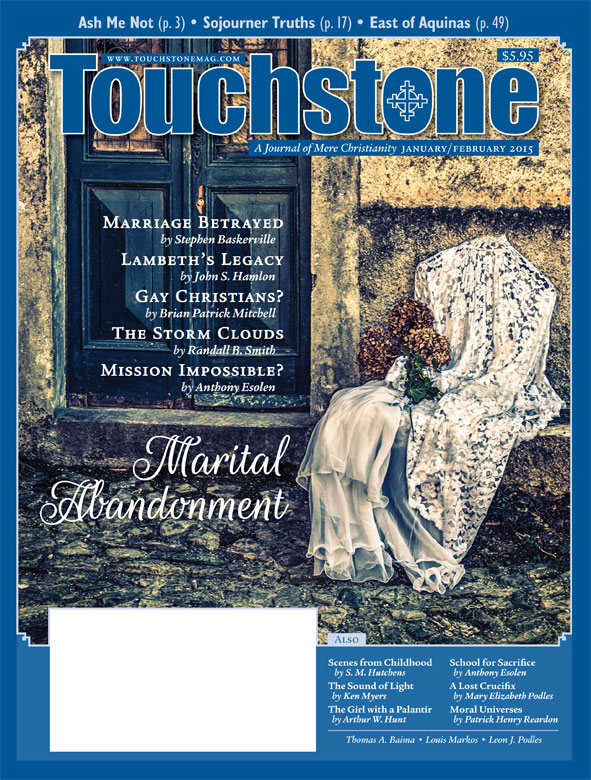
Feature
Living in the Land of Cain
The Sad Journey of Marriage & Sex from Lambeth to the Land of Nod
I n his preface to A Man for All Seasons, playwright Robert Bolt describes protagonist Thomas More as
a man with an adamantine sense of his own self. He knew where he began and left off . . . but at length he was asked to retreat from that final area where he located his self. And there this supple, humorous, unassuming and sophisticated person . . . was overtaken by an absolutely primitive rigor, and could no more be budged than a cliff.
"Adamantine"—unyielding, impervious, diamond-like—befits the real Thomas More, who, as councilor to King Henry VIII, was convicted of treason and beheaded in 1535. He would not sign the First Succession Act, which was anti-papal-authority, anti-Catherine of Aragon (including daughter Mary—fathered by Henry VIII), and pro-Princess Elizabeth (still in Anne Boleyn's womb).
At the formal Catholic level, More is the patron of statesmen and politicians; in the pews, he is a defender of marriage and family.
The Beauty of Marriage & Family—Anglican Style
The Anglican bishops at the Lambeth Conference of 1920 were also diamond-like. Compared to the grimy, banal, all-purpose language used today, they spoke of marriage with an eloquence and directness that is, in a word, lustrous:
The fellowship between man and woman in marriage was the earliest which God gave to the human race. . . . What our Lord adds about marriage is not given as new legislation, but as a declaration of God's original purpose. The man and his wife are no longer twain, but one flesh: and those whom God has joined together, man is not to put asunder. . . . [God] will work, as those who wait for Him well know, the miracle by which the two lives become one, yet so that each life becomes greater and better than it could have been alone. (Lambeth Conferences—1867–1930 [SPCK, 1948], 29)
By contrast, the Catholic world—up until the watershed-year 1968—saw few lines about the unifying woof in the warp and woof of marriage. In Pius XI's Casti Connubii (1930), for example, love's primary purpose is to help husband and wife form and perfect their interior life so "they may advance ever more and more in virtue, and above all that they may grow in true love toward God and their neighbor" (23). In order of emphasis, Pius puts procreation first, conjugal honor (based on mutual fidelity) second, and spousal love third.
But the Anglican bishops, having set the stage with the "oneness" of marriage, continue with the importance of procreation:
But marriage is not ordained only to give opportunity for the development of those two lives in unity. It has essentially the aim of bringing other lives into the world. Its indissolubility should secure to the children continued care and love of both their parents, so long as they live. The State's obvious interest in the children should lead it to preserve the strictness of -marriage law. (LC, 30)
A Journal of Mere Christianity—Delivered to Your Door
- Essays on theology, culture, and the Church
- Contributors from across the Christian traditions

Six print issues (one year) of Touchstone, plus full online access and PDF downloads for only $39.95.

Get a one-year full-access subscription to the Touchstone online archives for only $19.95.
bulk subscriptions
Order Touchstone subscriptions in bulk and save $10 per sub! Each subscription includes 6 issues of Touchstone plus full online access to touchstonemag.com—including archives, videos, and pdf downloads of recent issues for only $29.95 each! Great for churches or study groups.
Transactions will be processed on a secure server.
more on marriage from the online archives
29.1—Jan/Feb 2016
on Marriage, Moral Corruption & the Christian Duty of Witness by Regis Nicoll

28.1—January/February 2015
on State Impositions & Church Acquiescence by Stephen Baskerville
more from the online archives

32.4—July/August 2019
Does Biblical Language for Man Matter? by Stephen F. Noll

25.4—July/August 2012
The Corrosive & Far-Reaching Fallout of the Sexual Revolution by Anthony Esolen
calling all readers
Please Donate
"There are magazines worth reading but few worth saving . . . Touchstone is just such a magazine."
—Alice von Hildebrand
"Here we do not concede one square millimeter of territory to falsehood, folly, contemporary sentimentality, or fashion. We speak the truth, and let God be our judge. . . . Touchstone is the one committedly Christian conservative journal."
—Anthony Esolen, Touchstone senior editor
