




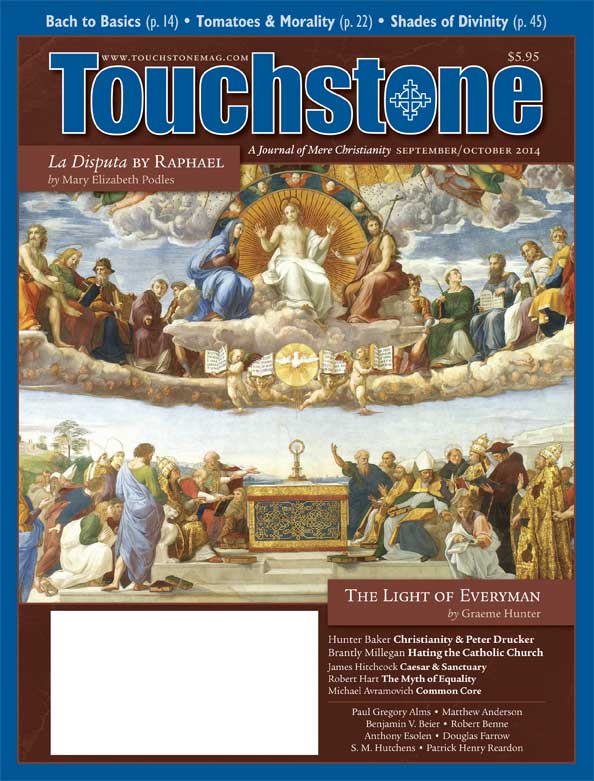
Feature
The Light of Everyman
Benedict XVI's Regensburg Lecture, St. John's Proemium & Intercultural Understanding
by Graeme Hunter
The hardest things to talk about are simple ones. My topic is the simplest thing of all: reality. I want to explain how it is that reality is intelligible to us, how it is equally intelligible to all people, and how, therefore, the intelligibility of reality makes intercultural understanding possible.
It will be difficult to convey these ideas to you because they are so simple, and because of the temptation—which you must resist—to impute to what I am saying some kind of complexity.
Intercultural understanding, for example, is not a complex thing. It is as simple as an African and an Asian coming to see things the same way.
But intercultural understanding is a hot-button topic, poisoned with political venom, wounded by ideological warfare. It can operate behind a veil of seemingly high-minded notions such as human rights, pluralism, tolerance, reasonable accommodation, and charters of values, behind which gather ignorant armies who glory in their otherness, their difference, their diversity, and, of course, their complexity.

The Fallout of Politicization
I can give you an example of how politicizing intercultural understanding makes discussing it difficult. Think back to the stormy reception given to a lecture of genius, spoken by then Pope Benedict XVI at the University of Regensburg on September 15, 2006. In that lecture, Benedict showed how the possibility of people's understanding one another lay at the root of European history—how Christianity arose out of the Hellenization of Hebrew faith, and Europe arose out of Christianity, and universities arose out of European civilization, and exist for the purpose of understanding. He showed how Christian Europe, with her universities, not only had the burden of understanding in her heart, but also held the key to understanding in her hand.
With the exception of small groups of independent-minded people in Europe and North America, however, the Regensburg lecture received little of the discussion it deserved. Instead, a single incidental remark near its beginning produced a fit of media hysteria. It was nothing Benedict said, but something he quoted from a fourteenth-century critic of Islam, which the pope censured as exhibiting "a brusqueness that we find unacceptable." But the damage was done. Politically incorrect words had been spoken, even if only in quotation, and the media were in full cry. By the time they had moved on to new hysterias, the Regensburg well had been poisoned, and few thought it healthy to draw their inspiration from those waters.
The politicization of topics like intercultural understanding makes people fearful of speaking about them. But people also don't like to think of themselves as timid, and so they pretend that intercultural understanding is a complex issue, something for anthropology, and sociology, and psychology to throw their techno-terminology at, until the thing itself sags and disappears under a heap of jargon, and its carcass can be said to be understood. Please resist that temptation, and return to the simple thought of an African and an Asian coming to be of one mind. That is all I mean by intercultural understanding.
The Domain of Metaphysics
Graeme Hunter is a contributing editor to Touchstone and Research Professor of Philosophy at Dominican University College in Ottawa. He is the author of Radical Protestantism in Spinoza's Thought (Ashgate).
A Journal of Mere Christianity—Delivered to Your Door
- Essays on theology, culture, and the Church
- Contributors from across the Christian traditions

Six print issues (one year) of Touchstone, plus full online access and PDF downloads for only $39.95.

Get a one-year full-access subscription to the Touchstone online archives for only $19.95.
bulk subscriptions
Order Touchstone subscriptions in bulk and save $10 per sub! Each subscription includes 6 issues of Touchstone plus full online access to touchstonemag.com—including archives, videos, and pdf downloads of recent issues for only $29.95 each! Great for churches or study groups.
Transactions will be processed on a secure server.
more on philosophy from the online archives
24.2—March/April 2011
Certain Death & the Last Lectures of Socrates & Jesus by Randall B. Smith
32.6—November/December 2019
An Open Letter to Christian Readers of Jordan Peterson & Roger Scruton by James Bryson
25.6—Nov/Dec 2012
The Loss of Aristotelian Logic & the Social, Moral & Sexual Consequences by Peter Kreeft
more from the online archives

33.4—July/August 2020
Our Views on the President Are Not Crucial by S. M. Hutchens

24.4—July/August 2011
The Cultural Marxists’ Strategic Assault on Religion, Life & Family by Patrick F. Fagan

30.2—March/April 2017
The Education of Children Takes Generations of Fidelity by W. Ross Blackburn
calling all readers
Please Donate
"There are magazines worth reading but few worth saving . . . Touchstone is just such a magazine."
—Alice von Hildebrand
"Here we do not concede one square millimeter of territory to falsehood, folly, contemporary sentimentality, or fashion. We speak the truth, and let God be our judge. . . . Touchstone is the one committedly Christian conservative journal."
—Anthony Esolen, Touchstone senior editor
