





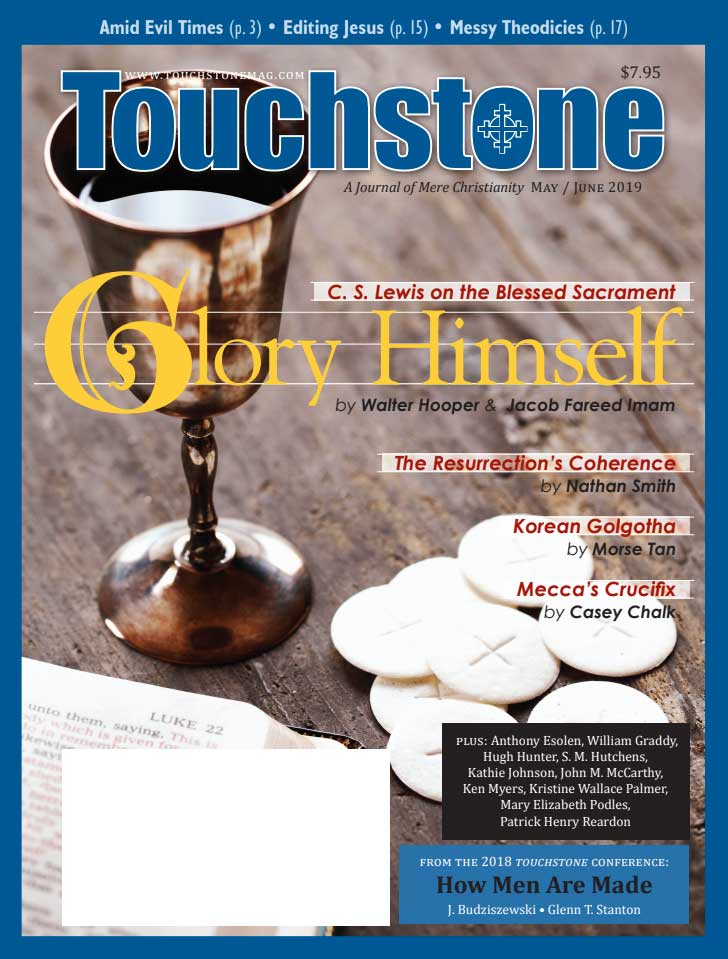
View
Theodicies & Messy Desks
Hugh Hunter on the Infinite Problem of Goods & Evil
When I teach the philosophy of theodicies, I always make sure to introduce Hunter's rule of theodicies: Don't open with 'em. Like a slowly building joke, a theodicy is all about the journey. Skip the intricate architecture of assumptions, and the whole thing collapses into un-persuasive glibness. That's because a theodicy is an answer to a problem, specifically to some version of the Problem of Evil, and if you don't define the problem, your answer won't make any sense.
The Problem of Evil can be captured, I think, in three assumptions. It is a problem because the assumptions seem inconsistent, and yet we Christians believe all three.
THIS ARTICLE ONLY AVAILABLE TO SUBSCRIBERS.
FOR QUICK ACCESS:
Hugh Hunter (Ph.D.) is a philosopher living in Ottawa.
A Journal of Mere Christianity—Delivered to Your Door
- Essays on theology, culture, and the Church
- Contributors from across the Christian traditions

Six print issues (one year) of Touchstone, plus full online access and PDF downloads for only $39.95.

Get a one-year full-access subscription to the Touchstone online archives for only $19.95.
bulk subscriptions
Order Touchstone subscriptions in bulk and save $10 per sub! Each subscription includes 6 issues of Touchstone plus full online access to touchstonemag.com—including archives, videos, and pdf downloads of recent issues for only $29.95 each! Great for churches or study groups.
Transactions will be processed on a secure server.
more on Philosophy from the online archives

25.6—Nov/Dec 2012
The Loss of Aristotelian Logic & the Social, Moral & Sexual Consequences by Peter Kreeft

29.5—Sept/Oct 2016
on Past & Present Atheism & the Invention of Happiness by Jordan Bissell
more from the online archives


32.6—November/December 2019
An Open Letter to Christian Readers of Jordan Peterson & Roger Scruton by James Bryson
5.3—Summer 1992
Everything You Need to Know About Morality & the Bible by David Mills
calling all readers
Please Donate
"There are magazines worth reading but few worth saving . . . Touchstone is just such a magazine."
—Alice von Hildebrand
"Here we do not concede one square millimeter of territory to falsehood, folly, contemporary sentimentality, or fashion. We speak the truth, and let God be our judge. . . . Touchstone is the one committedly Christian conservative journal."
—Anthony Esolen, Touchstone senior editor
