A THOUSAND WORDS by Mary Elizabeth Podles
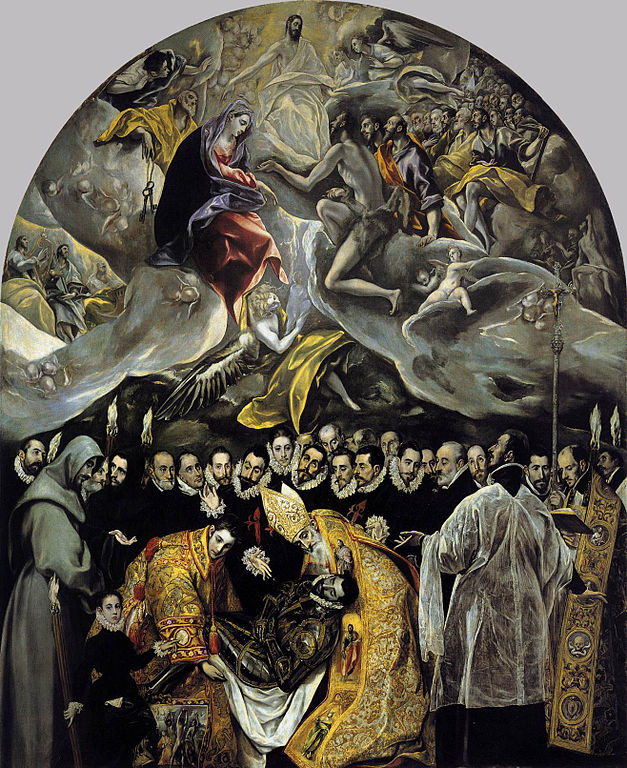
The Burial of the Count of Orgaz
Domenikos Theotokopoulos, called El Greco
Sometimes we still have the actual contracts that artists signed which specified the exact nature of the painting to be produced, and they can be an invaluable tool for the art historian. Such is the case with El Greco's Burial of the Count of Orgaz: both the original contract and, alas, the records of the litigation subsequent to it survive in the archives in Toledo, Spain. The painting was commissioned for the Church of Santo Tomé to decorate the burial chapel of its fourteenth-century benefactor, Gonzalo Ruiz de Toledo, later known as the Count of Orgaz, and was to depict the story of his funeral. So great was the count's virtue and generosity, ran the story, that at his death Saints Stephen and Augustine appeared and lowered his body into its tomb in this very chapel.
The painting fills nearly the whole wall of the small funerary chapel for which it was painted. It is divided roughly in halves, into a heavenly zone above and an earthly one below. In the heavens, Christ sits enthroned far aloft, and below him on billowing clouds of glory sit Mary, John the Baptist, and a host of prophets and saints; identifiable among them are Moses, David, Peter, and the two St. Jameses. In the center, an angel, spiraling upward, breaks through the clouds, bearing the soul of the count heavenwards; in the Byzantine tradition, his soul is represented as a little child, newly born to eternal life (El Greco trained as an icon painter in his native Crete).
After he left Crete, El Greco went to Venice and came under the influence of the painter Tintoretto. His human figures grew attenuated, and his brushwork loosened and became almost impressionistic. The upper half of the picture is painted in this loose Venetian style, perhaps to suggest a vision that is not describable in natural terms: abstracted from earthbound restrictions, the light flickers and the forms twist ecstatically and dissolve into transparency among the swirling clouds.
Not so, however, in the middle zone: here everything is geometrically ordered and portrait-like in its precision. El Greco has presented the fourteenth-century funeral according to the customs he knew, and dressed its participants in the black clothes and lace of sixteenth-century Toledo, as if to make the miraculous event present in his own times. We assume that this chorus line of worthies contains portraits of the painter's contemporaries, so carefully are their features and the cut of their whiskers portrayed, and yet with a few exceptions (the priest is presumably the pastor of Santo Tomé, a friend of his parishioner El Greco), their real identities have been lost.
Painter & Son
Just above the head of St. Stephen and the startled gentleman's gesticulating hand is a man who looks us directly in the eye. Generally, this is a clue that we are looking at a portrait of the artist, for it is he who conducts us into the space of the picture and presents the scene to us. It is a reasonable guess that this is El Greco; a later self-portrait shows us the same high-domed forehead, heavy-lidded eyes, and long hooked nose.
El Greco regarded himself as more than a mere craftsman, but a philosopher and thinker as well as a painter, and thus worthy to stand among the intellectuals and nobles of his time. If they, the contemporaries of El Greco, anchor their own times between the events of the past (the burial) and the eternal, it is El Greco's direct gaze that links us, the viewers, to the world of his painting.
Still another figure makes direct eye contact: the little page at the lower left, who directs our attention to the dead count. This is a portrait of the painter's own son. The artist has signed his name on the boy's handkerchief, and dated it, not with the date of the painting (which we know from the documents to be 1586–1588), but with 1578, the year of his son Jorge Manuel's birth. Thus El Greco links the birth of his best work, his son, with the miracle of the count's death. Not only does the boy look into our eyes, but he also gently touches St. Stephen's sleeve, as if to remind the saint of our presence, just outside the picture
space.
More Real than the Real World
Mary Elizabeth Podles is the retired curator of Renaissance and Baroque art at the Walters Art Museum in Baltimore, Maryland. She is the author of A Thousand Words: Reflections on Art and Christianity (St. James Press, 2023). She and her husband Leon, a Touchstone senior editor, have six children and live in Baltimore, Maryland. She is a contributing editor for Touchstone.
A Journal of Mere Christianity—Delivered to Your Door
- Essays on theology, culture, and the Church
- Contributors from across the Christian traditions
Six print issues (one year) of Touchstone, plus full online access and PDF downloads for only $39.95.
Get a one-year full-access subscription to the Touchstone online archives for only $19.95.
bulk subscriptions
Order Touchstone subscriptions in bulk and save $10 per sub! Each subscription includes 6 issues of Touchstone plus full online access to touchstonemag.com—including archives, videos, and pdf downloads of recent issues for only $29.95 each! Great for churches or study groups.
Transactions will be processed on a secure server.
more on art from the online archives
more from the online archives
calling all readers
Please Donate
"There are magazines worth reading but few worth saving . . . Touchstone is just such a magazine."
—Alice von Hildebrand
"Here we do not concede one square millimeter of territory to falsehood, folly, contemporary sentimentality, or fashion. We speak the truth, and let God be our judge. . . . Touchstone is the one committedly Christian conservative journal."
—Anthony Esolen, Touchstone senior editor