





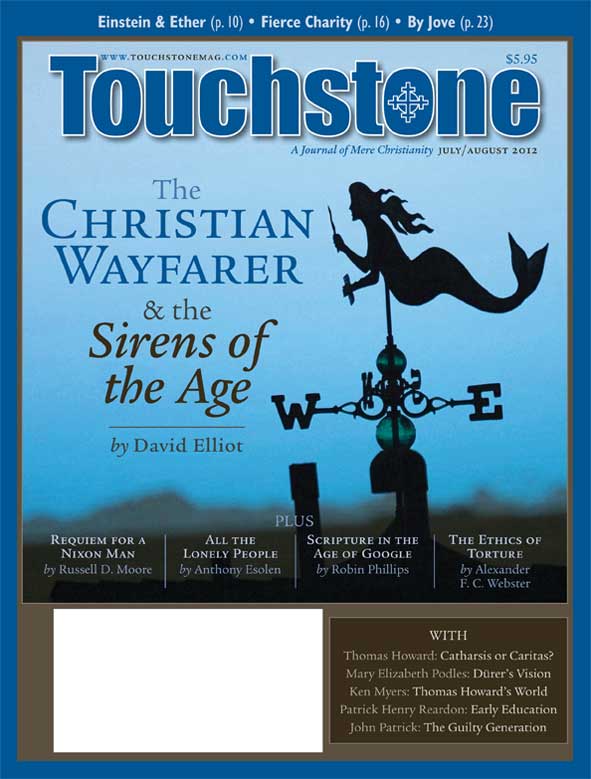
A Thousand Words
Albrecht Dürer's Vision of the Seven Candlesticks
by Mary Elizabeth Podles
In 1498, Albrecht Dürer published his Apocalypse, the first book to be planned, illustrated, and published by an artist. It was an audacious undertaking for a 27-year-old. No doubt he hoped to cash in on the anxiety that the world would end in a round-numbered year, 1500 in his case, but there was no guarantee of success for such a new departure. For one thing, Dürer's illustrations claimed the front sides of each page, while the text flowed in a continuous stream on the reverse, not necessarily in direct juxtaposition to the scenes illustrated. That is, the illustrations were trumps, and the biblical text secondary.

Vision of the Seven Candlesticks
And what illustrations they were. Even today it is hard for us to conceive of the Four Horsemen without thinking of Dürer's flying wedge of terrors. But perhaps even more striking is his Vision of the Seven Candlesticks, in which the Evangelist describes the beatific vision in symbolic terms:
. . . on turning I saw seven golden lampstands, and in the midst of the lampstands one like a son of man, clothed with a long robe and with a golden girdle round his breast; his head and his hair were white as white wool, white as snow; his eyes were like a flame of fire, his feet were like burnished bronze, refined as in a furnace, and his voice was like the sound of many waters; in his right hand he held seven stars, from his mouth issued a sharp two-edged sword, and his face was like the sun shining in full strength.
Art historians love to find visual sources borrowed by their artists. Dürer drew on the earlier German Bible of Anton Koberger (1483) for his composition: a rather minimalist and literal rendering of the text in woodcut, with the vision set inside a conventional mandorla of clouds. But in Dürer's hands the same image becomes hallucinatory and surreal.
Master of the Woodcut
What is it that makes Dürer's image so compelling? Partly it is his mastery of the woodcut medium, even though it is at best an intractable one. In order to lock into the press and print with typeface, each line in the woodcut must be raised in relief. That is, all of the area that prints as white must be cut away by the artisan's knife, leaving behind narrow raised ridges that hold the ink and print as black lines.
In the early days of printing, most woodcuts were no more skillfully done than Koberger's. But Dürer, who trained with his father as a goldsmith and only later turned to art, transformed the language of the medium and made a new range of effects possible. Dürer drew with a broad-nibbed pen directly on the pearwood block, and, at the beginning, he was probably the only one skilled enough to cut his own designs.
By the time Dürer composed and cut the Vision of the Seven Candlesticks, he had gained full mastery of the woodcut line and its possibilities. He was able to make exact renderings and multiple copies of his autograph drawings: we, in the age of the Xerox machine, fail to realize the revolutionary impact of the early print media. From Dürer onward, printing would never be the same.
Mystical Forms
We should look a little more closely, then, at Dürer's Vision. The two figures, John and the Holy One on the throne, are fully articulated in space and speak an eloquent emotional language of gesture. Dürer by this time had been to Italy and absorbed the lessons of the budding Italian Renaissance. But the space his figures occupy is clearly the realm of the imagination and the supernatural, with its floating lampstands and startling effects of light around Christ's head and hand.
Mary Elizabeth Podles is the retired curator of Renaissance and Baroque art at the Walters Art Museum in Baltimore, Maryland. She is the author of A Thousand Words: Reflections on Art and Christianity (St. James Press, 2023). She and her husband Leon, a Touchstone senior editor, have six children and live in Baltimore, Maryland. She is a contributing editor for Touchstone.
A Journal of Mere Christianity—Delivered to Your Door
- Essays on theology, culture, and the Church
- Contributors from across the Christian traditions

Six print issues (one year) of Touchstone, plus full online access and PDF downloads for only $39.95.

Get a one-year full-access subscription to the Touchstone online archives for only $19.95.
bulk subscriptions
Order Touchstone subscriptions in bulk and save $10 per sub! Each subscription includes 6 issues of Touchstone plus full online access to touchstonemag.com—including archives, videos, and pdf downloads of recent issues for only $29.95 each! Great for churches or study groups.
Transactions will be processed on a secure server.
more on art from the online archives
32.4—July/August 2019
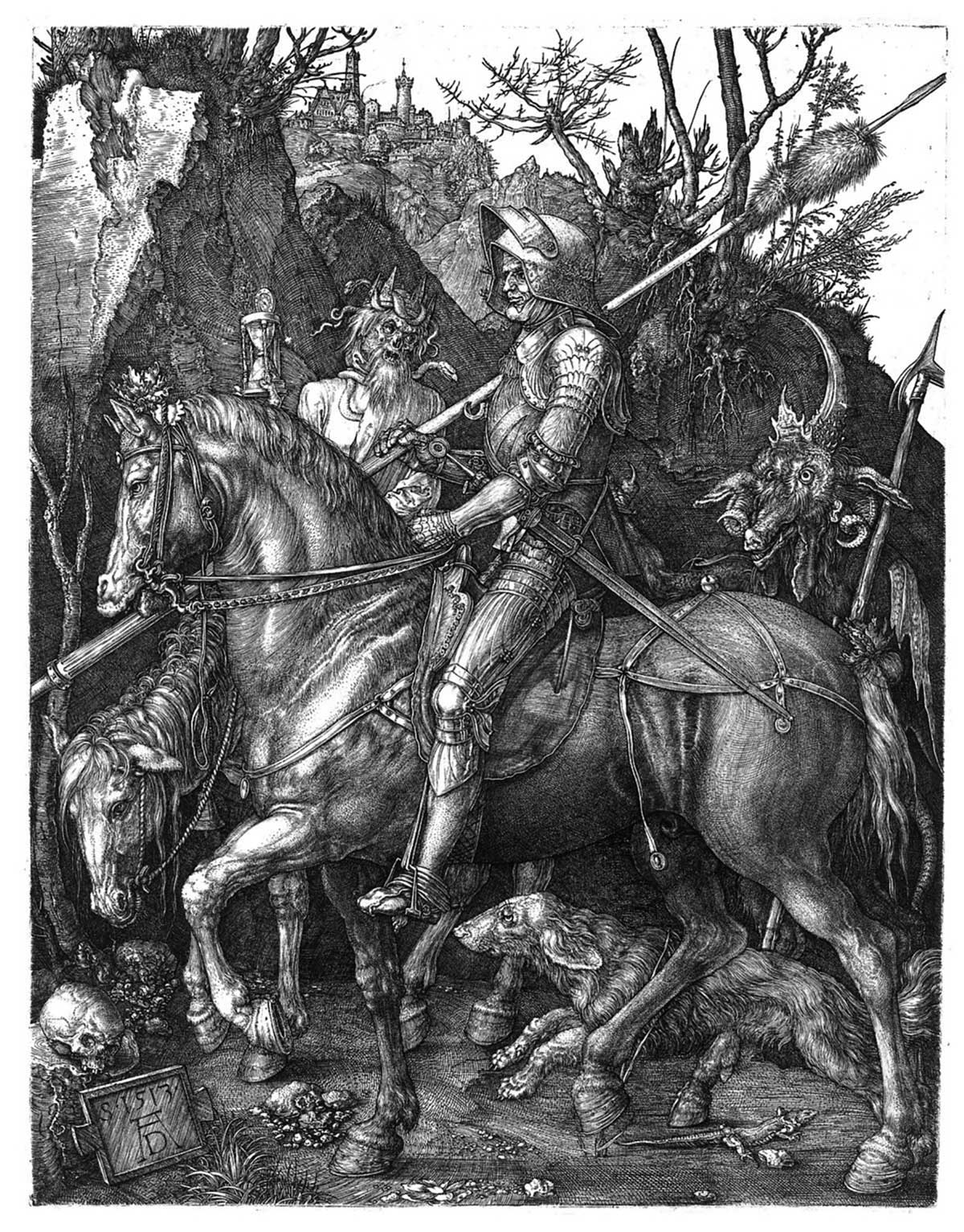
on Single-Mindedness in Durer's Ritter, Tod, und Teufel by Anthony Costello
33.2—March/April 2020
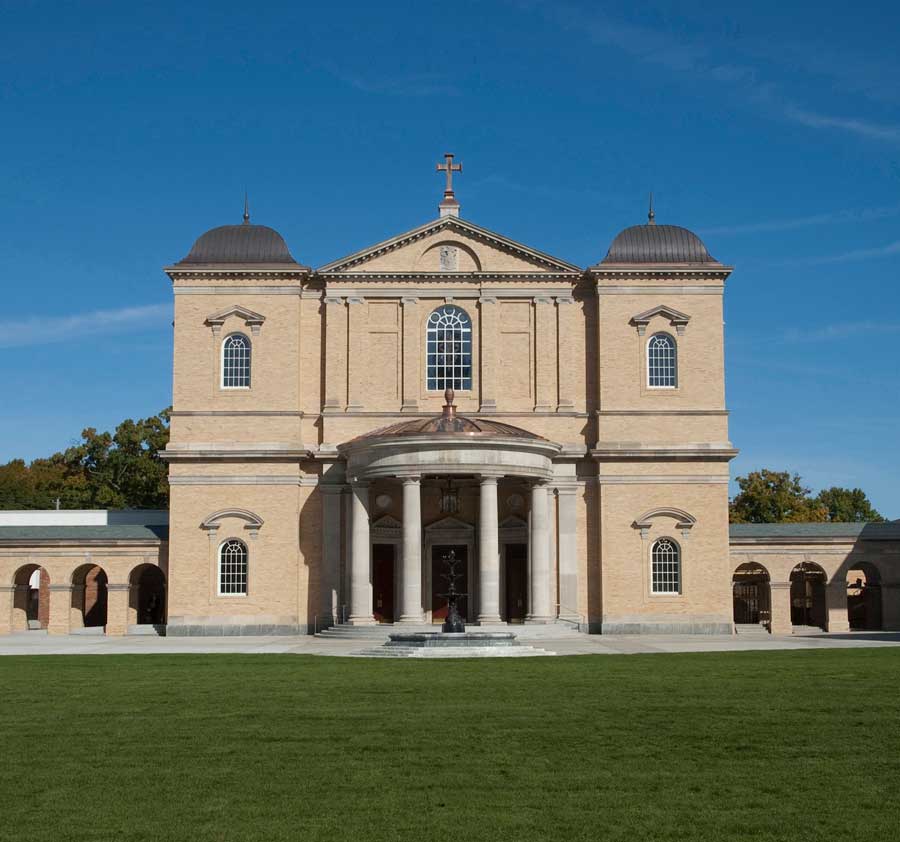
An Architectural Sign of Mere Christianity by Michael Ward
more from the online archives

26.1—Jan/Feb 2013
Manly Chastity, Hedonism & the Law of Non-contradiction by Anthony Esolen
29.2—March/April 2016
The History of Family Strength in America May Reveal Good News by Allan C. Carlson
calling all readers
Please Donate
"There are magazines worth reading but few worth saving . . . Touchstone is just such a magazine."
—Alice von Hildebrand
"Here we do not concede one square millimeter of territory to falsehood, folly, contemporary sentimentality, or fashion. We speak the truth, and let God be our judge. . . . Touchstone is the one committedly Christian conservative journal."
—Anthony Esolen, Touchstone senior editor


