




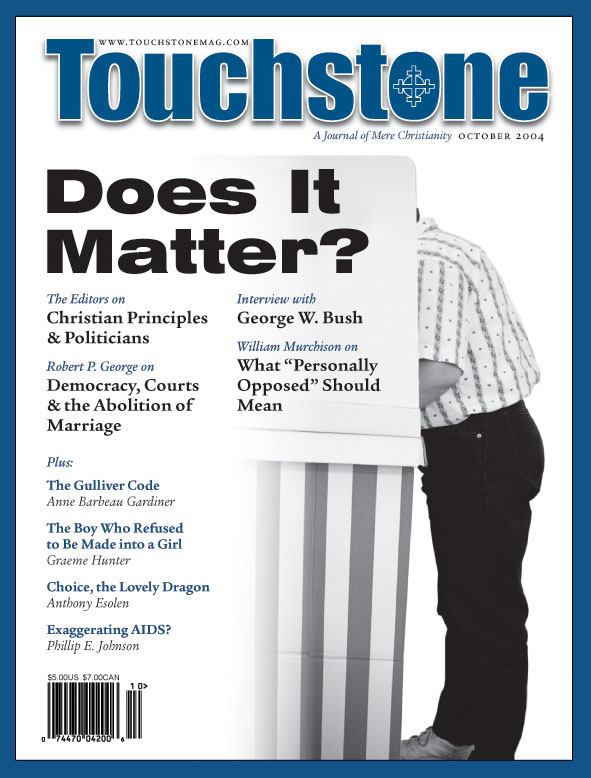
High Courts & Misdemeanors
Lochnerizing Courts & the Abolition of Marriage
by Robert P. George
Judges are not legislators. The legitimacy of their decisions, particularly those decisions that displace the judgments of the people’s elected representatives, depends entirely on the truth of the claim that the law authorizes the court to settle the matter. When this claim is false, a judicial edict is not redeemed by its good intentions and even its good consequences (if the consequences of the edict in fact turn out to be good).
Decisions in which the courts usurp the constitutionally granted authority of the people in a basically just democratic polity are not merely incorrect; they are themselves unconstitutional. Any such ruling usurps the just authority of the people to govern themselves through the constitutional procedures of deliberative democracy.
Judicial Powers
The power of judicial review is nowhere mentioned in the Constitution. There were, and are, scholars and statesmen who believe that courts should not be granted the power to invalidate legislation in the name of the Constitution. In reaction to Chief Justice John Marshall’s opinion in the 1803 case of Marbury v. Madison, Thomas Jefferson warned that judicial review would lead to a form of despotism.
The courts themselves have claimed the power of judicial review based on inferences drawn from the Constitution’s identification of itself as supreme law, and the nature of the judicial office. But even if we credit these inferences, as I am inclined to do, it must be said that early supporters of judicial review, including Chief Justice Marshall himself, did not imagine that the federal and state courts would exercise the sweeping powers they have come to exercise today. Jefferson and the critics were, it must be conceded, more prescient.
As for Marshall’s ruling in Marbury, a good case can be made that the power he actually claimed for the courts was quite limited. What the Supreme Court decided in that case was that the Court itself was forbidden by the Constitution to exercise original jurisdiction putatively conferred upon it by the Judiciary Act of 1789. Marshall reasoned that Article III of the Constitution fixed the Court’s original jurisdiction and that Congress was powerless to expand it.
According to the constitutional scholar Robert Lowry Clinton, all this meant was that the Court was relying on its own interpretation of the Constitution in deciding what it could and could not do within its own sphere. This was entirely consistent with its recognizing a like power of the other branches of government to interpret the Constitution for themselves in deciding what they could and could not do in carrying out their constitutional functions.
However that may be—and I am not engaging the legitimacy of judicial review here—the power of the judiciary has expanded massively, and many judges now hold a clearly unconstitutional view of their power to overturn legislative acts that strike them as unenlightened or otherwise undesirable. Whatever the exact relation of the courts to the legislatures, the courts, including the Supreme Court of the United States, regularly go beyond their constitutional limits.
This expansion began slowly. Even if we read Marbury more broadly than Professor Clinton reads it, treating it as a case in which the justices presumed to tell the Congress what it could and could not do, it would be another 54 years before the Supreme Court would do it again. And it could not have chosen a worse occasion.
Robert P. George is McCormick Professor of Jurisprudence and Director of the James Madison Program in American Ideals and Institutions at Princeton University (web.princeton.edu/sites/jmadison). His books include In Defense of Natural Law (Oxford University Press) and Conscience and Its Enemies (ISI Books). He has served as chairman of the U.S. Commission on International Religious Freedom. He is a senior editor of Touchstone.
A Journal of Mere Christianity—Delivered to Your Door
- Essays on theology, culture, and the Church
- Contributors from across the Christian traditions

Six print issues (one year) of Touchstone, plus full online access and PDF downloads for only $39.95.

Get a one-year full-access subscription to the Touchstone online archives for only $19.95.
bulk subscriptions
Order Touchstone subscriptions in bulk and save $10 per sub! Each subscription includes 6 issues of Touchstone plus full online access to touchstonemag.com—including archives, videos, and pdf downloads of recent issues for only $29.95 each! Great for churches or study groups.
Transactions will be processed on a secure server.
more on marriage from the online archives

24.1—January/February 2011
Marriage Thrives in Reality, Not in Our Dreams by Nathan Schlueter

32.1—January/February 2019
Divine Love & the Love of Man & Woman Surpass Mere Consent by Anthony Esolen
more from the online archives

28.2—March/April 2015
Man, Woman & the Mystery of Christ
An Evangelical Protestant Perspective by Russell D. Moore
29.3—May/June 2016
Our Choice Is Obedience or Jesus as Anti-Christ by Anthony Esolen
calling all readers
Please Donate
"There are magazines worth reading but few worth saving . . . Touchstone is just such a magazine."
—Alice von Hildebrand
"Here we do not concede one square millimeter of territory to falsehood, folly, contemporary sentimentality, or fashion. We speak the truth, and let God be our judge. . . . Touchstone is the one committedly Christian conservative journal."
—Anthony Esolen, Touchstone senior editor
