





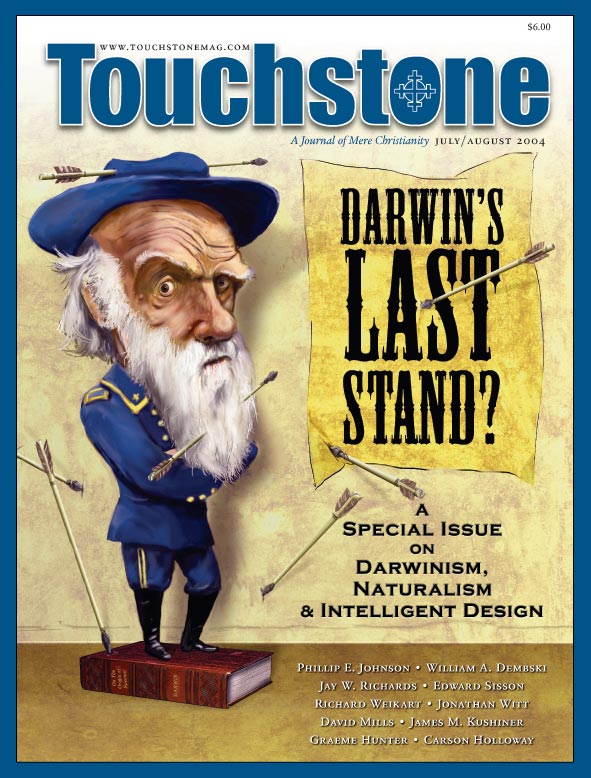
Eugenocide
Darwinism & the Rise of German Eugenics
by Richard Weikart
Darwinism was a matter of life and death, and no one understood this better than Darwin. Immediately after explaining that each organism “has to struggle for life, and to suffer great destruction,” he closed his chapter on “The Struggle for Existence” in On the Origin of Species on a more comforting note: “When we reflect on this struggle, we may console ourselves with the full belief, that the war of nature is not incessant, that no fear is felt, that death is generally prompt, and that the vigorous, the healthy, and the happy survive and multiply.”
THIS ARTICLE ONLY AVAILABLE TO SUBSCRIBERS.
FOR QUICK ACCESS:
Richard Weikart is professor of history at California State University, Stanislaus, and author of From Darwin to Hitler: Evolutionary Ethics, Eugenics, and Racism in Germany and Hitler's Ethic: The Nazi Pursuit of Evolutionary Progress (both from Palgrave Macmillan). Some of his writings can be found at www.csustan.edu/history/faculty/weikart.
A Journal of Mere Christianity—Delivered to Your Door
- Essays on theology, culture, and the Church
- Contributors from across the Christian traditions

Six print issues (one year) of Touchstone, plus full online access and PDF downloads for only $39.95.

Get a one-year full-access subscription to the Touchstone online archives for only $19.95.
bulk subscriptions
Order Touchstone subscriptions in bulk and save $10 per sub! Each subscription includes 6 issues of Touchstone plus full online access to touchstonemag.com—including archives, videos, and pdf downloads of recent issues for only $29.95 each! Great for churches or study groups.
Transactions will be processed on a secure server.
more on evolution from the online archives

22.6—July/August 2009
on a Noble Defense Doomed by Darwinian Materialism by John G. West

32.2—March/April 2019
Flight from the Absolute: Cynical Observations on the Postmodern West, Volume II by Paul Gosselin by Louis Markos

22.8—November/December 2009
Looking for Beauty & Justice 150 Years After Darwin’s Classic by Charles Taliaferro
more from the online archives

22.3—April 2009
Neil Postman's Amusing Ourselves to Death: Public Discourse in the Age of Show Business by J. Daryl Charles

32.4—July/August 2019
on Single-Mindedness in Durer's Ritter, Tod, und Teufel by Anthony Costello
calling all readers
Please Donate
"There are magazines worth reading but few worth saving . . . Touchstone is just such a magazine."
—Alice von Hildebrand
"Here we do not concede one square millimeter of territory to falsehood, folly, contemporary sentimentality, or fashion. We speak the truth, and let God be our judge. . . . Touchstone is the one committedly Christian conservative journal."
—Anthony Esolen, Touchstone senior editor
