




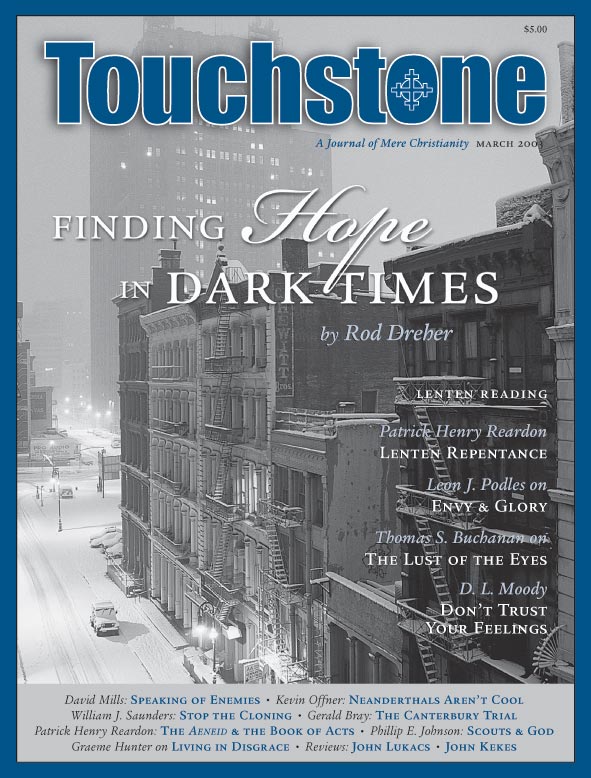
Good Without God?
The Art of Life
by John Kekes
Ithaca/London: Cornell University Press, 2002
(267 pages; $29.95, hardcover)
reviewed by Graeme Hunter
During the early decades of the twentieth century philosophy became a specialized subject, pursued by professionals and preoccupied with technical problems and method. This change resulted in the elimination of much obscurity and dilettantism and raised the standard of clarity and precision demanded of philosophical works. It also resulted in the alienation of those who traditionally turned to philosophy for help with their reflections but who had no interest in technicalities. This book is addressed to them.”
So says the philosopher John Kekes in the preface of this profound reflection on the art of living. And he keeps his promise, spurning the dried husks that are frequently marketed as “ethics.” Not that this book is an easy read. Though not pretentious, it is still philosophy. Its merit is to be worth the effort needed to understand it.
Just as cities can be made beautiful by their elegant layout or through decorative monuments, so books can be rewarding through the new shape they give to our thoughts or through aphoristic insights strategically placed along the way. Kekes’s principal aim is to reshape our moral thinking—that is what makes his book a challenge—but some minor monuments enliven its progress. Here is a sampling:
On Rights: “A right is a claim against others. This claim may or may not be cashed in. People may have a right to commit suicide, have an abortion, and see pornographic movies. But that is not an invitation to engage in these activities. There is a question of when rights should be acted on.”
On Depth: “People lack depth if their minds are cluttered with accurate information about trivial facts, and someone may possess great depth on some subject and yet be mistaken about it.”
On Self-Respect versus Self-Esteem: “The essential moral difference that is obscured by using self-respect and self-esteem interchangeably is that people’s moral achievements may vary and those who have realized their reasonable potentialities are entitled to feel better about themselves than those who have failed.”
On Choice: “Choice becomes more important for people whose personal excellences are insecurely formed. . . . [It] becomes an indication of lack of excellence rather than a condition of it.”
Each of the aphorisms above says something significant and original about matters that concern most of us today, about which we recognize the need to reflect. But these lines do not occur in isolation. They are woven into the fabric of a sustained discussion about what it is that makes a good life and to what extent it lies in our power to lead one.
So what does account for the goodness of good lives? Kekes is too wise to think that he can exhaust the topic, but he offers a definition that applies to the broad range of good lives he intends to consider: “Good lives combine personal satisfactions, derived from engagements in projects in a manner that reflects one’s ideals of personal excellence, and moral acceptability, which depends on conformity to the universal, social and individual requirements of morality.” There is a lot packed into this definition, but it is not restrictive. In keeping with Kekes’s pluralism, it allows us the possibility of organizing good lives around excellences, ideals, and projects that other equally good people do not share. In the first part of his book, he illustrates his pluralism by examining a number of good lives organized around principles as different as decency, moral authority, and honor.
Graeme Hunter is a contributing editor to Touchstone and Research Professor of Philosophy at Dominican University College in Ottawa. He is the author of Radical Protestantism in Spinoza's Thought (Ashgate).
A Journal of Mere Christianity—Delivered to Your Door
- Essays on theology, culture, and the Church
- Contributors from across the Christian traditions

Six print issues (one year) of Touchstone, plus full online access and PDF downloads for only $39.95.

Get a one-year full-access subscription to the Touchstone online archives for only $19.95.
bulk subscriptions
Order Touchstone subscriptions in bulk and save $10 per sub! Each subscription includes 6 issues of Touchstone plus full online access to touchstonemag.com—including archives, videos, and pdf downloads of recent issues for only $29.95 each! Great for churches or study groups.
Transactions will be processed on a secure server.
more from the online archives
32.1—January/February 2019
The Diabolical Failure of Leaders in the Present Crises by James M. Kushiner
33.3—May/June 2020
Maternal Body: A Theology of Incarnation from the Christian East by Carrie Frederick Frost
Fertile Ground: A Pilgrimage Through Pregnancy by Laura S. Jansson by Agnes R. Howard

28.2—March/April 2015
Why Scientism's Cherished Progress Narrative Fails by Jonathan Witt
calling all readers
Please Donate
"There are magazines worth reading but few worth saving . . . Touchstone is just such a magazine."
—Alice von Hildebrand
"Here we do not concede one square millimeter of territory to falsehood, folly, contemporary sentimentality, or fashion. We speak the truth, and let God be our judge. . . . Touchstone is the one committedly Christian conservative journal."
—Anthony Esolen, Touchstone senior editor
