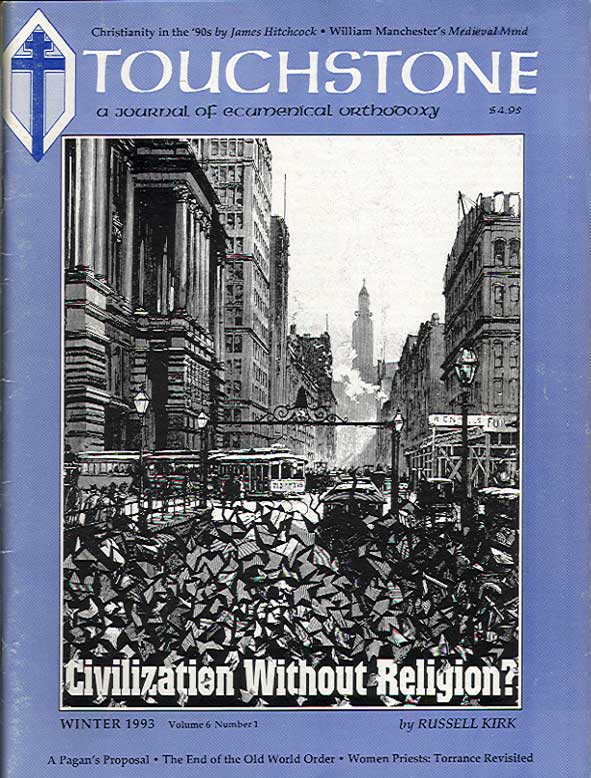
In Stillness Tried by James Hitchcock

In Stillness Tried

Christianity in the ’90s

History is always full of uncertainties, and perhaps that is the only unchanging lesson which it teaches. Both God's providence and human freedom mean, among other things, that the future is never merely projected on a straight line from the present.

But the 1990s seem perhaps more uncertain than any time since 1945, and seldom in the memory of most living people is there less obvious assurance as to where the world is going.

Often society seems to be simply carried along by the overwhelming power of events, to which human beings must somehow adapt, which they can barely hope to affect, much less to control. During the 1930s the reality of economic depression dominated everything, and the first half of the 1940s was dominated by war. Beginning in 1945 peoples all over the world, especially Americans, seemed at last to have the opportunity to build the kind of world they wanted.

On the whole, they did a reasonably good job. The United States entered the most prosperous period in its history and assumed a position of leadership in the world which was mainly beneficial. There was a return to fundamental values, especially religion and family life. Elsewhere in the world there was a similar recover of prosperity, as well as new beginnings for many former colonial peoples. Although the evil empire of communism was strong, even then its foundations were rotting.

Practically no one foresaw the character of the 1960s, which was anything but a linear development from the previous decade. What is usually called “the sixties” actually began about 1966 and lasted until the mid-1970s. The decade remains in many ways mysterious as to what precisely caused the great explosion which deeply affected every aspect of life—not only politics but also religion, education, families, personal morality, and virtually everything else that could be named. Even those who were the ostensible leaders of these new movements did not claim to control them, and everyone was to some degree or another carried along by gale forces. (Drugs serve as a revealing metaphor for the age—those who used them were ostentatiously asserting their freedom even as they were choosing the vilest kind of slavery.)

Common sense saw that the New Left could not last, but what followed was not precisely predictable, although in retrospect it was quite logical. The “me generation” was not a repudiation of New Left values, as conventional wisdom has it, but their transfer and extension—the cult of self-assertion and social destruction, which had taken primarily political forms in the 1960s, was now kindled in every area of life. Those who had previously “liberated” themselves from government and other structures of authority now began exploring “inner space.”

It was predictable (and often predicted) that there would be a reaction against all this, which can be conveniently dubbed The Reagan Era. During the 1980s values which had been dismissed as obsolete—patriotism, religious faith, self-reliance, the family, tradition—were given new respectability through the efforts of often highly intelligent and creative “conservatives” who succeeded in gaining public attention and changing the terms of respectable discussion. President Reagan was not primarily the cause of this, and his own contributions were relatively modest. But the White House remains a “bully pulpit,” and the fact hat he occupied it for eight years forced people to listen to the New Right even when they may not have wanted to.

Inevitably, Christians have tended to respond to broad cultural movements rather than to shape them, except in rare cases. As the churches lurched sharply leftward in the 1960s, many people followed, many more drifted away, and others began to take steps to preserve and strengthen authentic faith in the midst of a culture which was experienced as overwhelmingly hostile. The era of the “me generation” made expressions of deep personal feeling publicly respectable in ways they had not been before, and highly expressive religious movements such as the charismatic renewal were able to use that to give authentic witness.

The Reagan era was dominated on one level by the questions of religion’s public role, as bold believers, and some sympathetic non-believers, insisted that faith has to be more than personal and subjective and must attempt to shape the culture.

Throughout the period 1929–45, and again in 1965–90, Christians in a sense let the world set their agendas, as liberal Christians insist it must. Whether or not church members were embracing the spirit of the age or opposing it, they did not have to worry much about discovering their task—it seemed obviously to be that of relating in some way to the march of history.


James Hitchcock is Professor emeritus of History at St. Louis University in St. Louis. He and his late wife Helen have four daughters. His most recent book is the two-volume work, The Supreme Court and Religion in American Life (Princeton University Press, 2004). He is a senior editor of Touchstone.

A Journal of Mere Christianity—Delivered to Your Door

  • Essays on theology, culture, and the Church
  • Contributors from across the Christian traditions

Subscribe (Print + Online)

Six print issues (one year) of Touchstone, plus full online access and PDF downloads for only $39.95.

Subscribe (Online Only)

Get a one-year full-access subscription to the Touchstone online archives for only $19.95.


bulk subscriptions

Order Touchstone subscriptions in bulk and save $10 per sub! Each subscription includes 6 issues of Touchstone plus full online access to touchstonemag.com—including archives, videos, and pdf downloads of recent issues for only $29.95 each! Great for churches or study groups.

Transactions will be processed on a secure server.


more from the online archives

24.1—January/February 2011

The Romance of Domesticity

Marriage Thrives in Reality, Not in Our Dreams by Nathan Schlueter

20.4—May 2007

Children of the Reformation

A Short & Surprising History of Protestantism & Contraception by Allan C. Carlson

19.4—May 2006

Liberalism as Religion

The Culture War Is Between Religious Believers on Both Sides by Howard P. Kainz

calling all readers

Please Donate

"There are magazines worth reading but few worth saving . . . Touchstone is just such a magazine."
—Alice von Hildebrand

"Here we do not concede one square millimeter of territory to falsehood, folly, contemporary sentimentality, or fashion. We speak the truth, and let God be our judge. . . . Touchstone is the one committedly Christian conservative journal."
—Anthony Esolen, Touchstone senior editor

Support Touchstone

00