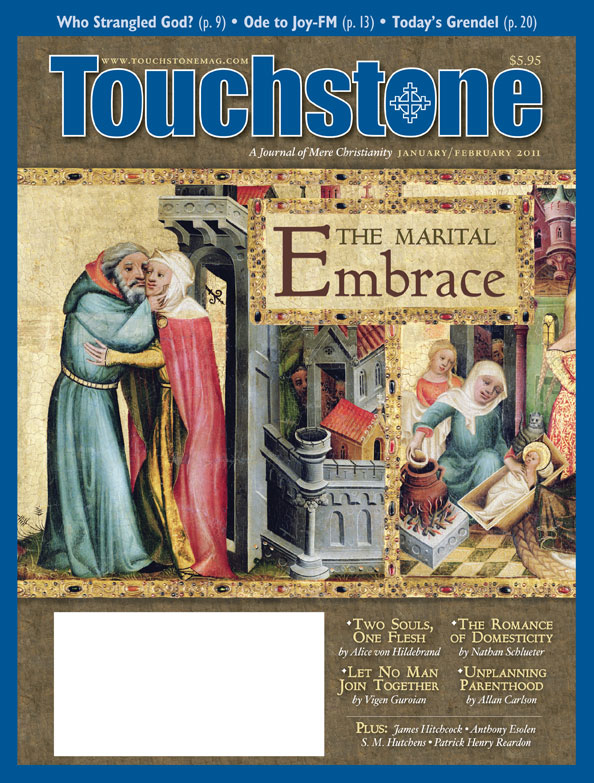
Let No Man Join Together by Vigen Guroian

Let No Man Join Together

An Orthodox Christian View of a Beseiged Sacrament

by Vigen Guroian

In recent years, homosexual persons and their supporters in North America have argued that marriage should be redefined to include the union of two persons of the same sex. Increasingly, this argument has been cast as a civil liberties issue: homosexual persons seek constitutional rights and liberties that have long been denied to them, key among these being marriage.

Same-sex marriage, however, is not just a legal matter. It is also a religious issue. For millennia, Western civilization has strictly understood marriage to be the union between a man and a woman. This definition, grounded in biblical beliefs about the nature of God and humanity, was reflected in common morality and civil law. Only recently has this understanding been questioned.

At present, the debate is principally over marriage between homosexual persons, but it is not likely to remain so. For if our society extends the boundaries of marriage’s meaning beyond the union of a man and a woman, there will remain no compelling reason under the law to deny “marital” status to heterosexual same-sex partners who seek the benefits that come with it, or, for that matter, to persons in polygamous relationships. This will explode the historical meaning of marriage that has obtained in our culture for millennia.

Under these circumstances, the gay and same-sex marriage issue obliges Orthodox Christians to be very clear about their Church’s theology of marriage, and why a partnership—and partnership is the appropriate term, not union or marriage—of any sort between persons of the same sex is not in character nuptial.

Understandings of Marriage

In pagan Rome during the first centuries of the Christian era, marriage was one of several acceptable forms of cohabitation and family life, and was available as a legal status only to free citizens. If two such persons, man and woman, lived together by consent in a regularized fashion and assumed the roles and responsibilities of husband and wife, then they were considered married under the law.

Roman law stipulated that marriage in its essence was not about intercourse but the free consent of the individuals entering into it. Marriage would exist, therefore, where there was the intention to form a household and did not require legal formalization, though that was available and qualified a couple for the special privileges accorded marriage. These included passing down the family name to children and inheritance of the father’s estate by the legitimate offspring of the marriage.

To this day, Western Christian understandings of marriage strongly reflect the Roman principle of consent. This consensual view of marriage became dominant in Latin and Western Christianity as the Church ingested Roman law. To one degree or another, in Roman Catholic and Protestant traditions alike, consent was “baptized” as a central element of marriage. The Roman Catholic Church eventually defined marriage as a sacrament, but the principle of consent has been at least as important in its theology of marriage. The principle of consent lies behind the Roman Catholic Church’s belief that the bride and groom administer their marriage to one another and is reflected in its denial of divorce. (Space does not permit a more nuanced discussion of the Roman Catholic theology of marriage, especially more recent emphasis on the “nuptial mystery” by some writers, including John Paul II. This emphasis is more compatible with Orthodox theology.)

In the Orthodox tradition, however, consent was not “baptized” as the validation or essence of a marriage. The clerical officer (bishop or priest), representing the Church, marries the bride and groom, and the couple is by this act bonded as husband and wife to Christ and the Church. The conjugal love union, and not consent, is understood to be at the heart of marriage. Marriage is a sacrament of love. This love union is founded and grounded in God’s will, in his creative act of making mankind male and female, so that, through their love for one another and sexual union, a man and a woman may become “one flesh.” Consent properly belongs to betrothal and is incorporated in Orthodox rites for the same.


Vigen Guroian was, until his retirement, Professor of Religious Studies in Orthodox Christianity at the University of Virginia in Charlottesville. His books include Tending the Heart of Virtue: How Classic Stories Awaken a Child's Moral Imagination (2002) and The Orthodox Reality: Culture, Theology, and Ethics in the Modern World (Baker Academic, 2018).

A Journal of Mere Christianity—Delivered to Your Door

  • Essays on theology, culture, and the Church
  • Contributors from across the Christian traditions

Subscribe (Print + Online)

Six print issues (one year) of Touchstone, plus full online access and PDF downloads for only $39.95.

Subscribe (Online Only)

Get a one-year full-access subscription to the Touchstone online archives for only $19.95.


bulk subscriptions

Order Touchstone subscriptions in bulk and save $10 per sub! Each subscription includes 6 issues of Touchstone plus full online access to touchstonemag.com—including archives, videos, and pdf downloads of recent issues for only $29.95 each! Great for churches or study groups.

Transactions will be processed on a secure server.


more on christianity from the online archives
30.3—May/June 2017

Three Trojan Horses

Insider Attempts to Disorient the Orthodox by Alexander F. C. Webster

33.4—July/August 2020

The Joy of God

by S. M. Hutchens

25.3—May/Jun 2012

Just Sayin'

on What We Used to Know vs. What We Know Now by Thomas Howard


more from the online archives

21.10—December 2008

Savior in a Manger

Early Christian Teaching on the Incarnation & Redemption by Patrick Henry Reardon

21.1—January/February 2008

One Flesh of Purest Gold

John Chrysostom’s Discovery of the Blessings & Mysteries of Marriage by Mike Aquilina

30.4—July/Aug 2017

Soul Comforter

on Emily Dickinson & the Source of Our Hope by Josh Mayo

calling all readers

Please Donate

"There are magazines worth reading but few worth saving . . . Touchstone is just such a magazine."
—Alice von Hildebrand

"Here we do not concede one square millimeter of territory to falsehood, folly, contemporary sentimentality, or fashion. We speak the truth, and let God be our judge. . . . Touchstone is the one committedly Christian conservative journal."
—Anthony Esolen, Touchstone senior editor

Support Touchstone

00