





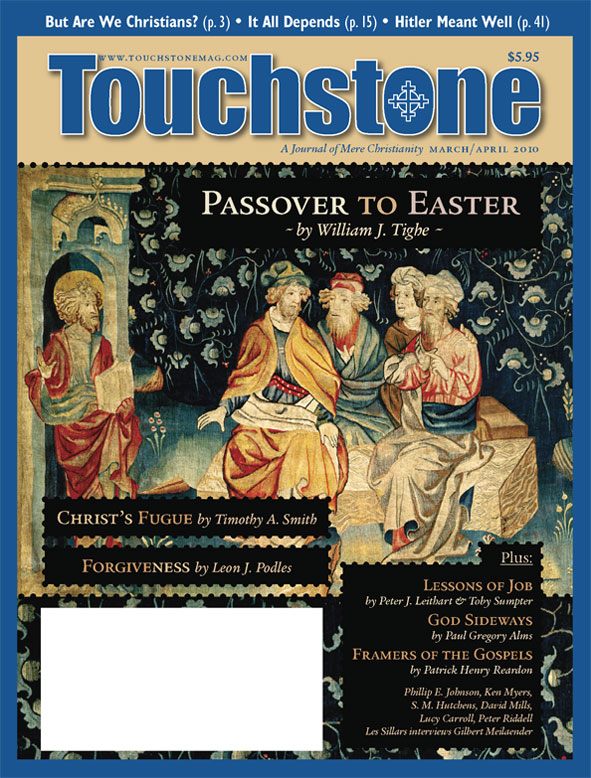
But Are We Christians?
Ecumenical Bedfellows of the Manhattan Declaration
According to the website of the British organization Ekklesia, which calls itself “the religion and society think-tank at the cutting edge of culture, spirituality, and politics,” St. Matthew’s in the City, an Anglican church in Auckland, commissioned a billboard depicting a glum-looking Joseph in bed with a disappointed Mary, over the legend, “Poor Joseph. God is a hard act to follow.” The agency that designed it said it was supposed “to challenge stereo-types about the way that Jesus was conceived, and get people talking about the Christmas story.” The church’s priest, clearly pleased with this clever bit of prig-baiting, identified the defecation as an effect of “progressive Christianity . . . distinctive in that not only does it articulate a clear view, [but it] is also interested in engaging those who differ.”
I was alerted to that little bijou while I was pondering the remarks of Protestants, Catholics, and Orthodox who would not sign the Manhattan Declaration because it presumes co-belligerency based on a common profession of the gospel. The protesting writers did not believe members of communions other than their own could be considered Christian, properly speaking, so cooperation based on fellowship in the gospel was impossible. While agreeing with their principles, I question their judgment of fact, finding occasion to remember what certain of their own authorities, all themselves downwind of “progressive Christianity,” have said about the ovinity of other folds’ sheep.
THIS ARTICLE ONLY AVAILABLE TO SUBSCRIBERS.
FOR QUICK ACCESS:
S. M. Hutchens is a senior editor and longtime writer for Touchstone.
A Journal of Mere Christianity—Delivered to Your Door
- Essays on theology, culture, and the Church
- Contributors from across the Christian traditions

Six print issues (one year) of Touchstone, plus full online access and PDF downloads for only $39.95.

Get a one-year full-access subscription to the Touchstone online archives for only $19.95.
bulk subscriptions
Order Touchstone subscriptions in bulk and save $10 per sub! Each subscription includes 6 issues of Touchstone plus full online access to touchstonemag.com—including archives, videos, and pdf downloads of recent issues for only $29.95 each! Great for churches or study groups.
Transactions will be processed on a secure server.
more on ecumenism from the online archives
31.4—July/August 2018
Labels & the Ecumenism of Discipleship by James M. Kushiner
more from the online archives


24.4—July/August 2011
The Cultural Marxists’ Strategic Assault on Religion, Life & Family by Patrick F. Fagan

32.1—January/February 2019
Answers Secular & Religious by Allan C. Carlson
calling all readers
Please Donate
"There are magazines worth reading but few worth saving . . . Touchstone is just such a magazine."
—Alice von Hildebrand
"Here we do not concede one square millimeter of territory to falsehood, folly, contemporary sentimentality, or fashion. We speak the truth, and let God be our judge. . . . Touchstone is the one committedly Christian conservative journal."
—Anthony Esolen, Touchstone senior editor
