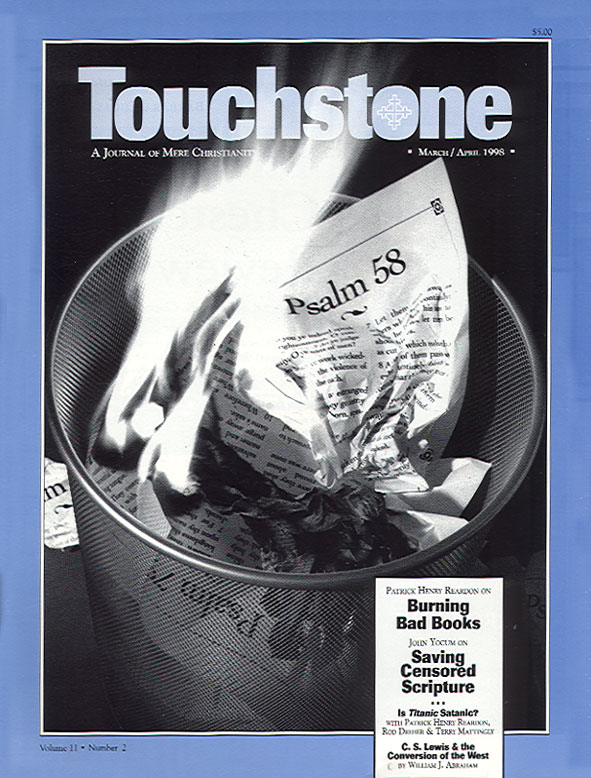
From Book Burning to Canon
On the Destruction & Preservation of Sacred & Profane Texts
by Patrick Henry Reardon
I have been known to take advantage of the special sales that local libraries run now and then with a view to making their limited shelf space available to newer titles, and once in a while I thereby discover some work or other that I am happy to add to my own little collection. Glancing up over my desk right now I espy, for example, more than a score of the Loeb Classics acquired in this way, and just behind me is an original French work of Henri Bergson similarly obtained.
Such windfalls do not come very often, however, and I presume that the books left unsold at the end of such special sales will, in due course, find their way to the nearest incinerator. (Indeed, I once rescued more than 70 volumes of Migne, both Greek and Latin, that I detected in a large stack of books already condemned to the flames and awaiting execution. These are now housed in my family’s library, the deserving objects of filial respect and deep affection.) By and by, the last copies of many books will perish in this way, and humanity will never hear of them again. That is to say, we enlightened, broadminded folk of the late twentieth century, for all our vaunted liberalism and freedom of thought, still regularly practice the burning of books.
I cannot believe this is a bad thing, in principle. If an arsonist were to torch the whole lot of the “new titles” section of any popular bookstore on a given day, to say nothing of the paperback displays at the local pharmacist’s or grocer’s, it is probable that he would not impoverish human culture by the slightest fraction. It is likely, rather, that he would only be hastening, for those books, the otherwise determined hour of their due retribution. That most volumes should eventually be burned is a principle on which the human race has acted for centuries.
In a similar vein, just a few days ago I inquired of a well-known American literary critic which living novelists he most favored. None, he responded, and then went on to remark that Flannery O’Connor and Walker Percy were the last novelists he could take seriously. I felt gratified to hear his severe assessment, as it confirmed my own layman’s impression of the present state of the novel. To suggest that these newer novels are not worth reading is, on the other hand, to imply that someday they must relinquish their shelf space and head for the furnace.
Natural Book Selection
Nonetheless, I myself am not disposed to burn books prematurely, preferring to let a kind of natural selection make that ultimate determination in the name of history. In literature, as in biology, there is a case to be made for the survival of the fittest, and, as any librarian knows, some books just seem to disappear forever, all by themselves.
Moreover, there lives an instinct in me that does not like to burn books at all, if it can be avoided, and I am reluctant to assume the heady responsibility for doing so. Thus I do it very rarely. Even back when I feared that my growing children might stumble across the family’s copies of Collette and D. H. Lawrence, unto the harming of their minds and souls, I simply concealed the offending volumes in a secret place rather than throw them out. As a matter of fact, I hid those copies so well that I have never been able to find them again, which is probably just as well, for I cannot imagine reading that sort of thing during these final years as I await my summons to come before the Throne.
One is impressed that some works of inestimable value have come down to us from antiquity only by the thinnest threads of survival. If my memory is accurate on the point, for instance, Suetonius’s Lives of the Caesars reached the age of print only by a single manuscript, which has since perished. It is a profoundly shuddering thought that the human race came so close to losing Suetonius altogether.
Even some important Christian works have reached us, humanly speaking, only by the narrowest margins of probability. For example, one thinks of how much poorer we would be without the works of St. Justin Martyr. One tries to imagine the yawning gap in our liturgical studies without Chapters 65–67 of the First Apology, or how incomplete would be the history of Christian metaphysics if we knew nothing of Justin’s theory of the logos spermatikos. Yet, except for a handful of quotations preserved in later authors, the texts of Justin have come down to us on but a single manuscript, Parisinus 450, bearing the date September 11, 1363. That is how close we came to losing Justin.
Patrick Henry Reardon is pastor emeritus of All Saints Antiochian Orthodox Church in Chicago, Illinois, and the author of numerous books, including, most recently, Out of Step with God: Orthodox Christian Reflections on the Book of Numbers (Ancient Faith Publishing, 2019).
A Journal of Mere Christianity—Delivered to Your Door
- Essays on theology, culture, and the Church
- Contributors from across the Christian traditions
Six print issues (one year) of Touchstone, plus full online access and PDF downloads for only $39.95.
Get a one-year full-access subscription to the Touchstone online archives for only $19.95.
bulk subscriptions
Order Touchstone subscriptions in bulk and save $10 per sub! Each subscription includes 6 issues of Touchstone plus full online access to touchstonemag.com—including archives, videos, and pdf downloads of recent issues for only $29.95 each! Great for churches or study groups.
Transactions will be processed on a secure server.
more from the online archives
calling all readers
Please Donate
"There are magazines worth reading but few worth saving . . . Touchstone is just such a magazine."
—Alice von Hildebrand
"Here we do not concede one square millimeter of territory to falsehood, folly, contemporary sentimentality, or fashion. We speak the truth, and let God be our judge. . . . Touchstone is the one committedly Christian conservative journal."
—Anthony Esolen, Touchstone senior editor