




When We Were Weird
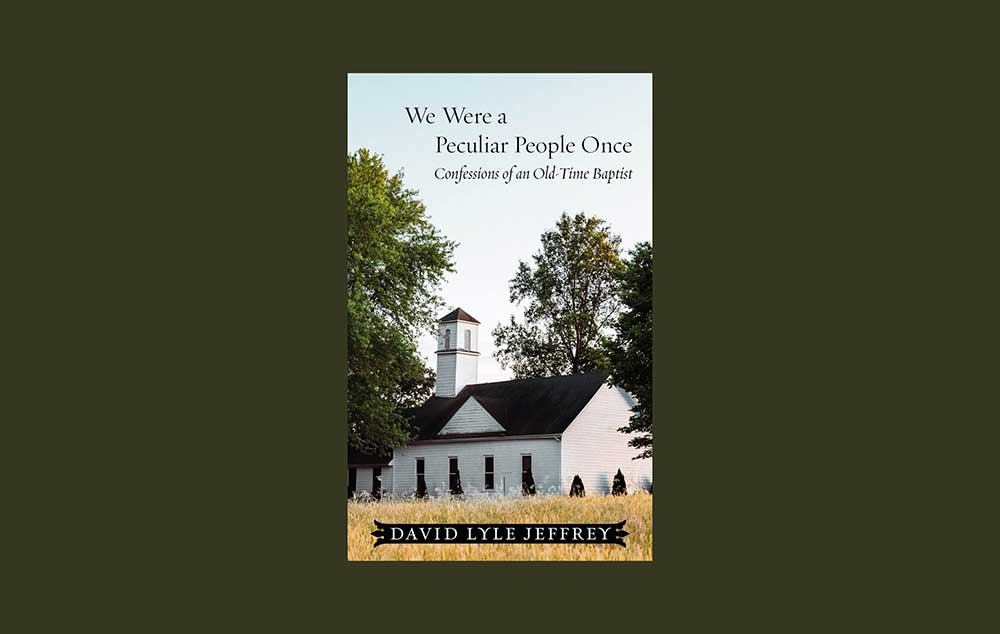
We Were a Peculiar People Once: Confessions of an Old-Time Baptist by David Lyle Jeffrey
What if Mark Twain had been a committed Christian with deep theological awareness? Then he might have been David Lyle Jeffrey! Jeffrey’s new book, We Were a Peculiar People Once: Confessions of an Old-Time Baptist, is a gem. Rarely have I laughed so heartily and lamented so deeply in the same book. This book is part memoir, part prophetic call; uproariously funny, searchingly convicting. I cannot commend it warmly enough.
While not hiding his critique, which is central to the book, Jeffrey begins with many humorous stories from his childhood among the Canadian Baptists. Humor arises from everything, from outhouses to prayer meetings. For instance, we read about Jeffrey and his friends providing “exotic” meat for a local restaurant one summer by catching and selling cats and turtles—“I still feel pretty bad about the cats,” he says. Not surprisingly, the restaurant was shut down that summer for “illicit culinary practices.”
This story comes in a section about weekly prayer meetings and the confession of sin. In it, Jeffrey mentions a certain lady who found too much significance in telling more and more of her sinful past each week (until finally stopped). Regarding her confession of past improprieties with “several” men, Jeffrey comments, “By this time, I was old enough to have noticed that, even granting the wear and tear of time, Agnes would not likely have been the sort to draw a sober man’s attention” (32).
Baptisms, of course, were central to Baptist life, so we are also treated to the story of a river baptism gone awry. Both minister and candidate slipped under, with the result that “Minnie was doing something like a windmill backstroke headed downriver” (37). Jeffrey knows how to tell a story!
A Sturdy Church Life
These stories accompany Jeffrey’s recounting of the key aspects of church life while he was growing up. We see the serious, intentional catechesis that went on in the Canadian Baptist churches of his childhood. The importance of doctrinally rich hymns shows up often. Jeffrey says that hymns were the soundtrack of his father’s life: one would often hear him singing them (off-key) while driving the tractor. “People sometimes think that Baptists have no theology, but they would at that time have been wrong; all one had to do was consider the old hymns closely” (47).
Jeffrey also mentions that Bible instruction was not left to church meetings only, but was also carried on at home: most households had “family altars” where fathers read the Scriptures to their family members most nights. It is not surprising, then, that Jeffrey says, “Even as a child I was made keenly aware that my sins put Jesus on the cross” (45). Prayer meetings, at which people shared their real struggles and acknowledged their faults (even if some, like Agnes, took it too far), led to the building-up of close-knit communities where people stepped up to meet one another’s needs.
The annual missions fair was another big deal—rivaling Christmas and Easter among the kids, he says. “Support of missions was intrinsic to our gospel obedience. Missionaries were prominent among our heroes; we were raised on biographies of the likes of William Carey, Samuel Marchman, David Brainerd, David Livingstone, Lottie Moon, Amy Carmichael, and Hudson Taylor” (47). It is this sturdy church life and heritage which Jeffrey finds missing in too many churches today.
Standing Out, Not Fitting In
Some of the humor in Jeffrey’s stories comes from the fact that his people were out of step with the world, and they knew it. Being out of step came as no surprise, even to the kids, and was considered part of the reality of being devoted to Christ. “We cared about some things more than general popularity” (138), he writes. His people were teased or mocked for being different, but “largely our cheerfulness amidst the teasing owed to one simple fact: we were confident that what we had by the grace of God was more than worth it. Our identities were accordingly pretty secure” (139).
His people did not expect to “fit in” but to “stand out.” The later generations’ loss of willingness to embrace being a peculiar people is something Jeffrey laments and rebukes. This is shown powerfully in his recounting of an anniversary service he attended at one of the churches he had grown up in. The founding pastor of this church, who had also married Jeffrey’s parents, preached at the anniversary. His text was 2 Timothy 3:1–7, a strong passage warning people against turning away from truth to error. Jeffrey found the church to be significantly changed from his childhood, and not just in its physical aspects. Apparently the preacher did as well, for while he acknowledged all the nice amenities the church had gained in recent years, he also decried the congregation’s lack of real spiritual power due to their efforts to accommodate the world.
Jeffrey says it was at this event that the idea of his book began. The changes at his old church illustrated a broader trend, a “softening of old Baptist character,” producing “a more popular, culturally accommodating church” which was, however, “weaker in its gospel witness and less inclined to holiness” (144–145). He sees this reflected in the wider church world. Rather than being marked by the fear of God and unconcerned about the praise of the world, we are today more often marked by unconcern for the things of God and fear of losing the approval of the world. As Jeffrey states, “Like other Baptists/evangelicals, we gave up on being peculiar and tried to become cool, to be modern, to be ‘relevant’” (xv).
A Far Higher Good
Ray Van Neste is Dean of the School of Theology and Missions at Union University in Jackson, Tennessee.
A Journal of Mere Christianity—Delivered to Your Door
- Essays on theology, culture, and the Church
- Contributors from across the Christian traditions

Six print issues (one year) of Touchstone, plus full online access and PDF downloads for only $39.95.

Get a one-year full-access subscription to the Touchstone online archives for only $19.95.
bulk subscriptions
Order Touchstone subscriptions in bulk and save $10 per sub! Each subscription includes 6 issues of Touchstone plus full online access to touchstonemag.com—including archives, videos, and pdf downloads of recent issues for only $29.95 each! Great for churches or study groups.
Transactions will be processed on a secure server.
more from the online archives

18.4—May 2005
The Idylls, Idols & Devils That Corrupt the Moral Imagination by Vigen Guroian
14.1—January/February 2001
The Christian Heart of Fatherhood
The Place of Marriage, Authority & Service in the Recovery of Fatherhood by John M. Haas

calling all readers
Please Donate
"There are magazines worth reading but few worth saving . . . Touchstone is just such a magazine."
—Alice von Hildebrand
"Here we do not concede one square millimeter of territory to falsehood, folly, contemporary sentimentality, or fashion. We speak the truth, and let God be our judge. . . . Touchstone is the one committedly Christian conservative journal."
—Anthony Esolen, Touchstone senior editor
