Collateral Damage
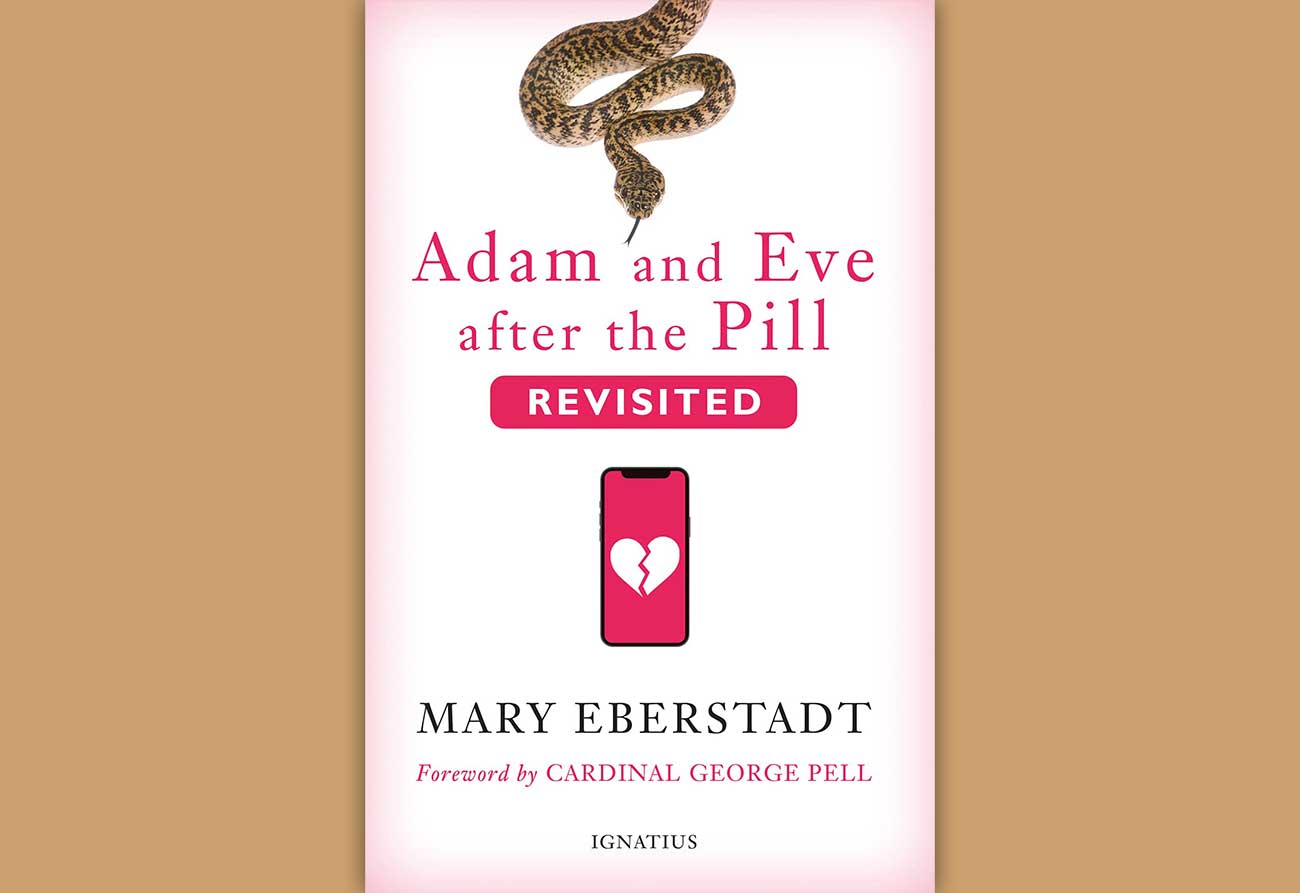
Adam and Eve After the Pill, Revisited by Mary Eberstadt
In 2012, Mary Eberstadt wrote a book, Adam and Eve After the Pill, which challenged the triumphalist progressive narrative of the sexual revolution. The revolution had its winners—if Hugh Hefner and his playboy simulacra can be counted as such—but losers abounded: aborted babies; unwed mothers and their progeny; children of divorce; the “stars” of porn and the addicts of the same. Eberstadt returns to the topic with Adam and Eve After the Pill, Revisited. While the former book focused on the “microscopic effects of the revolution,” the new one examines the “macroscopic” effects, specifically what the revolution has done to society, politics, and the church.
The Religious Divide of Our Time
Eberstadt insists that “secular progressivism . . . has erected a church.” Indeed, it is only through a religious framework that secular progressivism makes any sense at all. Just as Christianity possesses creedal statements outlining the faith, as well as rituals and sacraments for worship, so too does secular progressivism. The tenets of its creed are listed in signs that adorn the well-manicured lawns of posh homes: “in this house we believe black lives matter, love is love, women’s rights are human rights,” and so on. The best example of a progressive sacrament would be abortion, which, as Peter Kreeft noted in his book Jesus Shock, uses the words of Jesus at the Last Supper—this is my body—to enact its own bloody sacrifice.
Eberstadt proposes that the sacrosanct nature of the sexual revolution is an essential creedal element of this church. Emblematic is the defense of Margaret Sanger, whose stalwart eugenic credentials should render her persona non grata to a movement that champions racial identitarianism, yet she retains her status as a secular saint of the revolution. Progressives believe black lives matter, but not as much as the right to abortion, which ought to be enshrined into law without any limitation whatsoever—as it has been in my home state of Minnesota.
Mere Christianity, which continues to uphold a belief in traditional sexual ethics, remains the bulwark against the religion of secular progressivism. Eberstadt writes: “The religious divide of our time is between those who think they can compromise with the sexual revolution without compromising their faith and those who are awakening to the fact that this experiment has been tried and has failed.” She terms the faith of the compromisers “Christianity Lite.” But this is less a third option between traditional Christianity and secular progressivism than it is a way station on the road to apostasy. “Christianity Lite has proven to be incapable of rewriting rules about sex alone. Once bedrock teaching is dispensed with, the temptation apparently becomes overwhelming to put other inconvenient doctrines on the chopping block.”
Although the book’s title refers to the contraceptive pill, Eberstadt notes that capitulation started with the Anglicans—and not on the matter of contraception at Lambeth in 1930, but earlier, on divorce. Once one throws out the words of Jesus that insist upon the indissolubility of marriage, there is really no stable ground from which to stop sliding. She summarizes the pattern: “an unfortunate option” becomes “an unremarkable option” becomes “a theologically preferable” option. Thus with divorce, thus with contraception, thus, increasingly, with euthanasia and transgenderism.
In exchange for orthodoxy, Christianity Lite has gained the esteem of the world—but its pews are empty. Embracing sterility, its adherents have failed even to replace themselves, let alone fulfill Christ’s command to “make disciples of all nations.” Eberstadt quotes Joseph Bottum, who insists that “the death of the [Protestant] Mainline is the central historical fact of our time: the event that distinguishes the past several decades from every other period in American history.” How silly, how shameful, how ridiculous, that so many church leaders try to encourage the faithful to abandon orthodoxy for what has been revealed to be a mess of pottage!
Eberstadt is a Catholic, but the book is aimed at a broader audience. To the casualties of the revolution, both secular and religious, she offers encouragement and reminds them that they have been wronged but are not alone. She likewise fortifies all those who seek to maintain the constant teaching of Christianity. After all, while some Christian churches are further along the path of apostasy than others, treading this path remains a temptation to which none is immune. As I write, the German bishops in the denomination I share with Eberstadt are offering to bless same-sex unions. Officially, this is against the law of the Roman Catholic Church. As canon lawyers try to determine if this constitutes schism or just the near occasion thereof, the pope remains silent. The line between mere Christianity and those who have tried to wed the spirit of the age cuts not just between, but often through, churches.
Light in the Darkness
If traditional Christianity is the macro enemy of the secular progressive faith, the family is its micro adversary. Indeed, the two are inextricably tied together. As Eberstadt expresses it: “Family is a driver of religious faith, not just vice versa.” She summons ample statistical evidence to corroborate her theory: as family life fractures, traditional religion is abandoned; as society becomes less conventionally religious, it has trouble providing the soil in which families can be established and in which they can thrive. It’s less a matter of causation than it is of interrelated phenomena. After all, God is our Father; is it any wonder that those whose own fathers have fled have trouble relating to him from whom all human fathers claim their name?
Eric Jackson is a software developer who lives with his wife and their four children in South St. Paul, Minnesota. His work has appeared in the New Oxford Review and the St. Austin Review.
A Journal of Mere Christianity—Delivered to Your Door
- Essays on theology, culture, and the Church
- Contributors from across the Christian traditions

Six print issues (one year) of Touchstone, plus full online access and PDF downloads for only $39.95.

Get a one-year full-access subscription to the Touchstone online archives for only $19.95.
bulk subscriptions
Order Touchstone subscriptions in bulk and save $10 per sub! Each subscription includes 6 issues of Touchstone plus full online access to touchstonemag.com—including archives, videos, and pdf downloads of recent issues for only $29.95 each! Great for churches or study groups.
Transactions will be processed on a secure server.
more on Sex from the online archives

28.3—May/June 2015
Of Bicycles, Sex, & Natural Law
Describing Human Ends & Our Limitations Is Neither Futile Nor Unloving by R. V. Young
more from the online archives
calling all readers
Please Donate
"There are magazines worth reading but few worth saving . . . Touchstone is just such a magazine."
—Alice von Hildebrand
"Here we do not concede one square millimeter of territory to falsehood, folly, contemporary sentimentality, or fashion. We speak the truth, and let God be our judge. . . . Touchstone is the one committedly Christian conservative journal."
—Anthony Esolen, Touchstone senior editor