




Ivanka Demchuk’s Icon of the Annunciation
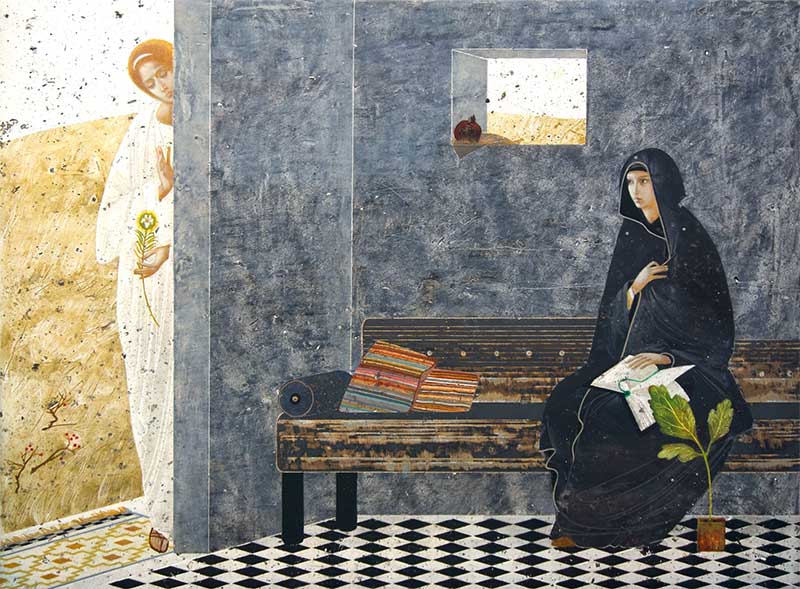
In these essays, the author often examines the interactions in art between the two halves of the Church, East and West. Within that context, we have explored the pendulum swings between icon and narrative, abstraction and naturalism, tradition and innovation. Nowhere are these themes more evident than in the Ukrainian artist Ivanka Demchuk’s icon of the Annunciation dating from 2019.
From the very start this painting breaks the conventional mold. Traditionally, Byzantine icons of the Annunciation conflate the story into a single image outside of time: the angel extends its hand in greeting, while Mary raises hers in both surprise and acceptance, and the Holy Spirit descends from above. Western artists more often explore the narrative movement of the story, choosing either the moment of greeting, of surprise, of questioning, or of acceptance. Demchuk chooses still another, the moment before the angel enters.
Mary is sitting in a dark room with only a small window above her head casting golden light onto her face. The gold is not traditional Byzantine gilding, but rather the gold of a wheat field, with a bright white sky above it. But like an icon’s gold leaf, the gold paint represents the Uncreated Light breaking into the darkness of the earthly realm, the dark gray walls enlivened only by the striped cushions and the little plant by Mary’s knee.
The angel, standing in the realm of light on the threshold of Mary’s room, seems to hesitate with downcast eyes, a reluctant gesture and face half hidden. Is Gabriel somehow unwilling to submit his Lord to the suffering he knows the Savior’s life will entail? On the windowsill sits a pomegranate, whose many seeds symbolize Mary’s fertility, but because those seeds also resemble drops of blood, they can also symbolize the Passion.
Mary, by contrast, looks in the angel’s direction with wide eyes and an expectant expression. Her face is brightly lit; she is already fully in grace. She has been reading the Scriptures, open on her lap, and is aware of the prophecies of the coming Messiah. Overlapping the book is a fig tree, often used in Scripture as a symbol of Israel, perhaps here with the added meaning of the Tree of Jesse from which Jesus will spring, or even that paradisal tree by which Mary, the new Eve, will bring salvation from sin.
Nothing is here by accident: even the cushions, with their multicolored stripes, recall Joseph’s coat, for Joseph is an Old Testament prototype of Jesus, through whom the tribes of Israel were saved. Outside the door under Gabriel’s feet are the trampled grapevines of the ruined vineyard of Israel; Mary is thus shown as the last remnant of fully faithful Israel still living in hopes of the Savior.
Traditional & Modern
Stylistically, this panel is a complicated mix. Demchuk places the figures in their traditional places, with the angel on the left and Mary on the right. She uses the traditional tempera medium, the time-honored abstraction and elongation of the figures, the symbolic lily and dark blue gown with three stars of the conventional Byzantine icon, and clearly pays them homage.
At the same time, this is a very modern painting. The sophisticated layering, scraping, and mixing of the pigments on the panel recall the twentieth-century paintings of the abstract expressionists and the color field artists, their enjoyment of the medium and the expressive possibilities of color. Here, though, the artist adds a layer of meaning, a feeling of antiquity like the icons she imitates, and a symbolic contrast of light and dark.
At the same time, Demchuk’s lovely and elegant figures, her use of the bright gold color, and the patterning of the floor and cushions summon up images of the Austrian painter Gustav Klimt. Klimt had drawn upon the Byzantine gold and mosaic patterns for his own pictures of earthly love and beauty; here, Demchuk returns them to their original context. This is not an accident. Demchuk is a member of the Lviv school of iconographers, which deserves a closer look.
A Church & Its Art
Mary Elizabeth Podles is the retired curator of Renaissance and Baroque art at the Walters Art Museum in Baltimore, Maryland. She is the author of A Thousand Words: Reflections on Art and Christianity (St. James Press, 2023). She and her husband Leon, a Touchstone senior editor, have six children and live in Baltimore, Maryland. She is a contributing editor for Touchstone.
A Journal of Mere Christianity—Delivered to Your Door
- Essays on theology, culture, and the Church
- Contributors from across the Christian traditions

Six print issues (one year) of Touchstone, plus full online access and PDF downloads for only $39.95.

Get a one-year full-access subscription to the Touchstone online archives for only $19.95.
bulk subscriptions
Order Touchstone subscriptions in bulk and save $10 per sub! Each subscription includes 6 issues of Touchstone plus full online access to touchstonemag.com—including archives, videos, and pdf downloads of recent issues for only $29.95 each! Great for churches or study groups.
Transactions will be processed on a secure server.
more on art from the online archives
33.2—March/April 2020
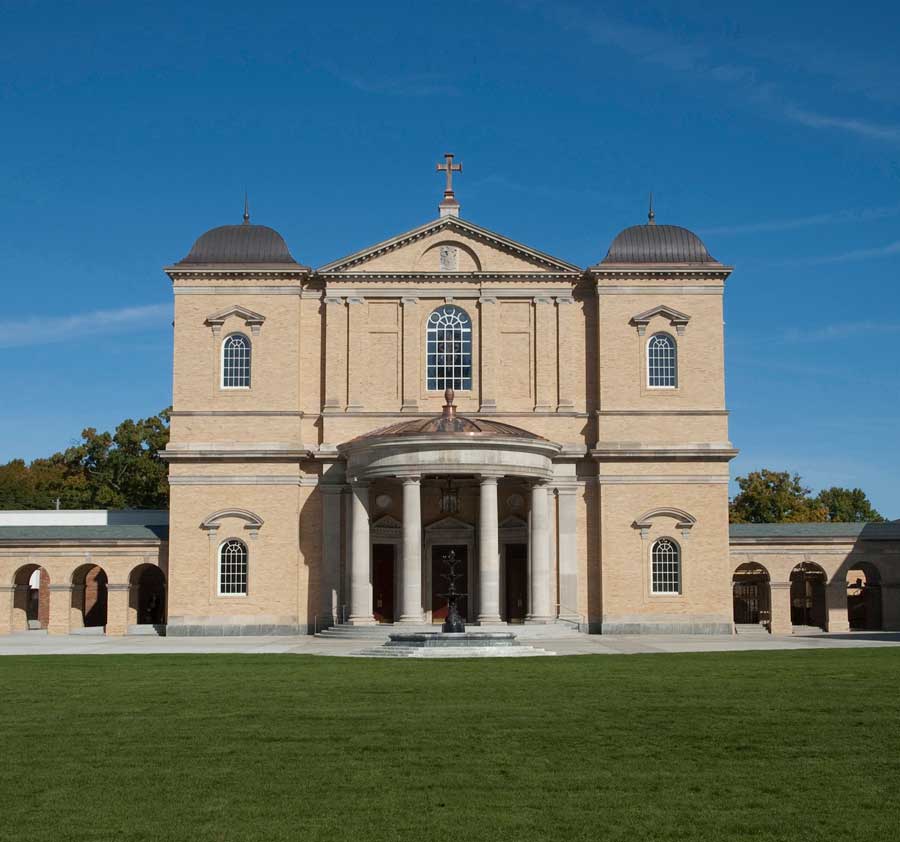
An Architectural Sign of Mere Christianity by Michael Ward
32.4—July/August 2019
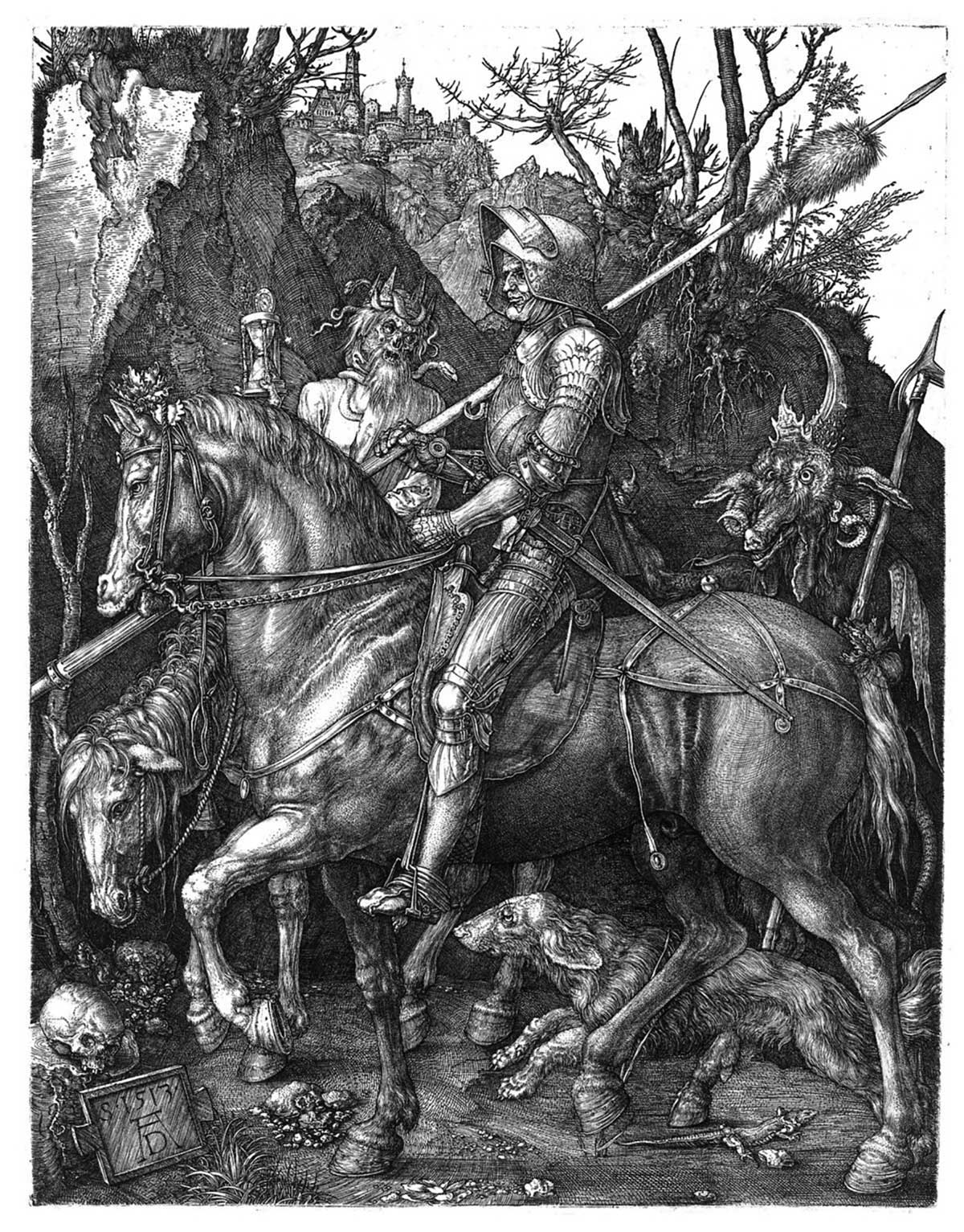
on Single-Mindedness in Durer's Ritter, Tod, und Teufel by Anthony Costello
more from the online archives
21.6—July/August 2008
Benedict XVI on the Crisis of Faith & Reason by Samuel Gregg

36.4—Jul/Aug 2023
Our Political Void & the Disintegration of Truth by Michael Hanby

24.5—Sept/Oct 2011
on Wondering or Wandering Through College Education by Anthony Esolen
calling all readers
Please Donate
"There are magazines worth reading but few worth saving . . . Touchstone is just such a magazine."
—Alice von Hildebrand
"Here we do not concede one square millimeter of territory to falsehood, folly, contemporary sentimentality, or fashion. We speak the truth, and let God be our judge. . . . Touchstone is the one committedly Christian conservative journal."
—Anthony Esolen, Touchstone senior editor
