




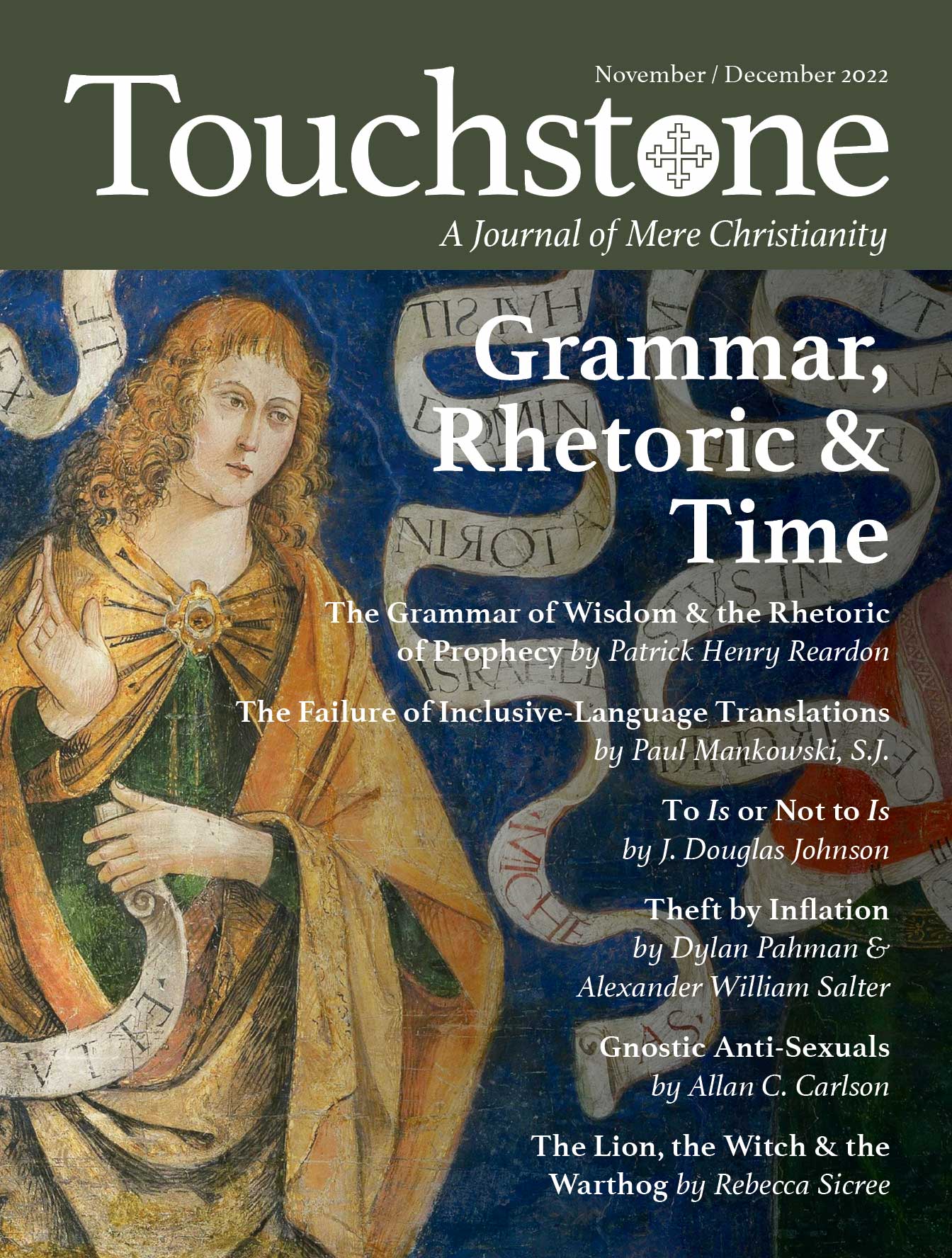
Dominical Dialectics
by Patrick Henry Reardon
Among the features that make up the “teaching style” of our Savior, one of the more notable is his refusal to let his hearers and interlocutors define the terms of discussion. It is one of the ways in which he makes it clear that the gospel is more than simply an answer to a human question. The Good News eludes all attempts to restrict it to a human concern. Jesus sees to this.
For example, when a speculative point is raised, Jesus occasionally turns the inquiry into an exhortation. We observe, for instance, his response to the query, “Who is the greatest in the kingdom of God?” Instead of a straightforward reply, he admonishes the disciples to become as little children (Matt. 18:2–4). There is a second level of irony in this answer—namely, little children do not ask such questions. The query, that is to say, was prompted by the non-childlike ambitions of those who posed it (cf. Luke 9:46).
On receiving a purely conjectural question, Jesus sometimes uses it as the occasion to give a very practical admonition. For instance, asked about how many will be saved, he offers very useful counsel about how to be saved (Luke 13:23–24).
Our Lord frequently responds to a question by posing a counter-question. In some cases the latter device is simply rhetorical. For instance, when asked if it is “lawful for a man to divorce his wife for any reason,” he appeals to Holy Scripture by employing an interrogative form: “Have you not read . . . ?” (Matt. 19:3–4; cf. Luke 6:2–3). Likewise, when Nicodemus inquires, “How can these things be?”, Jesus challenges him, “Are you a teacher in Israel and do not know these things?” (John 3:9–10). In these cases the counter-questions serve no purpose beyond their rhetorical force.
On other occasions, the Lord’s counter-question is a direct foil to block a questioner’s malicious intent (cf. Luke 11:53–54). Thus, when his enemies inquire by what authority he does “these things” (cleansing the temple, withering a fig tree, and so forth), he declines to answer until the questioners should answer his counter-question about the authority of John the Baptist (Mark 11:28–30).
Sometimes, however, the Lord’s counter-question alters the direction and raises the level of the conversation. The most dramatic example of this phenomenon, I suppose, is the incident involving “spies who pretended to be righteous, that they might seize on his words, in order to deliver him to the power and the authority of the governor.” In hopes of attaining this goal, they ask Jesus, “Is it lawful for us to pay taxes to Caesar or not?” (Luke 20:20–26).
The questioners here feel they can hardly fail: If the answer is yes, then Jesus will be perceived as taking the side of the Roman overlord. If the answer is no, then he is subject to arrest as a revolutionary.
The Lord recognizes the intent of this question, which is about as subtle as Mount McKinley. He requests the questioners to show the proper coin of the tax. This request accomplishes two things: First, it suggests that Jesus himself does not have such a coin (cf. Matt. 17:24–27). Second, it proves that the questioners do have such a coin, thus demonstrating their hypocrisy in initiating the interrogation. If Jesus were interested in simply putting these hypocrites to shame, the entire discussion could reasonably end right here.
It is at this point, however, that Jesus asks his counter-question: “Whose image and inscription does it have?” The image on the coin is, in fact, essential to the discussion, and this in two ways: First, the emperor’s image on the coin is what renders it objectionable: it violates the prohibition against images. Second, the image indicates the coin’s basic significance: it belongs to Caesar. That is to say, Jesus does not evade the question about paying taxes to Caesar; he answers it, and the answer is yes!
At the same time, however, the Lord elevates the discussion above the limits of the original question. He uses the latter to distinguish between the relative and legitimate claims of the state and the absolute claims of God. This dominical distinction, which was always at least implicit in the Prophets, thus provides a practical norm in the Christian life. While remaining radically faithful to God, Christians are to support and give their allegiance to the government Providence has placed over them. The debt they owe to the state is not optional. Sharing in the economic and political benefits the state provides, they are under a stern moral obligation to bolster, maintain, and provide for it.
Patrick Henry Reardon is pastor emeritus of All Saints Antiochian Orthodox Church in Chicago, Illinois, and the author of numerous books, including, most recently, Out of Step with God: Orthodox Christian Reflections on the Book of Numbers (Ancient Faith Publishing, 2019).
A Journal of Mere Christianity—Delivered to Your Door
- Essays on theology, culture, and the Church
- Contributors from across the Christian traditions

Six print issues (one year) of Touchstone, plus full online access and PDF downloads for only $39.95.

Get a one-year full-access subscription to the Touchstone online archives for only $19.95.
bulk subscriptions
Order Touchstone subscriptions in bulk and save $10 per sub! Each subscription includes 6 issues of Touchstone plus full online access to touchstonemag.com—including archives, videos, and pdf downloads of recent issues for only $29.95 each! Great for churches or study groups.
Transactions will be processed on a secure server.
more on bible from the online archives
32.3—May/June 2019
on the Implications of Changing the Pater Noster by John M. McCarthy
32.2—March/April 2019
on Preserving Physical & Spiritual Nourishment by Nathanael Devlin
27.4—July/August 2014
The Bible, Sacred Theology & the Mind of Christ by Patrick Henry Reardon
more from the online archives
27.2—March/April 2014
on C. S. Lewis & the New State Paganism by W. E. Knickerbocker

33.2—March/April 2020
on How Bodily Resurrection Informs Social Justice by W. Ross Blackburn

20.8—October 2007
The Deep & Abiding Biblical Roots of Western Liberal Education by David Lyle Jeffrey
calling all readers
Please Donate
"There are magazines worth reading but few worth saving . . . Touchstone is just such a magazine."
—Alice von Hildebrand
"Here we do not concede one square millimeter of territory to falsehood, folly, contemporary sentimentality, or fashion. We speak the truth, and let God be our judge. . . . Touchstone is the one committedly Christian conservative journal."
—Anthony Esolen, Touchstone senior editor
