Papist Patriots
Our Dear-Bought Liberty: Catholics and Religious Toleration in Early America by Michael D. Breidenbach
One of the many excellent qualities of this deeply researched (1,101 endnotes) and highly readable work of historical revision is the clarity of its purpose:
American historians can no longer assume that Catholics in the early republic served merely as a contrast to its religious and political order. Instead, Catholics should be counted as proponents of complementary ideologies about church-state relations and contributors to the development of temporal independence and religious liberty in the United States. In this respect, the American founding was continuous with medieval and Renaissance debates over papal authority that shaped early modern political thought about state authority. The "Machiavellian moment" in America was as much about ecclesiastical republicanism as it was about political republicanism. The point is not to suggest that there was a Catholic moment in the American founding. Instead, a comprehensive account of the religious and political thought of the founding must acknowledge the complexity of its European antecedents, including conciliarism (146).
Rather than serving simply as an absolutist, papalist, anti-republican, and sectarian foil to the unfolding story of a democratic republic with deep commitments to political and religious liberties, American Catholics were fully engaged cooperators in the new birth of freedom in the history of civilization. Michael D. Breidenbach offers a very convincing presentation of this interpretation of American Catholic participation in this liberal development.
A Unique Colony
In Part I, "Subjects," the significance of conciliarism, beginning with the fifteenth-century Council of Constance, which located fundamental Roman Catholic authority in general church councils, is offered as a counter to "papalism" and its commitment to a claim of papal infallibility and papal authority in civil and temporal affairs. George Calvert, the first Lord Baltimore, a one-time high-ranking official in the reign of King James I of England and a convert to Catholicism in the mid-1620s, was able to achieve a colonial charter for Maryland with his successful demonstration of a primary loyalty to the English state despite his religion.
His son Cecil, the actual founder of the new colony, was likewise able to balance his Catholicism—and a popularly assumed and consequent papalist commitment—with a 1638 Maryland oath that denied the deposing power of the pope. As well, religious toleration was a staple in Maryland as long as Catholics were in charge. This included a unique English colonial religious initiative, the Toleration Act of 1649, for all Trinitarian Christians in the colony.
Still, the deposing claim made by Pope Pius V in 1570 (Regnans in Excelsis), when he excommunicated Elizabeth I and dispensed her countrymen from their allegiance to her, would serve as a marker that would remain at the heart of all efforts to achieve English Catholic emancipation until its realization in 1829. A lingering anti-Catholic ethos would certainly infect colonial Americans whether or not they ever actually encountered a Catholic. To be the latter was to identify with not only the wrong religion but also the wrong politics. Catholicism was then a most convenient, and perennial, foil for "the rights of Englishmen."
The Carrolls & the Revolution
Part II, "Revolutionaries," principally features the Carroll family of Maryland. Arriving in America in the late seventeenth century, Charles Carroll the Settler was successful despite the (sporadically enforced) penal laws against Catholics enacted in the new royal colony after the Glorious Revolution of 1688–1689. Even as later Lords Baltimore became Anglicans in the early eighteenth century and regained their Maryland proprietorship, and as the Church of England became established in the colony, the Carroll family continued to acquire great wealth despite the prejudice against their religion and the attendant religious and political disabilities.
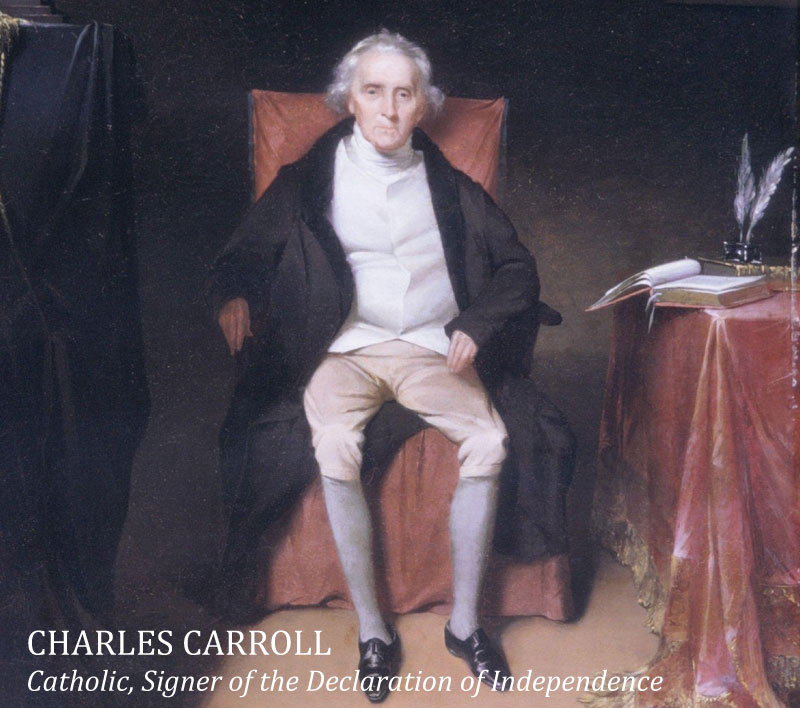
But when Charles Carroll of Carrollton and his anti-imperial politics emerged in the years prior to the American Revolution, his religion figured far less than his American patriotism. Breidenbach suggests that, during their education in France and Belgium, both this later Carroll and his Jesuit second cousin, John Carroll, imbibed conciliarist and "anti-papalist" (in the sense of denying papal infallibility and authority in temporal affairs) attitudes and, surprisingly, Jansenist prejudices against any union of church and state. These attitudes would prove to be of republican moment in their involvement in the American cause for freedom against British assaults on self-government. Indeed, Charles Carroll was not only active in Maryland's revolutionary regime, but also the one Catholic signer of the Declaration of Independence.
Both Carrolls, as well as John's brother Daniel, who was involved in the writing of both American constitutions (the Articles of Confederation in 1781 and the new document of 1787), were able to maintain an authentic Catholic religious faith along with their commitment to republican or popular government, the separation of church and state, and religious pluralism. Coupled with the general public embrace of the American Revolution by the tiny American Catholic population (less than one percent of the total), the efforts of the Carrolls, among other, less-known Catholics, helped create a founding moment that would, if grudgingly at times, admit Catholics to toleration and eventually to full religious liberty in the new republic.
A Revealing Correspondence
Part III, "Citizens," describes Catholic participation in the creation and approval of the new nation's Constitution and the proscription of any religious test for federal office, as well as in the enactment of the First Amendment, which prohibited the federal Congress from establishing any religion or interfering with religious liberty. These circumstances were not achieved at that time in all of the states, but Catholic sentiment was clear in its embrace of these constitutional expressions of religious freedom.
A Journal of Mere Christianity—Delivered to Your Door
- Essays on theology, culture, and the Church
- Contributors from across the Christian traditions

Six print issues (one year) of Touchstone, plus full online access and PDF downloads for only $39.95.

Get a one-year full-access subscription to the Touchstone online archives for only $19.95.
bulk subscriptions
Order Touchstone subscriptions in bulk and save $10 per sub! Each subscription includes 6 issues of Touchstone plus full online access to touchstonemag.com—including archives, videos, and pdf downloads of recent issues for only $29.95 each! Great for churches or study groups.
Transactions will be processed on a secure server.
more on Catholic from the online archives
35.4—Jul/Aug 2022
The Death Rattle of a Tradition
Contemporary Catholic Thinking on the Question of War by Andrew Latham
more from the online archives
calling all readers
Please Donate
"There are magazines worth reading but few worth saving . . . Touchstone is just such a magazine."
—Alice von Hildebrand
"Here we do not concede one square millimeter of territory to falsehood, folly, contemporary sentimentality, or fashion. We speak the truth, and let God be our judge. . . . Touchstone is the one committedly Christian conservative journal."
—Anthony Esolen, Touchstone senior editor