Diego Velasquez's Christ Crucified

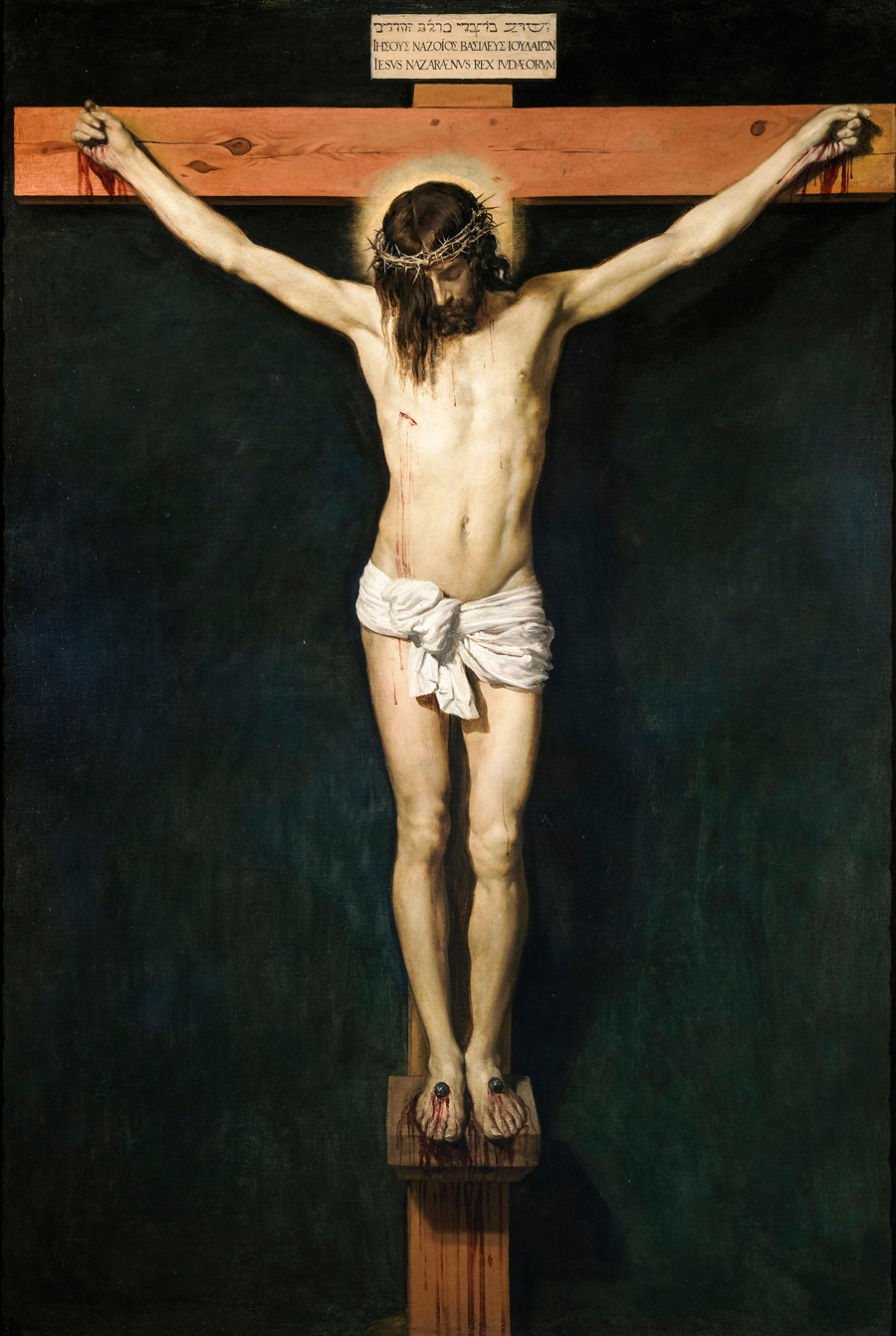
The name Diego Velasquez (1599–1660), painter to the Spanish court, usually calls to mind portraits, both formal and informal, of the royals and their courtiers, theatrical mythological scenes, genre scenes of Spanish life, and only a smattering of rather operatic, Baroque religious subjects. Therefore this stark and uncompromising Christ Crucified is rather a surprise from Velasquez, or for that matter, from anyone. Here there is no landscape, no other people, no action or expression of emotion, just empty space, blackness, and a Christ, up close and already dead. How to account for such a startling image?

Sometimes the circumstances of a painting's origins offer clues, but unfortunately, there is little to be found here. It is conjectured that Jerónimo de Villanueva, a highly placed official at court and the founder of the Convent of San Plácido in Madrid, may have commissioned it for the Benedictines there. In 1630, Villanueva had come under scrutiny by the Inquisition for alleged irregularities at the convent. At the same time, an incident involving the desecration of a sculpted crucifix in Madrid prompted an outpouring of pious devotions to Christ crucified, of which this might be one.

The painting would have served a double purpose: as an enhancement of the convent and as a public statement of orthodoxy and devotion on the part of Villanueva and the Benedictines. The painting is rather like a statue, perhaps like the one that was disfigured. (The careful carpentry of the cross, too, might be a reference to the Benedictines' emphasis on work.) Inquiries into the convent's activities were suspended.

Inspiration from Pacheco & Italy

The painting is not dated, but it fits with Velasquez's style from around 1632, the time of Villanueva's difficulties and of Velasquez's return from a yearlong trip to Italy. Velasquez was born in 1599 in Seville and was early apprenticed to Francisco Pacheco. Pacheco may have been undistinguished as a painter, but he was a learned and scholarly art theorist, who took charge of the younger artist's education. And more: Velasquez married his teacher's daughter and moved with them to Madrid, where in 1623 he was hired as court painter. Velasquez's Crucifixion closely follows one by Pacheco in several telling details: the placement of the feet, nailed separately; the misspelling of Nazarenus; and mistakes in the transcription of the Greek and Hebrew texts above Christ's head.

After some years in Madrid, Velasquez obtained permission to make a study trip to Italy. Its impact was transformative. In some ways, the Christ Crucified is a homage to Italy and what he saw there. First, he met with Classical sculpture on a grand scale, and with its revival by the painters of the Renaissance and by Velasquez's Italian contemporaries. Christ's nearly naked body is the Spanish painter's distillation of all that he had learned about ideal proportions and the naturalistic rendering of the flesh. Pacheco, in his theoretical writings, had mused, "Christ, our Lord, had no earthly father and thus completely resembled his mother, who, after Him, was the most beautiful creature that God ever created"; here, Velasquez has given Christ the beauty of Classical Antiquity.

Velasquez must also have encountered the Caravaggists in Italy, whose sharp contrasts of light and dark contrasted with the even lighting of the Classicists, which might have led him to set his Crucifixion against the stark black background. But he does not use shadow as a dramatic protagonist as did Caravaggio; instead, the painting is lit with an overall, even luminescence. Nor is he drawn to the Caravaggists' bloody taste for the horrific. Instead, mere trickles of blood flow from Christ's hands and feet, and from his side into his loincloth. To the Renaissance masters, that latter flow referred back to the Circumcision: the first wounding of Christ looked forward to the last. Even the joy of the Incarnation moved toward the final sorrow that we see here.

Finally, in Italy Velasquez fell under the spell of the Venetian painters, particularly of Titian, with their loose and painterly brushstrokes and luminous color. The sketchy handling of the paint defining the head, the tender expression on Christ's face, his loosened hair, and the luminosity of his faint halo all bear witness to the influence of Venetian painting.

A Visual Expression of the Dark Night

Still, all these factors—the circumstances of the commission, Velasquez's early training, and his experience of Italy—are not enough to account for the impact of this image; they merely explain the tools the artist had at hand. The real inspiration for the Christ Crucified seems to lie in the poetry of St. John of the Cross, the sixteenth-century Carmelite, theologian, and mystic. Drawn at first to the quiet contemplative life of the Carthusians, St. John met St. Teresa of Ávila and became confessor and spiritual director to her convent of Carmelite nuns, and went on to found the equivalent order of friars.

While at Ávila, John had a mystical encounter with the crucified Christ, a vision that informed the rich imagery and symbolism of his poetry, particularly the poem he called The Dark Night: Stanzas of the Soul. It describes in oblique language the journey of the soul through the dark night of hardship toward the sublime state of union with the divine light; it is one of the masterpieces of Spanish literature.


Mary Elizabeth Podles is the retired curator of Renaissance and Baroque art at the Walters Art Museum in Baltimore, Maryland. She is the author of A Thousand Words: Reflections on Art and Christianity (St. James Press, 2023). She and her husband Leon, a Touchstone senior editor, have six children and live in Baltimore, Maryland. She is a contributing editor for Touchstone.

A Journal of Mere Christianity—Delivered to Your Door

  • Essays on theology, culture, and the Church
  • Contributors from across the Christian traditions

Subscribe (Print + Online)

Six print issues (one year) of Touchstone, plus full online access and PDF downloads for only $39.95.

Subscribe (Online Only)

Get a one-year full-access subscription to the Touchstone online archives for only $19.95.


bulk subscriptions

Order Touchstone subscriptions in bulk and save $10 per sub! Each subscription includes 6 issues of Touchstone plus full online access to touchstonemag.com—including archives, videos, and pdf downloads of recent issues for only $29.95 each! Great for churches or study groups.

Transactions will be processed on a secure server.


more on art from the online archives
32.4—July/August 2019

Sojourner Knight

on Single-Mindedness in Durer's Ritter, Tod, und Teufel by Anthony Costello
30.3—May/June 2017

St. Luke the Evangelist

by Mary Elizabeth Podles

33.2—March/April 2020

Christ Chapel at Hillsdale

An Architectural Sign of Mere Christianity by Michael Ward


more from the online archives
27.5—Sept/Oct 2014

Food for Thought

on Growing Vegetables as a Primer in Moral Philosophy by Rachel Lu

32.4—July/August 2019

Pastor Prime

on a Steady Presence in an Unsteady World by Preston Jones

14.6—July/August 2001

The Transformed Relics of the Fall

on the Fulfillment of History in Christ by Patrick Henry Reardon

calling all readers

Please Donate

"There are magazines worth reading but few worth saving . . . Touchstone is just such a magazine."
—Alice von Hildebrand

"Here we do not concede one square millimeter of territory to falsehood, folly, contemporary sentimentality, or fashion. We speak the truth, and let God be our judge. . . . Touchstone is the one committedly Christian conservative journal."
—Anthony Esolen, Touchstone senior editor

Support Touchstone

00