





Son of Odysseus
Telegonos: A Tragedy in Verse by Jonathan Golding
Odysseus is one of the most fascinating figures from ancient literature. Rather than embody a single, fixed meaning—as Achilles does wrath unleashed and reconciled, or Antigone unswerving devotion to family, or Aeneas duty over personal happiness—Odysseus's signification as a legendary warrior of the Trojan War shifts considerably from Homer to the Greek tragedians, and again from the tragedians to Dante.
In the Odyssey, Odysseus is a noble, if crafty survivor who just wants to get home. He uses his wits to protect himself, his men, and his family, but he is essentially pious and honorable. He represents the ideal Homeric hero who balances prowess on the battlefield with the gift of persuasion, strength of arm with suppleness of tongue, able equally to manipulate weapons and words to achieve his goals.
In the Greek tragedies, however, Odysseus morphs into a Machiavellian villain for whom the ends always justify the means, a sophist who knows how to make the weaker argument the stronger and who is happy to bend the rules of ethics and morality to come out on top. He plays this role supremely in Sophocles' Philoctetes, where he tries to win over the noble son of Achilles, Neoptolemus, to his own ethos of Realpolitik. This darker view of Odysseus is picked up by and reflected in Roman literature, especially Virgil's Aeneid and Ovid's Metamorphoses.
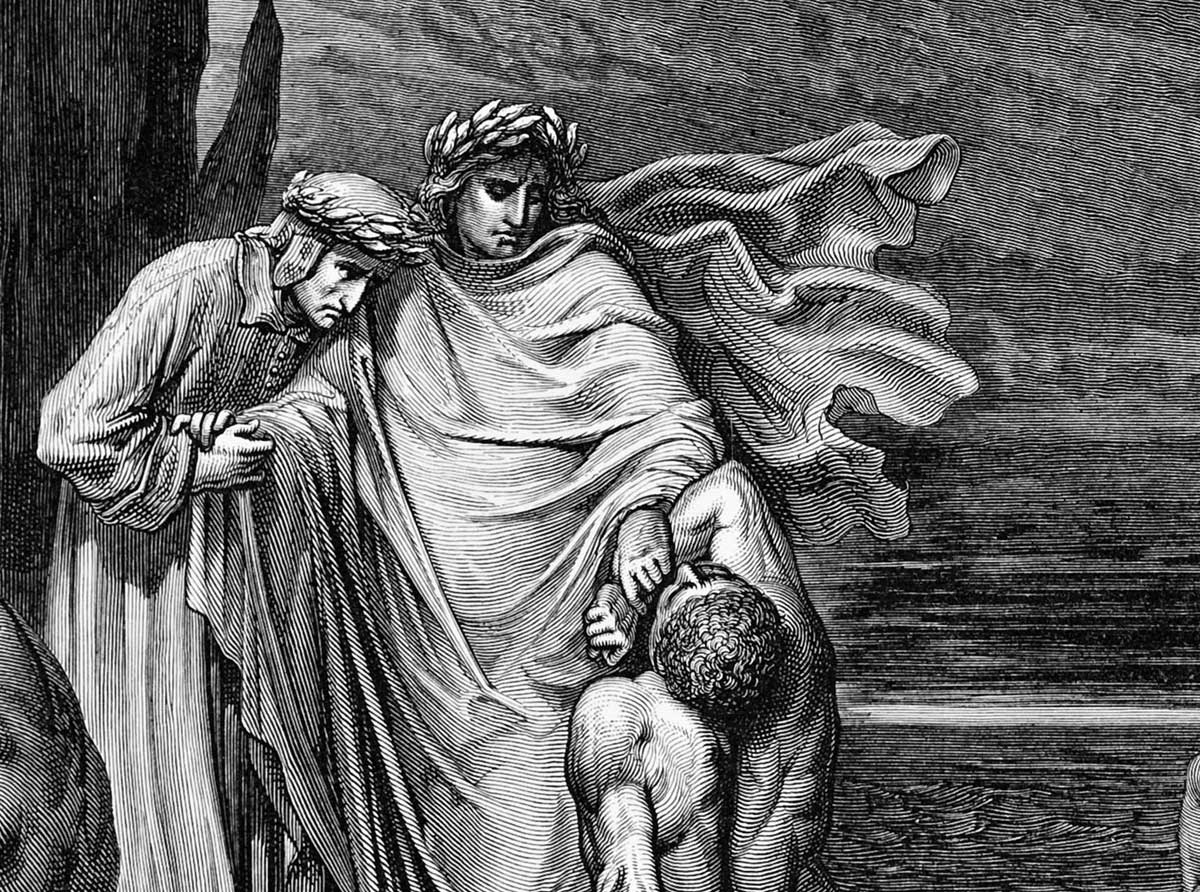
In Dante's Inferno, Odysseus (Ulysses in Latin) appears in the eighth level of hell as an evil counselor who uses his tongue to lead people astray. And yet, while branding him a deceiver, Dante allows Ulysses to tell a story—almost certainly invented by Dante—in which he goes on a last voyage of discovery through the Pillars of Hercules (the Straits of Gibraltar) into the Atlantic Ocean. This new image of Ulysses as an adventurer with wanderlust, a sort of Greek Sinbad the Sailor, was picked up by Tennyson, who, in his dramatic monologue "Ulysses," turns Homer's hero into the supreme Victorian explorer.
The Myth & the Play
Homer borrowed the raw material for the Iliad and Odyssey from the many tales of the Trojan War and its survivors that had been passed down to him via the oral tradition. That tradition included a particularly disturbing epilogue to the story of Odysseus that Homer decided not to tell. In it, Circe bears Odysseus a son named Telegonos. When he comes of age, Telegonos sails to Ithaca, where he is blown ashore by a storm and accidentally kills Odysseus with a poisoned spear made for him by Hephaestus. In the even more disturbing denouement of the tale, Telegonos marries Penelope and Telemachus marries Circe!
Just as the story of Oedipus, who unwittingly killed his father and married his mother, hardly seems the raw material for one of the greatest tragedies ever written, so the story of Telegonos does not, one would think, lend itself to serious literary treatment. Enter Jonathan Golding, a missionary kid who studied literature and theater arts and who, after wrestling with the writings of late antiquity and the early Church Fathers, converted to the Eastern Orthodox Church. With passion, boldness, and a wonderfully synthetic imagination, Golding transforms the Telegonos myth into a powerful tragic meditation on good and evil, reality and illusion, truth and deception, the vengeful old gods and the unknown God who has yet to be revealed.
Written in supple, fast-moving blank verse and in a dramatic style that combines Attic and Shakespearean tragedy, Golding's Telegonos removes the Telegonos/Penelope and Telemachus/Circe marriages while preserving the central accidental patricide and the overall mood of deception, taboo, and misdirected desire. Golding also chooses, wisely, to drop a defining element of ancient Greek dramaturgy that feels very artificial today—the use of a chorus—while maintaining the Aristotelian unities of time and space.
Like Shakespeare's The Tempest, one of the few plays in which the bard deigned to stick to the unities, Telegonos takes place in the space of a single day on the shore of an island upon which the protagonists have been shipwrecked by a storm. Regarding the latter, Prince Telegonos has been at sea in search of Odysseus, not just because he wants to know his true father but also because he has grown weary of the goddess Circe's cruel and deceptive ways, her black magic, and her hatred of mortals. For most of the play, neither he nor his crew knows that they have landed on Ithaca. They know the island is ruled by a king, but they have been told that he is an evil king who killed all his rivals and now rules as a tyrant.
The first character we meet is not Telegonos, but his servant and chief counselor, Polysemous. Golding names his invented character well, for polysemous means "many signs." Although we initially trust Polysemous as a seemingly noble servant of his prince, we slowly come to realize that he is an ambitious deceiver and a proponent of political expediency, as two-faced and treacherous as Circe. He is, in short, a perfect embodiment of the Odysseus of Philoctetes, the Aeneid, and Metamorphoses. Indeed, like Odysseus in Philoctetes, Polysemous does all he can to "wise up" the innocent Telegonos and force him to adopt a cynical, distrustful, proto-Darwinian view of the world.
Louis Markos , Professor in English and Scholar in Residence at Houston Baptist University, holds the Robert H. Ray Chair in Humanities. His 19 books include Lewis Agonistes; Restoring Beauty: The Good, the True, and the Beautiful in the Writings of C. S. Lewis; On the Shoulders of Hobbits: The Road to Virtue with Tolkien and Lewis; and From A to Z to Narnia with C. S. Lewis.
A Journal of Mere Christianity—Delivered to Your Door
- Essays on theology, culture, and the Church
- Contributors from across the Christian traditions

Six print issues (one year) of Touchstone, plus full online access and PDF downloads for only $39.95.

Get a one-year full-access subscription to the Touchstone online archives for only $19.95.
bulk subscriptions
Order Touchstone subscriptions in bulk and save $10 per sub! Each subscription includes 6 issues of Touchstone plus full online access to touchstonemag.com—including archives, videos, and pdf downloads of recent issues for only $29.95 each! Great for churches or study groups.
Transactions will be processed on a secure server.
more on literature from the online archives
32.2—March/April 2019
Misguided Mercy & Dante's Infernal Purgation by Joshua Hren


30.5—Sept/Oct 2017
on Costly Grace in Breece D'J Pancake's Flyover Country by Casey Chalk
more from the online archives
32.2—March/April 2019
Misguided Mercy & Dante's Infernal Purgation by Joshua Hren


20.8—October 2007
The Deep & Abiding Biblical Roots of Western Liberal Education by David Lyle Jeffrey
calling all readers
Please Donate
"There are magazines worth reading but few worth saving . . . Touchstone is just such a magazine."
—Alice von Hildebrand
"Here we do not concede one square millimeter of territory to falsehood, folly, contemporary sentimentality, or fashion. We speak the truth, and let God be our judge. . . . Touchstone is the one committedly Christian conservative journal."
—Anthony Esolen, Touchstone senior editor
