




Pelosi at Canossa?
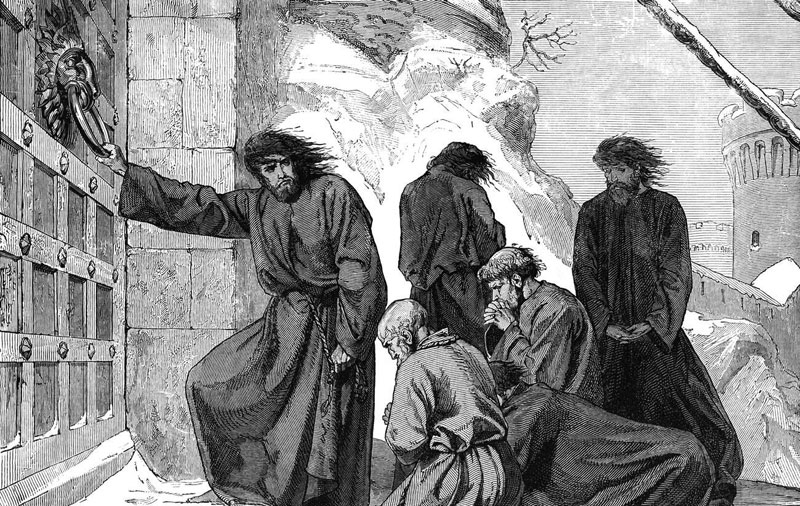
Christians are often frustrated by the secularism of the modern world, a world that has relegated the transcendent dimensions of human life to the realm of private opinion, while at the same time establishing the State and the Market as the absolutes that rule our lives, and that permit no rivals. The "separation of Church and State" has led to the absolutizing of the State and marginalizing of the Church. Some have responded to this situation by calling for its reversal, by making the state subordinate to the Church. They look back fondly at an age when princes would tremble at the frown of a pope, and even an emperor would dress in sackcloth and wait barefoot in the snow outside the pope's palace, pleading for his forgiveness.
This is the vision of the so-called integralists, and while it might be a somewhat idealized view of the past, it is not without some real basis in our history. What the integralists want is summarized by Father Edmund Waldstein, a leader of this movement:
Catholic integralism . . . holds that political rule must order man to his final goal. Since, however, man has both a temporal and an eternal end, integralism holds that there are two powers that rule him: a temporal power and a spiritual power. And since man's temporal end is subordinated to his eternal end, the temporal power must be subordinated to the spiritual power.
This is clear enough, but exactly how it should be implemented in a constitutional republic is not so clear, and Fr. Waldstein is reluctant to get down to cases, contenting himself with general principles. So, should there be a "Supreme Council" of bishops holding veto power, in the manner of the Islamic Republic of Iran, where a Council of Ayatollahs can intervene whenever it wills? Most integralists are reluctant to say. But not all. Adrian Vermeule, for example, is very specific about what integralism means in the American circumstance: it means a strong executive, able to rule by decree. In Vermeule's view:
As for the structure and distribution of authority within government, common-good constitutionalism will favor a powerful presidency ruling over a powerful bureaucracy, the latter acting through principles of administrative law's inner morality with a view to promoting solidarity and subsidiarity.
Vermeule is merely reflecting the views of his adopted mentor, Carl Schmitt, the Nazi jurist whose ruling allowed the Enabling Act of 1933 to go forward, the act of the Reichstag that gave the German Chancellor at the time, one Adolf Hitler, the right to rule by decree.
Regardless of how it is to be implemented, one can well imagine that integralists share a dream of a chastened Nancy Pelosi, repenting of her support of liberalism in general and abortion in particular, dressed in sackcloth and pleading for forgiveness in the snow outside the bishop's palace.
The Gelasian "Dyarchy" & Its Aftermath
Even if Madame Speaker decides that sackcloth is not a good look on her, there is no question that the integralists have a good deal of history on their side. It is a history that goes back at least to the fifth-century Pope Gelasius, who decreed, "There are two powers, august Emperor, by which this world is chiefly ruled, namely, the sacred authority of the priests and the royal power." On this beginning, the claims of papal power only got more extravagant as time went on. Gregory VII (1073–1085) claimed the power to depose emperors, and Innocent III (1198–1216) would claim a "plentitude of power," saying that "just as the moon derives its light from the sun and is indeed lower than it in quantity and quality, in position and in power, so too the royal power derives the splendor of its dignity from the pontifical authority."
These claims of papal power reached their height with the Bull Unam Sanctam of Pope Boniface VIII (1294–1303). Giving a rather tendentious reading of the "two swords" in Luke 22:38, Boniface held that both "are in the power of the Church, that is to say, the spiritual and the material sword, but the former is to be administered for the Church [and] the latter by the hands of kings and soldiers, but at the will and sufferance of the priest" (italics added).
But whatever one thinks of the papal pretensions to power, the truth is that these claims did not take place in a vacuum, and they could generally be considered a boon to the political development and security of Europe.
John C. Médaille is a retired businessman who has been teaching at the University of Dallas for the past 16 years. His primary course deals with Catholic social teaching and is a required course for the business degree. He is also the author of three books: The Vocation of Business: Social Justice in the Marketplace (Continuum, 2008); Toward a Truly Free Market: A Distributist Perspective (ISI Books, 2011); and, with Thomas Storck, Theology: Mythos or Logos; A Dialogue on Faith, Reason, and History (Angelico Press, 2020).
A Journal of Mere Christianity—Delivered to Your Door
- Essays on theology, culture, and the Church
- Contributors from across the Christian traditions

Six print issues (one year) of Touchstone, plus full online access and PDF downloads for only $39.95.

Get a one-year full-access subscription to the Touchstone online archives for only $19.95.
bulk subscriptions
Order Touchstone subscriptions in bulk and save $10 per sub! Each subscription includes 6 issues of Touchstone plus full online access to touchstonemag.com—including archives, videos, and pdf downloads of recent issues for only $29.95 each! Great for churches or study groups.
Transactions will be processed on a secure server.
more on Culture from the online archives
20.7—September 2007
Paul Didn’t Build Bridges to Popular Culture by Russell D. Moore

31.6—November/December 2018
Victimhood Culture Scapegoats Its Very Source by Michael P. Foley
more from the online archives

26.1—Jan/Feb 2013
Manly Chastity, Hedonism & the Law of Non-contradiction by Anthony Esolen

14.1—January/February 2001
A Sociologist Looks at Fatherlessness & Its Causes by David Blankenhorn

calling all readers
Please Donate
"There are magazines worth reading but few worth saving . . . Touchstone is just such a magazine."
—Alice von Hildebrand
"Here we do not concede one square millimeter of territory to falsehood, folly, contemporary sentimentality, or fashion. We speak the truth, and let God be our judge. . . . Touchstone is the one committedly Christian conservative journal."
—Anthony Esolen, Touchstone senior editor
