




From Heavenly Harmony
Consolation in Death
On Bach's Cantata BWV 106, Gottes Zeit ist die allerbesteZeit ("God's time is the very best time")
by Ken Myers
We really don't know whose funeral it was. For some time, it was suggested that Johann Sebastian Bach composed one of his earliest cantatas to honor the death of his maternal uncle, Tobias Lämmerhirt, who was buried on August 14, 1707. But that is now regarded as more a legend than a reliable fact.
What we do know is that Cantata BWV 106, Gottes Zeit ist die allerbesteZeit ("God's time is the very best time") is both a musical and theological tour de force. In this 20-minute-long work (also known as Actus tragicus) Bach organizes biblical texts, Lutheran melodies, and instrumental textures to convey the comforting message of the gospel in the face of death. Musicologist Eric Chafe observes that "the chronological aspect of the text mirrors the eras of 'salvation history'—the time of Israel, time of Christ, and time of the church."
I'm tempted to stop writing here and ask you to go listen to the work right now (the allofbach.com website has a splendid performance), but maybe I should try to explain how Bach managed (at the age of 22) to create this minor masterpiece.
God's Time Is Best
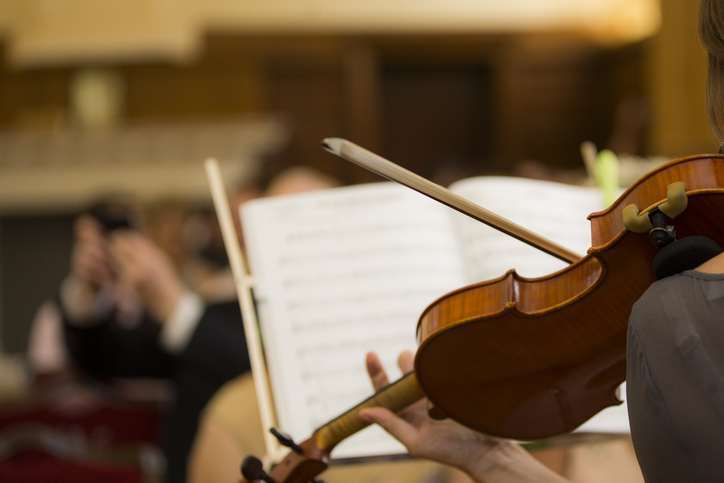
As is the case in about 25 of his cantatas, Bach begins Cantata BWV 106 with a brief instrumental introduction; these movements are often called Sinfonias, but here he uses the term Sonatina, a more modest and humble description appropriate to the simple scoring of the movement: two recorders, two violas da gamba, and continuo. Not only are the forces spare, they represent what at the time were old-fashioned instruments. Recorders were often used to suggest a more rustic or primitive sensibility. But this brief (two-and-a-half minutes) introduction is captivating. Conductor John Eliot Gardiner judges that "the opening sonatina comprises twenty of the most heart-rending bars in all of his works."
This compelling prelude is followed—seamlessly—by the second major section of the work, in which a four-part choir sings, somewhat somberly, the text that gives the cantata its name: "God's time is the very best time." After a very brief pause, a text from Acts 17 is sung in a lively and intricate fugue in triple meter: "In him we live, move, and are—so long as he wills." The word solange ("so long") is first sung in the soprano part and is dramatically sustained, before the other voices join in to finish with "so long as he wills." Then the tempo slows down, and the voices enter a minor key to sing: "In him we die at the right time, when he wills."
At the end of this phrase, there is a brief pause before a new section begins, this time with a tenor solo singing (still in that minor key) a verse from Psalm 90:12— "Ah, Lord, teach us to think that we must die so that we become wise." The singing of "Ach, Herr" ("Ah, Lord!") repeatedly comes across as an urgent cry.
Come, Lord Jesus
This tenor solo is followed by an assertive bass aria declaring (in a text from Isaiah 38): "Put your house in order, for you will die and not remain living." This short injunction is quickly followed by a dour, dirge-like chorus with a text from Ecclesiasticus: "It is the old covenant: Man, you must die!" In the midst of this gloom, a soprano solo is suddenly heard singing brightly: "Ja, ja, ja komm Herr Jesu, komm!" "Yes! Come, Lord Jesus." The hope articulated in the last chapter of the New Testament breaks into the darkness with a refreshing lyricism, reiterating over and over the call to Jesus to come.
Shortly after this soprano interruption begins, Bach subtly ornaments the soprano solo with the recorders and one viola da gamba playing a short snatch from a little-known chorale melody that was linked with a 12-stanza Lutheran hymn that proclaims: "I have left all that concerns me up to God. Let him do whatever he wants with me. . . . My time and hour will be when God wills; I do not dictate to him any bounds." This brilliant layering of one theological idea introduced sheerly through musical association with another that is being explicitly proclaimed by singers demonstrates both a musical and pastoral genius.
Ken Myers is the host and producer of the Mars Hill Audio Journal. Formerly an arts editor with National Public Radio, he also serves as music director at All Saints Anglican Church in Ivy, Virginia. He is a contributing editor for Touchstone.
A Journal of Mere Christianity—Delivered to Your Door
- Essays on theology, culture, and the Church
- Contributors from across the Christian traditions

Six print issues (one year) of Touchstone, plus full online access and PDF downloads for only $39.95.

Get a one-year full-access subscription to the Touchstone online archives for only $19.95.
bulk subscriptions
Order Touchstone subscriptions in bulk and save $10 per sub! Each subscription includes 6 issues of Touchstone plus full online access to touchstonemag.com—including archives, videos, and pdf downloads of recent issues for only $29.95 each! Great for churches or study groups.
Transactions will be processed on a secure server.
more on music from the online archives
33.3—May/June 2020
Bach's Cantata BWV 106, Gottes Zeit ist die allerbesteZeit (God's time is the very best time) by Ken Myers
more from the online archives
5.3—Summer 1992
Everything You Need to Know About Morality & the Bible by David Mills
30.6—Nov/Dec 2017
on Benedict XVI on the Fairest of the Sons of Men by Michael Martin De Sapio
calling all readers
Please Donate
"There are magazines worth reading but few worth saving . . . Touchstone is just such a magazine."
—Alice von Hildebrand
"Here we do not concede one square millimeter of territory to falsehood, folly, contemporary sentimentality, or fashion. We speak the truth, and let God be our judge. . . . Touchstone is the one committedly Christian conservative journal."
—Anthony Esolen, Touchstone senior editor
